
Critically examine the major factors responsible for a turnaround in the trajectory of India’s foreign policy in the post-cold war period.
How the answer moves
The flow snapshot — the routes in, the body, the counter-view and the routes out.
Route 1 Cold War’s end unsettled post-1947 assumptions → two pressures (systemic + economic) forced a reframing, not a rupture
Route 2 1991 the hinge → external shock meets domestic breakdown → doctrine reworked, core aims kept
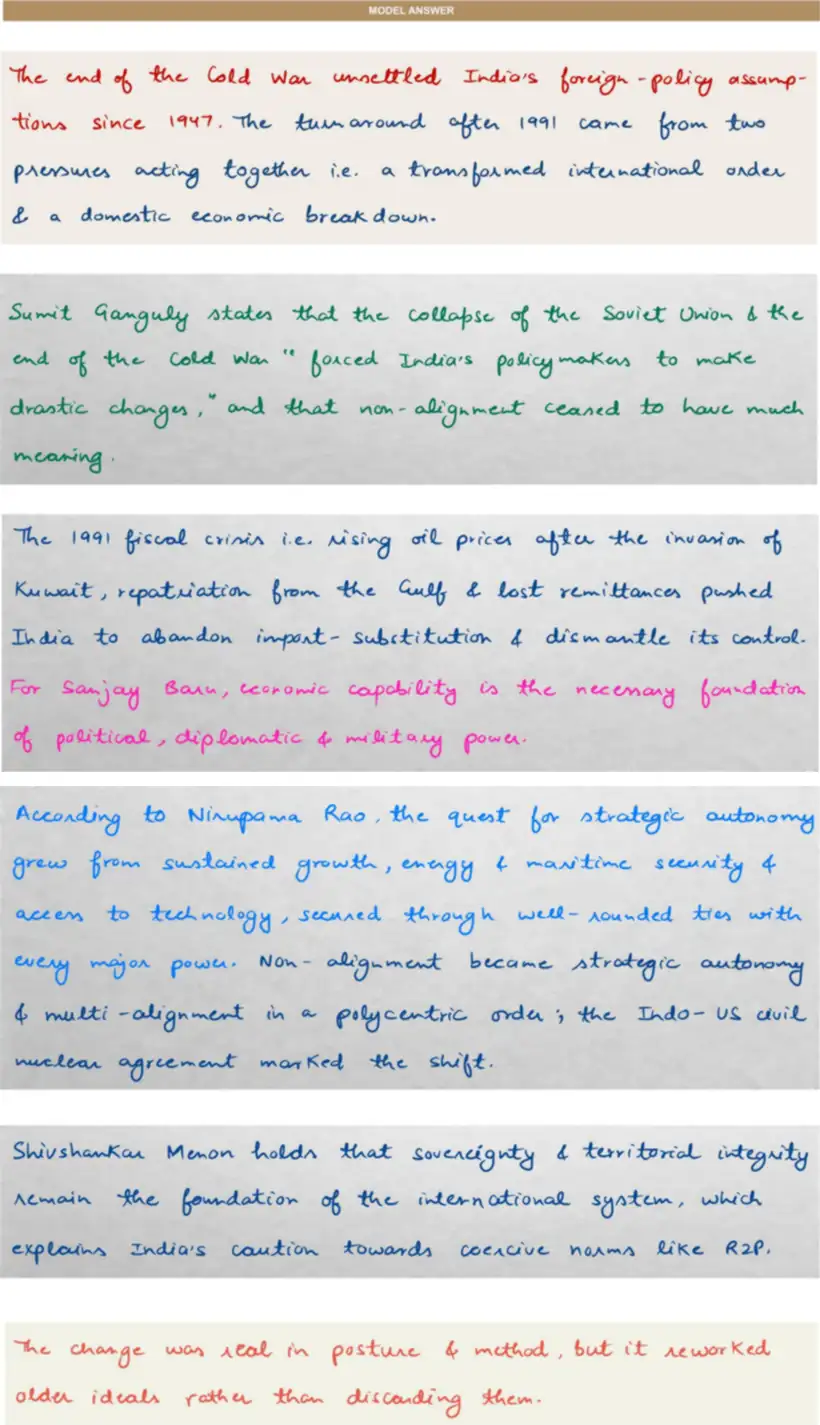
systemic shock (Ganguly: USSR collapse + Cold War’s end → nonalignment lost meaning) → unipolar adjustment (accommodate US, full ties with Israel, economy at centre) → economic crisis (1991 fiscal shock: oil, Gulf repatriation, lost remittances → end of import-substitution) → Baru: economy the necessary foundation of power → doctrinal reframing (Nirupama Rao: strategic autonomy from growth, energy/maritime security, technology, all-power ties) → non-alignment → strategic autonomy + multi-alignment (polycentric order) → Indo-US civil nuclear deal as marker
Menon: sovereignty & territorial integrity remain foundational → India cautious on coercive norms (R2P) → limits of the turnaround
Route 1 real in posture and method → but older ideals reworked, not discarded
Route 2 strategic autonomy the constant thread → change as evolution, adapted to a transformed order
Model answer
Handwritten, in the form it would be written in the examination hall.
Also asked on this head
Indian Foreign Policy — 17 questions in the Vault.
- India has adopted multi-alignment to fulfill its core values and interests in International relations. Discuss.
- What are the external determinants of the Foreign Policy of a State?
- How do the constituent states influence the foreign policy making process in India?
How this is taught
The same flow snapshot, built for every head of the syllabus, with the answer written in class.
The first session of Foundation 2027 is published in full.
Six programmes across three levels.