
Would you concur with the view that of late, India’s foreign policy has been in a transition mode from Nehruvianism to Neoliberalism? Support your answer with the help of suitable examples.
How the answer moves
The flow snapshot — the routes in, the body, the counter-view and the routes out.
Route 1 partial concurrence staked → Nehruvian pole (Sikri: sovereignty + autonomy + peace/disarmament) vs neoliberal pole (openness, interests) → autonomy qualifies the shift
Route 2 1991 as the watershed → idealism giving way to economic pragmatism → but a clean “from–to” overstates it → concur with reservation
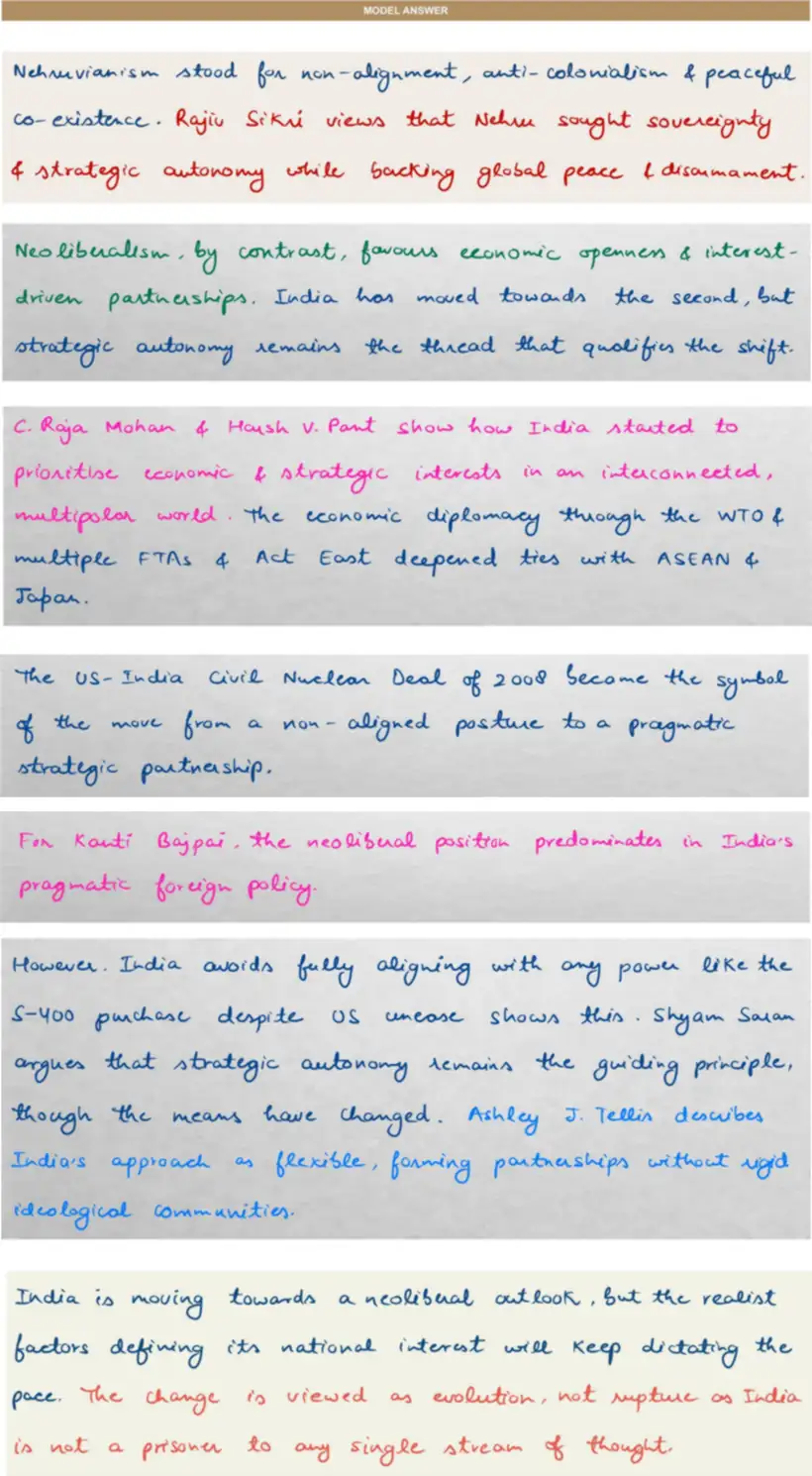
1991 liberalisation as hinge → Raja Mohan + Pant (economic/strategic interests in a multipolar world) → economic diplomacy: WTO / FTAs / Act East (ASEAN, Japan) → 2008 nuclear deal as symbol of the move → LEMOA / Rafale / Quad → Kanti Bajpai (neoliberal position predominates)
not a clean break → S-400 despite US unease → South–South cooperation + egalitarian climate/trade stands → Saran (autonomy the guiding principle, only means changed) → Tellis (flexible partnerships, no rigid ideology)
Route 1 concur: moving to a neoliberal outlook, but realist national interest sets the pace → evolution, not rupture
Route 2 transition in method, autonomy the constant → not a prisoner to any single stream of thought
Model answer
Handwritten, in the form it would be written in the examination hall.
Also asked on this head
Indian Foreign Policy — 17 questions in the Vault.
- India has adopted multi-alignment to fulfill its core values and interests in International relations. Discuss.
- What are the external determinants of the Foreign Policy of a State?
- How do the constituent states influence the foreign policy making process in India?
How this is taught
The same flow snapshot, built for every head of the syllabus, with the answer written in class.
The first session of Foundation 2027 is published in full.
Six programmes across three levels.