
What are the notable features of the recently concluded pact or the Acquisition and Cross-Servicing Agreement (ACSA) between India and Japan? How is it likely to address the security concerns of India?
How the answer moves
The flow snapshot — the routes in, the body, the counter-view and the routes out.
Route 1 signed 9 Sept 2020, in force July 2021 → the name says supplies and services, not bases → reach without obligation
Route 2 India’s logistics network after LEMOA → Japan added as an enabling framework, not an alliance → worth and limit in the same clause
permissive design: either may ask, other may provide → fifteen categories, food to port services → activities: exercises, UN peacekeeping, relief, evacuation, port visits → weapons and ammunition excluded → ten years, auto-renewal → distance converted into range → Djibouti / Andamans / Malacca → Malabar, JIMEX easier to sustain → joins the LEMOA network
Basrur and Kutty: autonomy preferred to alliance → so no obligation in a crisis → no reciprocal access agreement, unlike Australia and the Philippines → Lidarev: not a full ally → Taiwan contingency, access becomes exposure
Route 1 cost of presence falls, cost of commitment avoided
Route 2 maritime reach gained, land border with China untouched
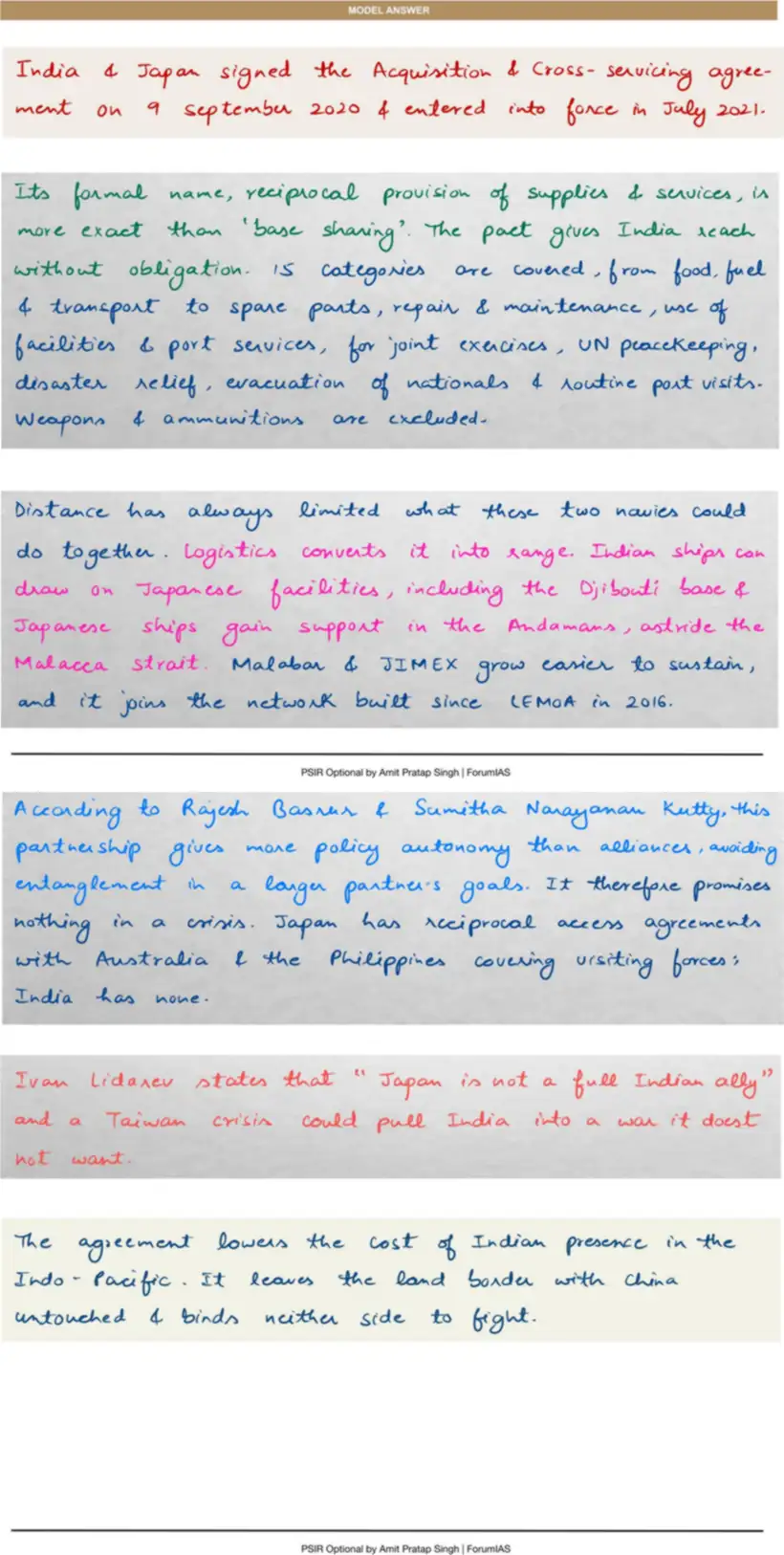
Model answer
Handwritten, in the form it would be written in the examination hall.
Also asked on this head
India and the Global Centres of Power — 27 questions in the Vault.
- Critically evaluate India-Russia relations in the 21st century. How have both the countries responded to America meddling in their relations in the recent times.
- “The mother of all deals” is a transformative milestone in Indo-EU trade relations. Elaborate on the new Security and Defence partnership.
- Does the idea of the 21st century as ‘Asian century’ continue to remain feasible given the growing friction between India and China?
How this is taught
The same flow snapshot, built for every head of the syllabus, with the answer written in class.
The first session of Foundation 2027 is published in full.
Six programmes across three levels.