
Quadrilateral Security Dialogue (QUAD) performs an important role in India’s strategic balancing act to withstand the dominance of China in Asia. Discuss.
How the answer moves
The flow snapshot — the routes in, the body, the counter-view and the routes out.
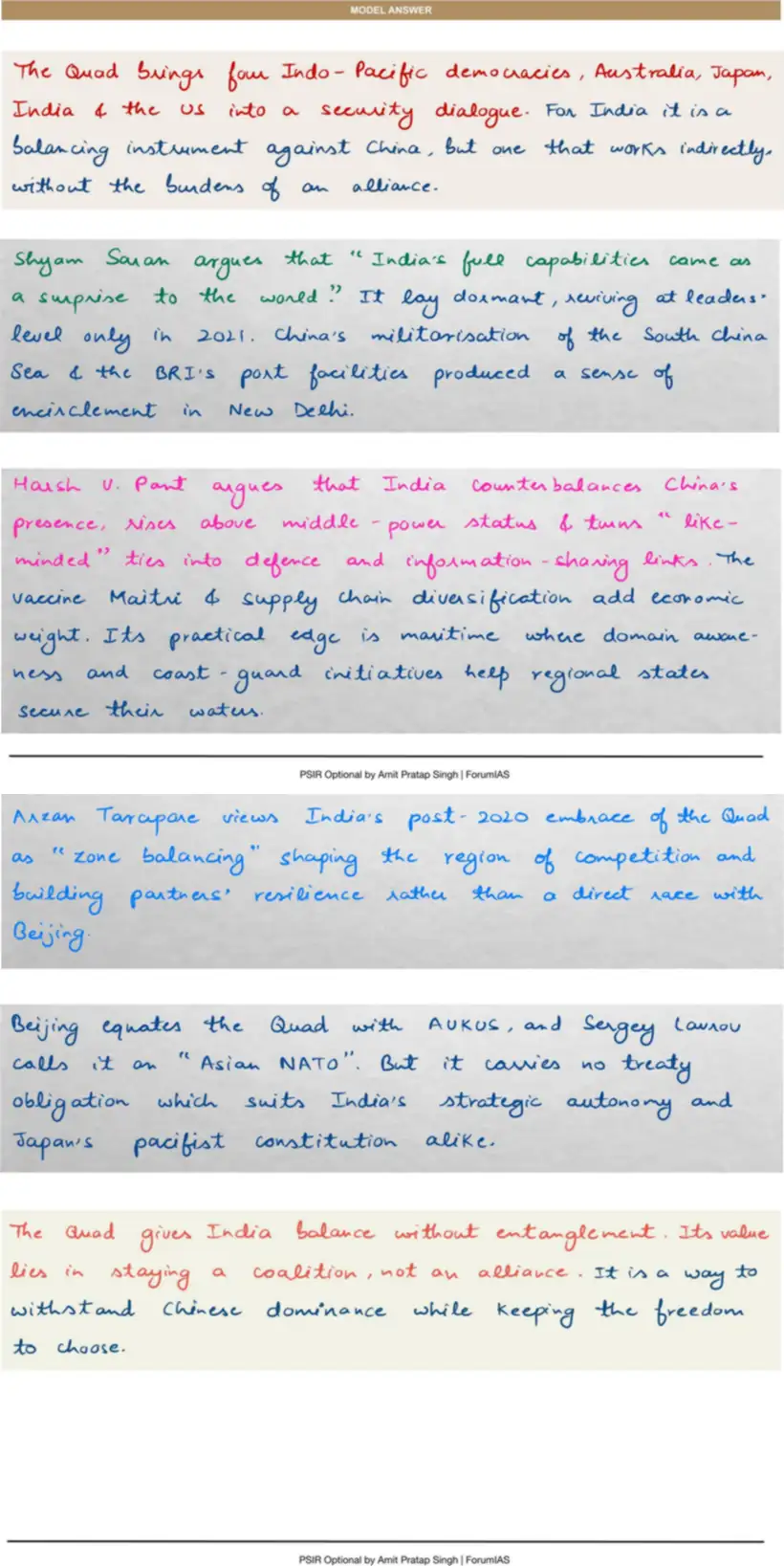
Route 1 four Indo-Pacific democracies in dialogue → India’s balancing instrument, but indirect, no alliance
Route 2 2004 tsunami origins → dormant → revived 2021 as China encircles → Quad as India’s answer
tsunami ‘core group’ / Shyam Saran → 2021 leaders’ revival / South China Sea militarisation + BRI encirclement → Pant: counterbalance, rise above middle-power, ‘like-minded’ defence + info links, Vaccine Maitri + supply chains → maritime edge (domain awareness, coast guard) → Tarapore: “zone balancing” — shape the region, build partners’ resilience, not a direct race → limited hard balancing after Galwan
Beijing = AUKUS clique / Lavrov “Asian NATO” vs no treaty obligation → suits strategic autonomy + Japan’s pacifist constitution
Route 1 balance without entanglement → value lies in coalition, not alliance
Route 2 withstand Chinese dominance while keeping the freedom to choose
Model answer
Handwritten, in the form it would be written in the examination hall.
Also asked on this head
India and the Global Centres of Power — 27 questions in the Vault.
- Critically evaluate India-Russia relations in the 21st century. How have both the countries responded to America meddling in their relations in the recent times.
- “The mother of all deals” is a transformative milestone in Indo-EU trade relations. Elaborate on the new Security and Defence partnership.
- Does the idea of the 21st century as ‘Asian century’ continue to remain feasible given the growing friction between India and China?
How this is taught
The same flow snapshot, built for every head of the syllabus, with the answer written in class.
The first session of Foundation 2027 is published in full.
Six programmes across three levels.