
Explain India’s relations with the European Union in the context of Brexit.
How the answer moves
The flow snapshot — the routes in, the body, the counter-view and the routes out.
Route 1 paradox: dense economic ties, thin strategic depth → Britain as India’s familiar bridge → Brexit removes it, two tracks
Route 2 “natural partners” (Wagner) but underused → Britain the comfortable gateway into Brussels → Brexit forces a rethink
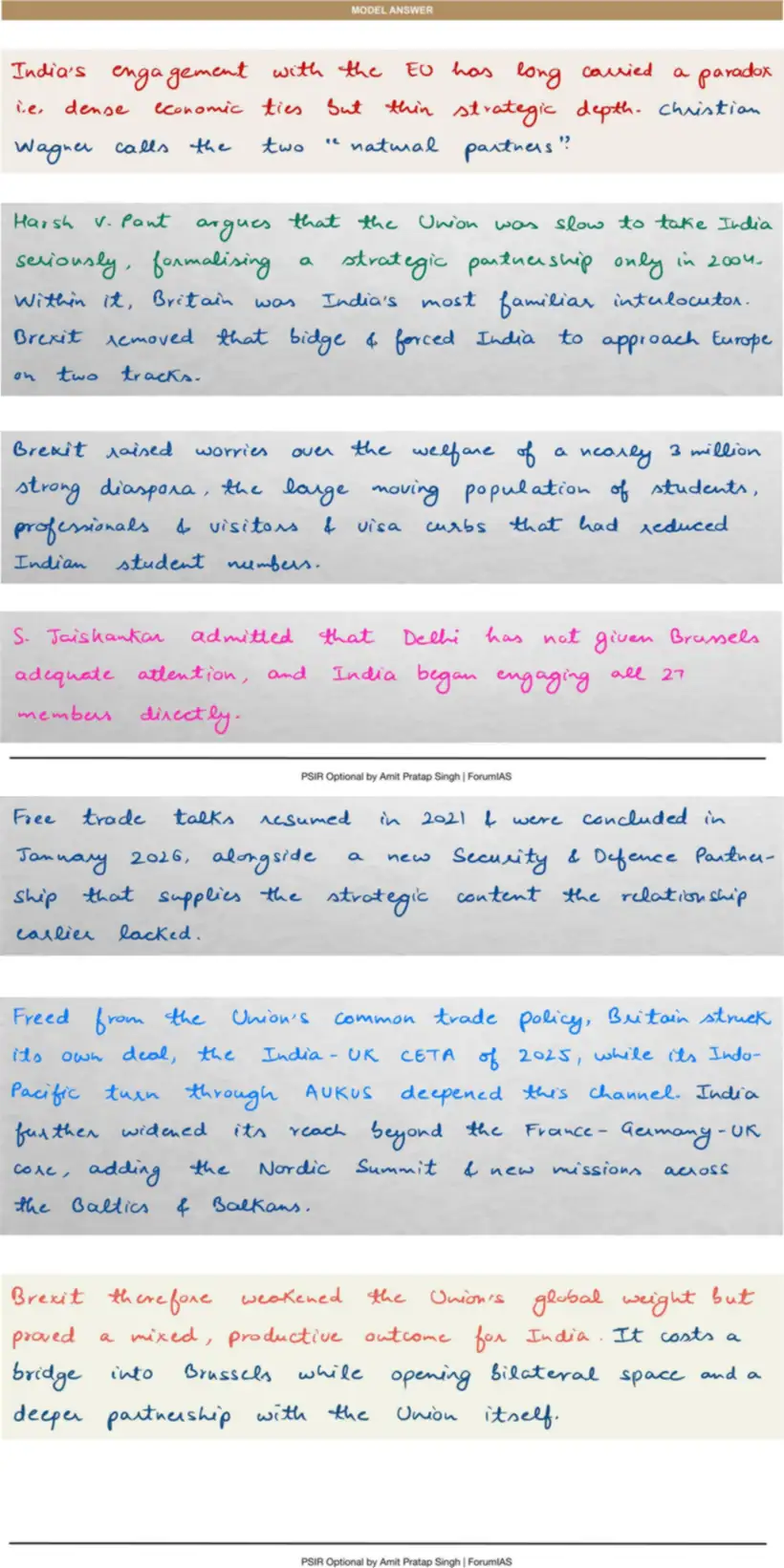
paradox (Wagner “natural partners” → Pant, late 2004) → Britain = familiar interlocutor inside EU → Brexit removes bridge → immediate concerns (diaspora / moving population / student-visa curbs) → strategic pivot (Jaishankar: under-attended Brussels → engage all 27 directly) → direct-track payoff (FTA resumed 2021 → concluded Jan 2026 + Security & Defence Partnership) → bilateral track (UK freed from EU trade policy → CETA 2025 + AUKUS) → widened Europe (Nordic Summit, Baltics/Balkans missions)
Brexit-as-loss (EU weakened, familiar interlocutor gone, diaspora + visa strain) vs Brexit-as-opportunity (bilateral room, direct Brussels engagement, deeper partnership)
Route 1 net loss for EU’s global weight; mixed for India — lost bridge, gained bilateral space
Route 2 Brexit as catalyst → from bridge-dependence to a direct, deeper Union partnership (FTA + defence) plus a standalone UK track
Model answer
Handwritten, in the form it would be written in the examination hall.
Also asked on this head
India and the Global Centres of Power — 27 questions in the Vault.
- Critically evaluate India-Russia relations in the 21st century. How have both the countries responded to America meddling in their relations in the recent times.
- “The mother of all deals” is a transformative milestone in Indo-EU trade relations. Elaborate on the new Security and Defence partnership.
- Does the idea of the 21st century as ‘Asian century’ continue to remain feasible given the growing friction between India and China?
How this is taught
The same flow snapshot, built for every head of the syllabus, with the answer written in class.
The first session of Foundation 2027 is published in full.
Six programmes across three levels.