
Describe briefly China’s ‘One Belt One Road (OBOR)’ Initiative and analyze India’s major concerns.
How the answer moves
The flow snapshot — the routes in, the body, the counter-view and the routes out.
Route 1 Xi 2013 → belt + maritime road, AIIB behind → Raisina invitation Jan 2017 declined → objection is to terms, not to roads
Route 2 connectivity as statecraft → India the lone large refuser → question is on what political terms infrastructure arrives
description (two limbs, geography, finance) → sovereignty as the first-order concern (CPEC through PoK, title problem) → 2025 Afghan extension → “unacceptable” reply → reciprocity charge (Arunachal vs PoK) → second-order strategic concern (Gwadar / Hambantota / Kyaukpyu, neighbourhood lending) → record 2025 engagement kills the “BRI is fading” reading
debt trap is the weakest Indian leg → Jones and Hameiri on Hambantota (Colombo’s project, small Chinese share, no swap, lease money to Western creditors) → the term itself was coined in Delhi
Route 1 India’s case rests on territory and reciprocity, not on predation
Route 2 sole SCO holdout nine years on → the position holds only if Delhi delivers its own connectivity (Raja Mohan)
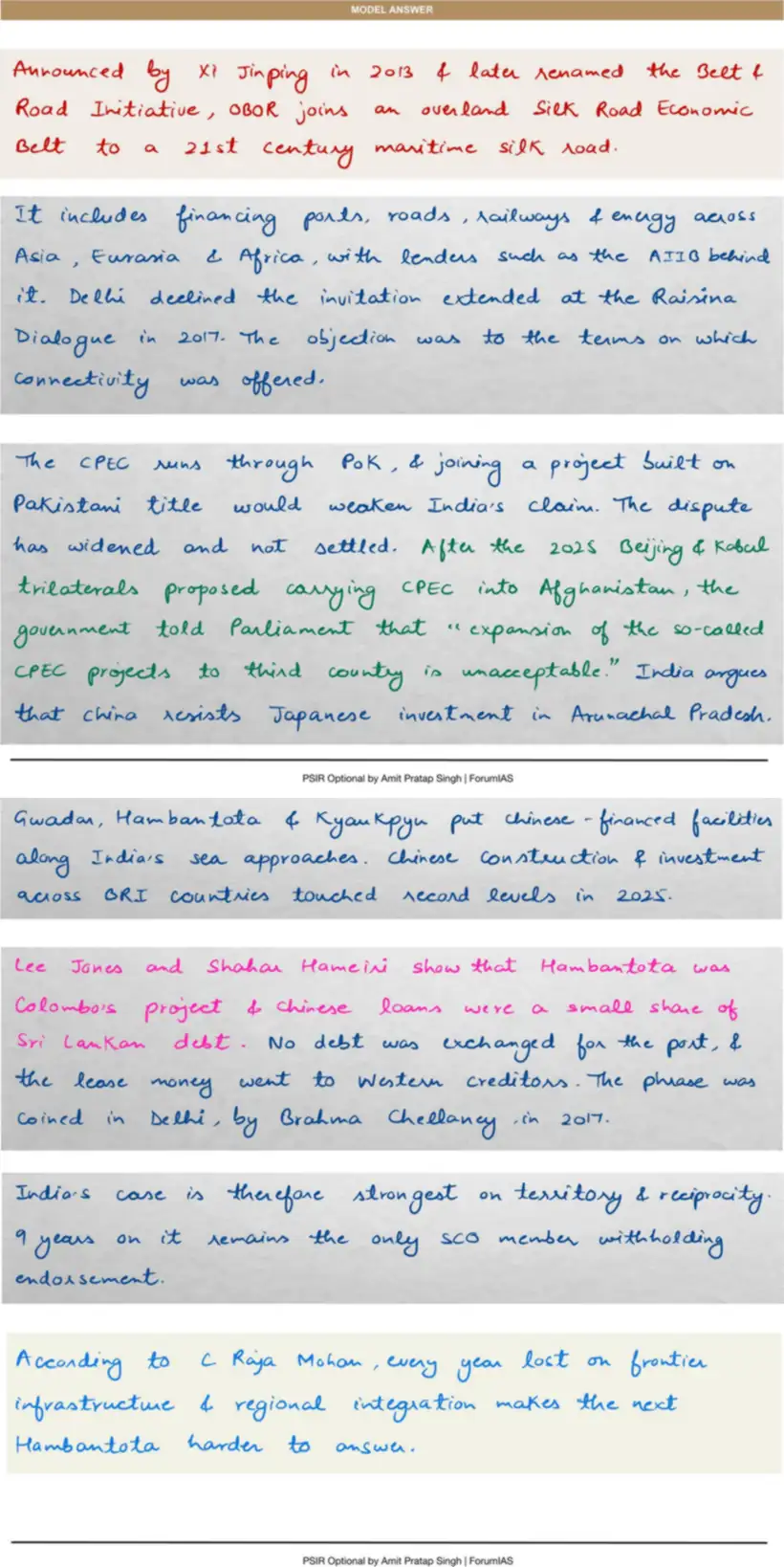
Model answer
Handwritten, in the form it would be written in the examination hall.
Also asked on this head
India and the Global Centres of Power — 27 questions in the Vault.
- Critically evaluate India-Russia relations in the 21st century. How have both the countries responded to America meddling in their relations in the recent times.
- “The mother of all deals” is a transformative milestone in Indo-EU trade relations. Elaborate on the new Security and Defence partnership.
- Does the idea of the 21st century as ‘Asian century’ continue to remain feasible given the growing friction between India and China?
How this is taught
The same flow snapshot, built for every head of the syllabus, with the answer written in class.
The first session of Foundation 2027 is published in full.
Six programmes across three levels.