
Bhutan has historically been an ally of India, but the China-Bhutan border related issues have become a security issue for India. Discuss.
How the answer moves
The flow snapshot — the routes in, the body, the counter-view and the routes out.
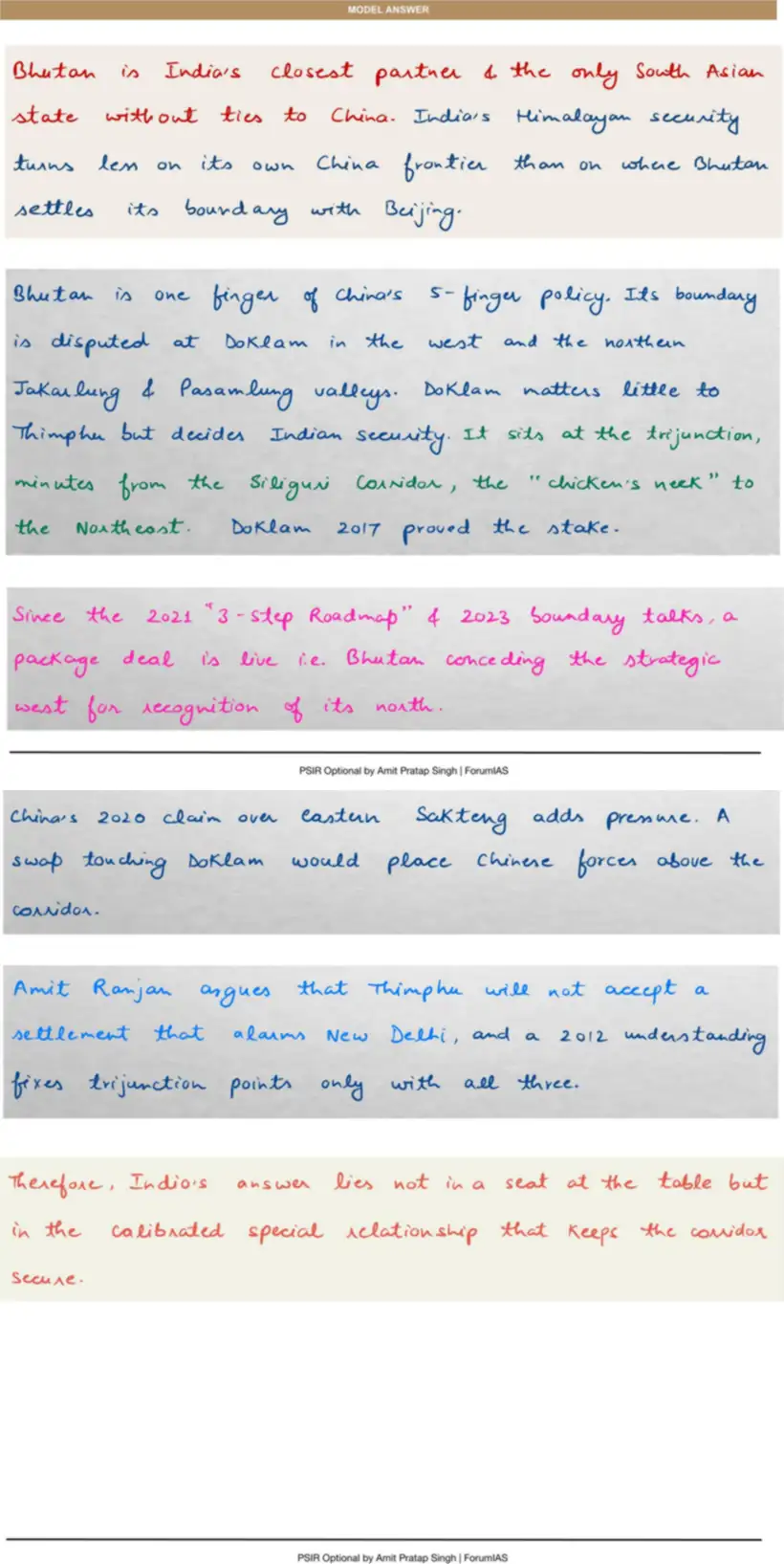
Route 1 closest ally, only S. Asian state without China ties → yet India’s security runs through the China–Bhutan border, not its own
Route 2 Bhutan negotiating its own boundary → outcome sets India’s Himalayan exposure → India not at the table
five-finger policy → two disputed sectors (Doklam west / Jakarlung–Pasamlung north) → Doklam trivial for Thimphu, decisive for India → trijunction + Siliguri “chicken’s neck” → Doklam 2017 → sharpening: 2021 Roadmap + 2023 talks → “package deal” (west for north) → 2020 Sakteng pressure → swap touching Doklam = Chinese forces above the corridor
Amit Ranjan: Thimphu won’t sign a deal that alarms Delhi → 2012 understanding: trijunction fixed only with all three
Route 1 India’s lever is the calibrated special relationship + CBMs, not a bilateral seat
Route 2 security rests on keeping the corridor secure, so Bhutan ties are handled with care, not pressure
Model answer
Handwritten, in the form it would be written in the examination hall.
Also asked on this head
India and the Global Centres of Power — 27 questions in the Vault.
- Critically evaluate India-Russia relations in the 21st century. How have both the countries responded to America meddling in their relations in the recent times.
- “The mother of all deals” is a transformative milestone in Indo-EU trade relations. Elaborate on the new Security and Defence partnership.
- Does the idea of the 21st century as ‘Asian century’ continue to remain feasible given the growing friction between India and China?
How this is taught
The same flow snapshot, built for every head of the syllabus, with the answer written in class.
The first session of Foundation 2027 is published in full.
Six programmes across three levels.