
Historical ties between India and Japan grew into a ‘special strategic and global partnership. Comment.
How the answer moves
The flow snapshot — the routes in, the body, the counter-view and the routes out.
Route 1 dispute-free civilizational base (Buddhism, no rivalry) → goodwill real but not sufficient → strategy did the building
Route 2 Japan as early symbol of Asian resurgence → historic warmth → but the formal partnership is strategy-driven, not sentiment-driven
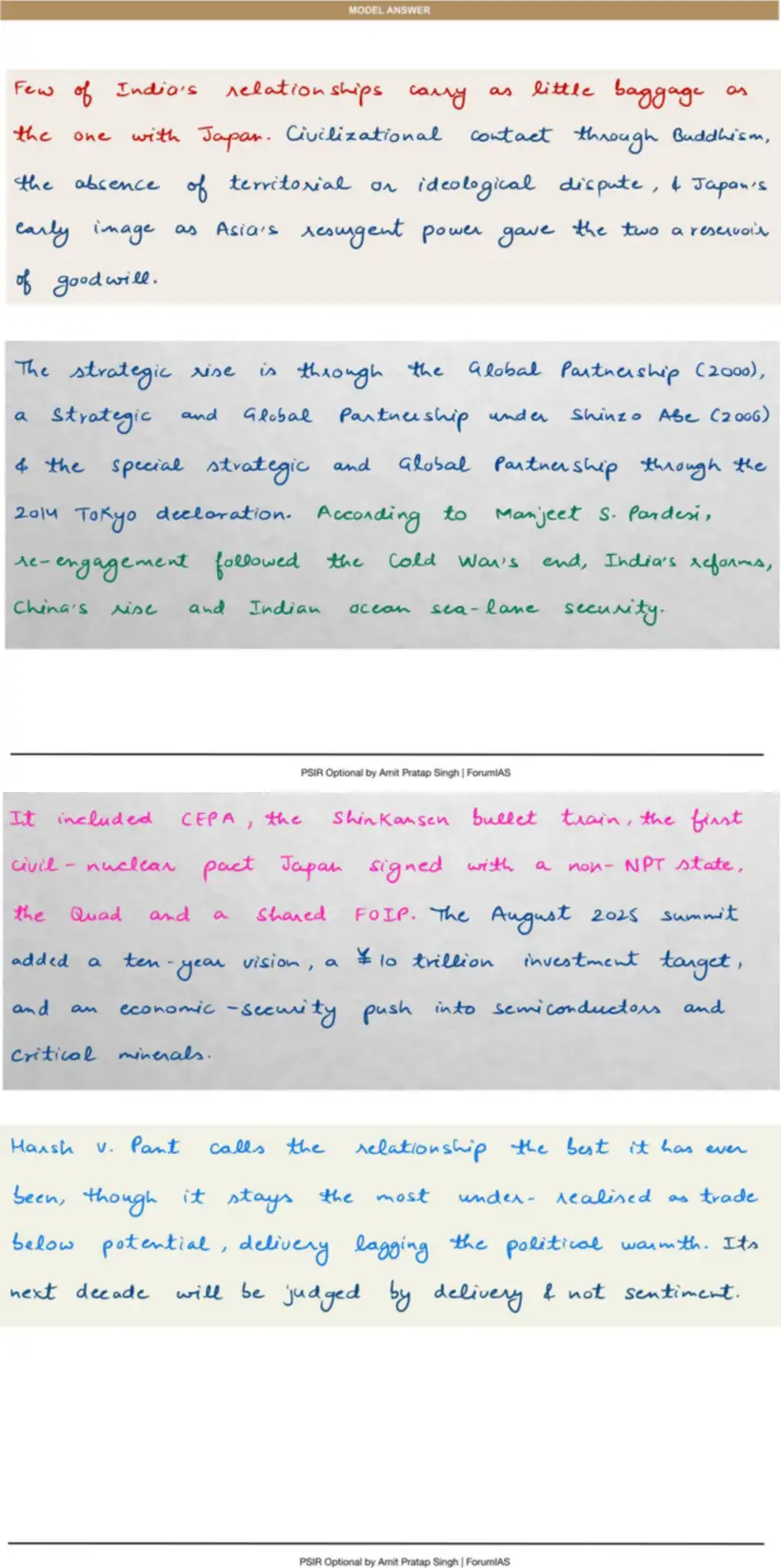
staged upgradation: Global Partnership 2000 → Strategic & Global 2006 (Abe) → Special Strategic & Global 2014 (Tokyo Declaration) → Pardesi’s drivers (Cold War’s end, reforms, China, sea lanes) → content fills the label: CEPA, bullet train, non-NPT civil-nuclear, Quad, FOIP → Aug 2025 summit: ten-year vision, ¥10 trillion, economic security (semiconductors, critical minerals)
Pant: best-ever, yet the most under-realised → trade below potential, delivery lagging the political warmth
Route 1 history supplied trust, strategy supplied momentum → judged by delivery, not sentiment
Route 2 real in framing and capital, thin in trade/industrial content → next decade’s test is execution
Model answer
Handwritten, in the form it would be written in the examination hall.
Also asked on this head
India and the Global Centres of Power — 27 questions in the Vault.
- Critically evaluate India-Russia relations in the 21st century. How have both the countries responded to America meddling in their relations in the recent times.
- “The mother of all deals” is a transformative milestone in Indo-EU trade relations. Elaborate on the new Security and Defence partnership.
- Does the idea of the 21st century as ‘Asian century’ continue to remain feasible given the growing friction between India and China?
How this is taught
The same flow snapshot, built for every head of the syllabus, with the answer written in class.
The first session of Foundation 2027 is published in full.
Six programmes across three levels.