
Examine the Geo-strategic points of contention in the bilateral relationship between India and China.
How the answer moves
The flow snapshot — the routes in, the body, the counter-view and the routes out.
Route 1 not a stray boundary row → structural contest for space + status between two rising powers
Route 2 Pardesi’s overlapping spheres → Himalayas / South Asia / Indian Ocean as one rivalry, not many
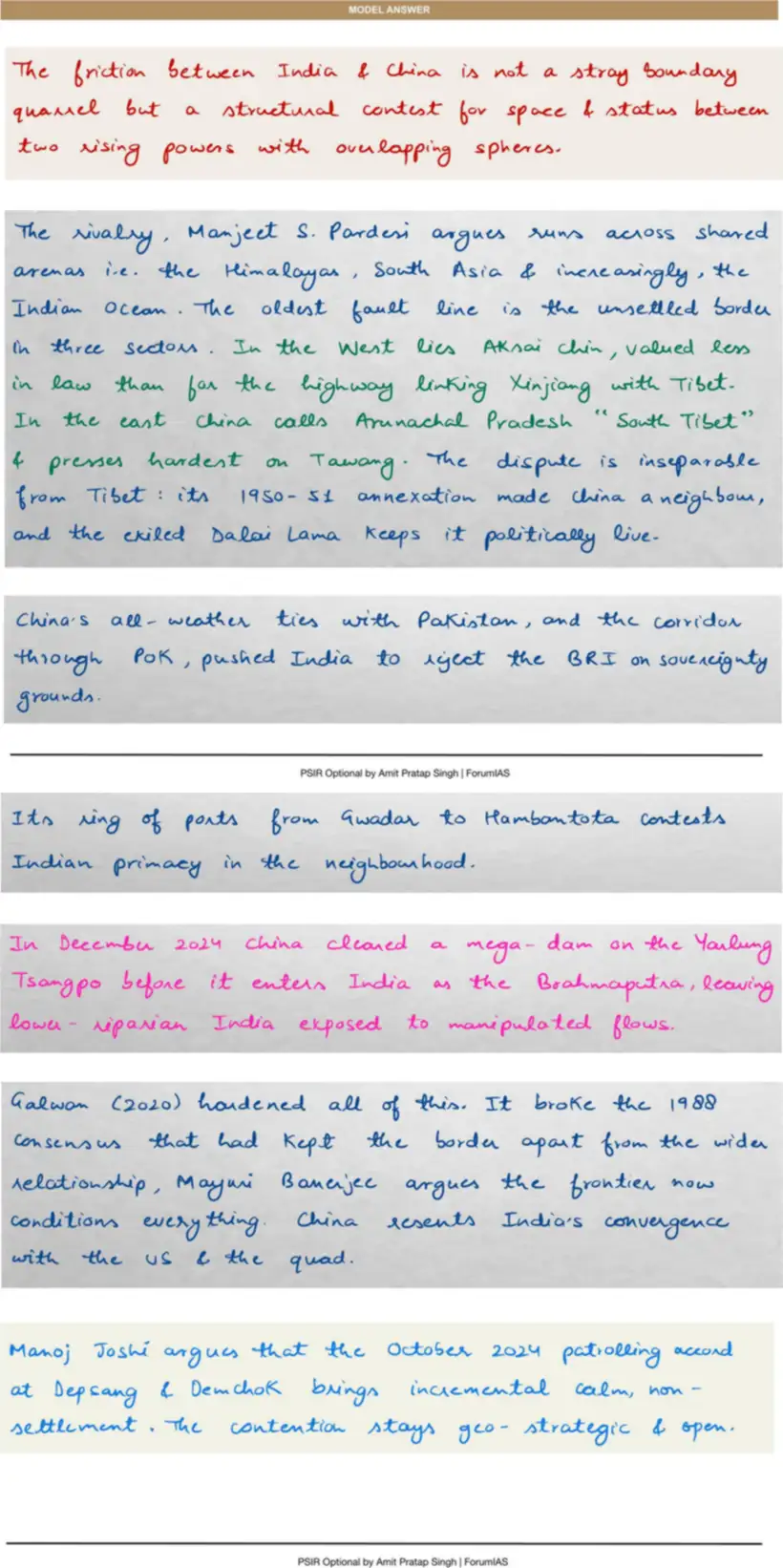
three-sector border → west: Aksai Chin (Xinjiang–Tibet highway) → east: “South Tibet” / Tawang → dispute rooted in Tibet + exiled Dalai Lama → second axis = encirclement → Pakistan + CPEC-through-PoK → BRI rejected on sovereignty → String of Pearls (Gwadar–Hambantota) → newer pressure = water → Yarlung Tsangpo mega-dam (Dec 2024), lower-riparian India → Galwan 2020 breaks 1988 consensus (Banerjee) → border now conditions everything → India–US + Quad convergence resented
interdependence + BRICS pull toward engagement → Oct 2024 Depsang–Demchok accord restores some calm
Route 1 points interlock — territory, Tibet, Pakistan, ocean, water — one contest for Asian primacy
Route 2 thaw incremental, not settlement (Joshi) → frontier peace the precondition → contention stays geo-strategic and open
Model answer
Handwritten, in the form it would be written in the examination hall.
Also asked on this head
India and the Global Centres of Power — 27 questions in the Vault.
- Critically evaluate India-Russia relations in the 21st century. How have both the countries responded to America meddling in their relations in the recent times.
- “The mother of all deals” is a transformative milestone in Indo-EU trade relations. Elaborate on the new Security and Defence partnership.
- Does the idea of the 21st century as ‘Asian century’ continue to remain feasible given the growing friction between India and China?
How this is taught
The same flow snapshot, built for every head of the syllabus, with the answer written in class.
The first session of Foundation 2027 is published in full.
Six programmes across three levels.