
What are the main drivers of India-Japan Strategic and Global Partnership?
How the answer moves
The flow snapshot — the routes in, the body, the counter-view and the routes out.
Route 1 India’s most conflict-free major-power tie → never adversaries, no dispute → Abe’s “natural ally”
Route 2 frictionlessness as the base → complementarity + China + Indo-Pacific stacked on it
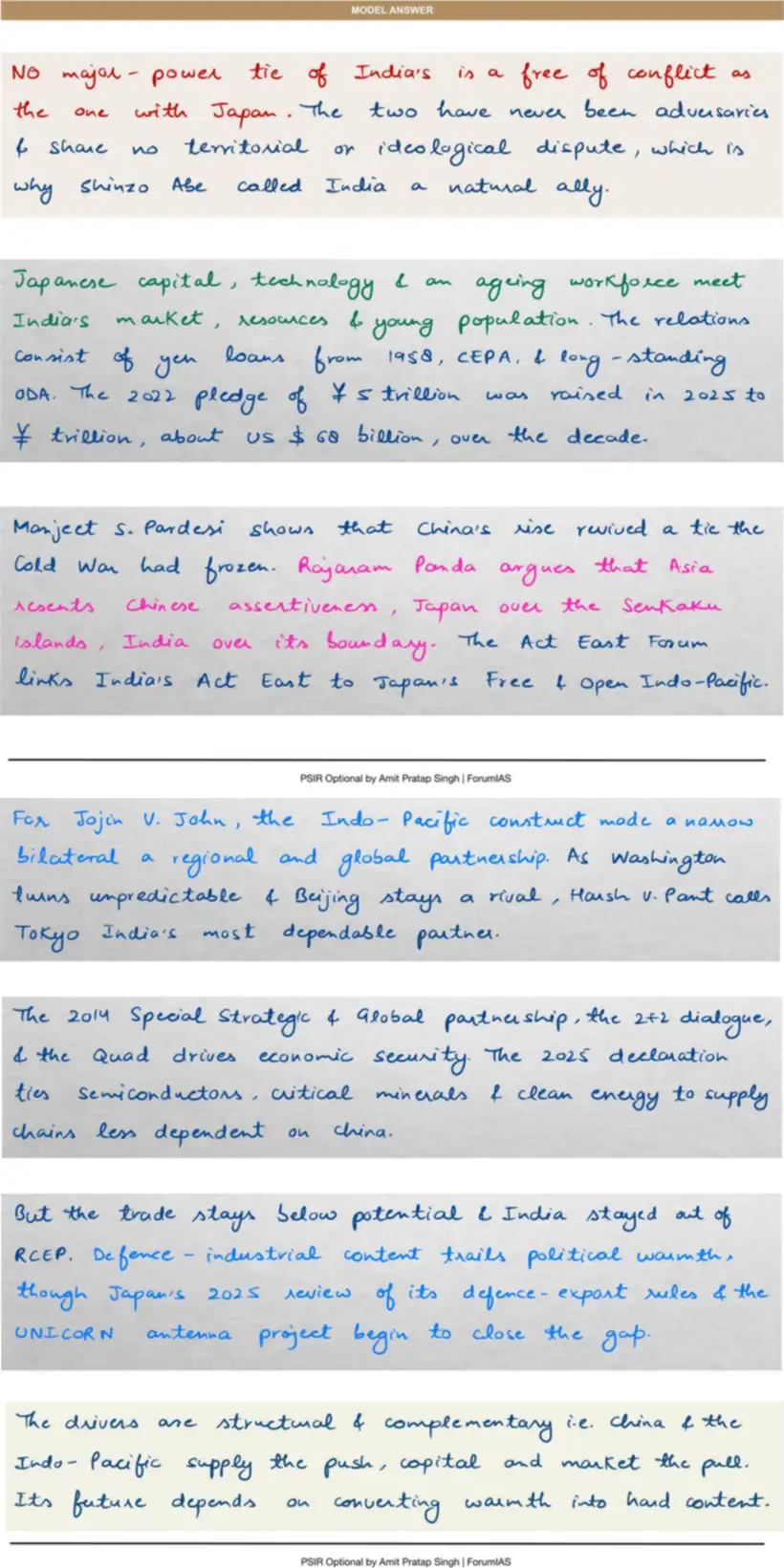
complementarity (capital/tech/ageing ↔ market/young) → economic base (yen loans, CEPA, ODA → ¥5tn to ¥10tn) → China the sharper driver (Pardesi: rise revives a frozen tie) → Panda (Asia resents assertiveness; Senkaku / boundary) → shared vision (Abe “confluence” → Act East Forum ↔ FOIP → John: construct makes it regional–global) → why now (US unpredictable + China rival → Pant: Japan dependable) → institutional density (SSGP 2014, 2+2, Quad) → newest driver: economic security (semiconductors / critical minerals / clean energy → de-risking China)
least encumbered yet most under-realised → trade below potential, out of RCEP, defence-industrial lag → Japan’s 2025 export-rule review + UNICORN begin to close it
Route 1 drivers structural + complementary → China/Indo-Pacific = push, capital/market = pull
Route 2 warmth is real; the future turns on converting it into hard content
Model answer
Handwritten, in the form it would be written in the examination hall.
Also asked on this head
India and the Global Centres of Power — 27 questions in the Vault.
- Critically evaluate India-Russia relations in the 21st century. How have both the countries responded to America meddling in their relations in the recent times.
- “The mother of all deals” is a transformative milestone in Indo-EU trade relations. Elaborate on the new Security and Defence partnership.
- Does the idea of the 21st century as ‘Asian century’ continue to remain feasible given the growing friction between India and China?
How this is taught
The same flow snapshot, built for every head of the syllabus, with the answer written in class.
The first session of Foundation 2027 is published in full.
Six programmes across three levels.