
Examine the provisions of Panchayat Extension Services Act (PESA), 1996.
How the answer moves
The flow snapshot — the routes in, the body, the counter-view and the routes out.
Route 1 73rd Amendment skips Fifth Schedule areas → Centre’s special responsibility → PESA extends Part IX while protecting tribal custom
Route 2 Bhuria Committee origin → “Constitution within the Constitution” → Gram Sabha, not elected Panchayat, made the seat of self-rule
4(a) state laws in consonance with customary law → 4(b) natural habitation/hamlet as village → 4(c) every village a Gram Sabha → 4(d) Gram Sabha safeguards customs, identity, resources, dispute resolution → 4(e) approves plans, selects beneficiaries → real powers: minor forest produce, water bodies, markets, money lending, intoxicants, land alienation → authority shifts Panchayat → Gram Sabha → Samatha upholds tribal resource control
promise on paper → state laws dilute PESA, power returned to Panchayat, line/forest departments override Gram Sabha → Dandekar: Gram Sabha authority not made superior → Bijoy: unfinished agenda
Route 1 radical in design, incomplete in practice
Route 2 realisation depends on bending state law and bureaucracy to the Gram Sabha
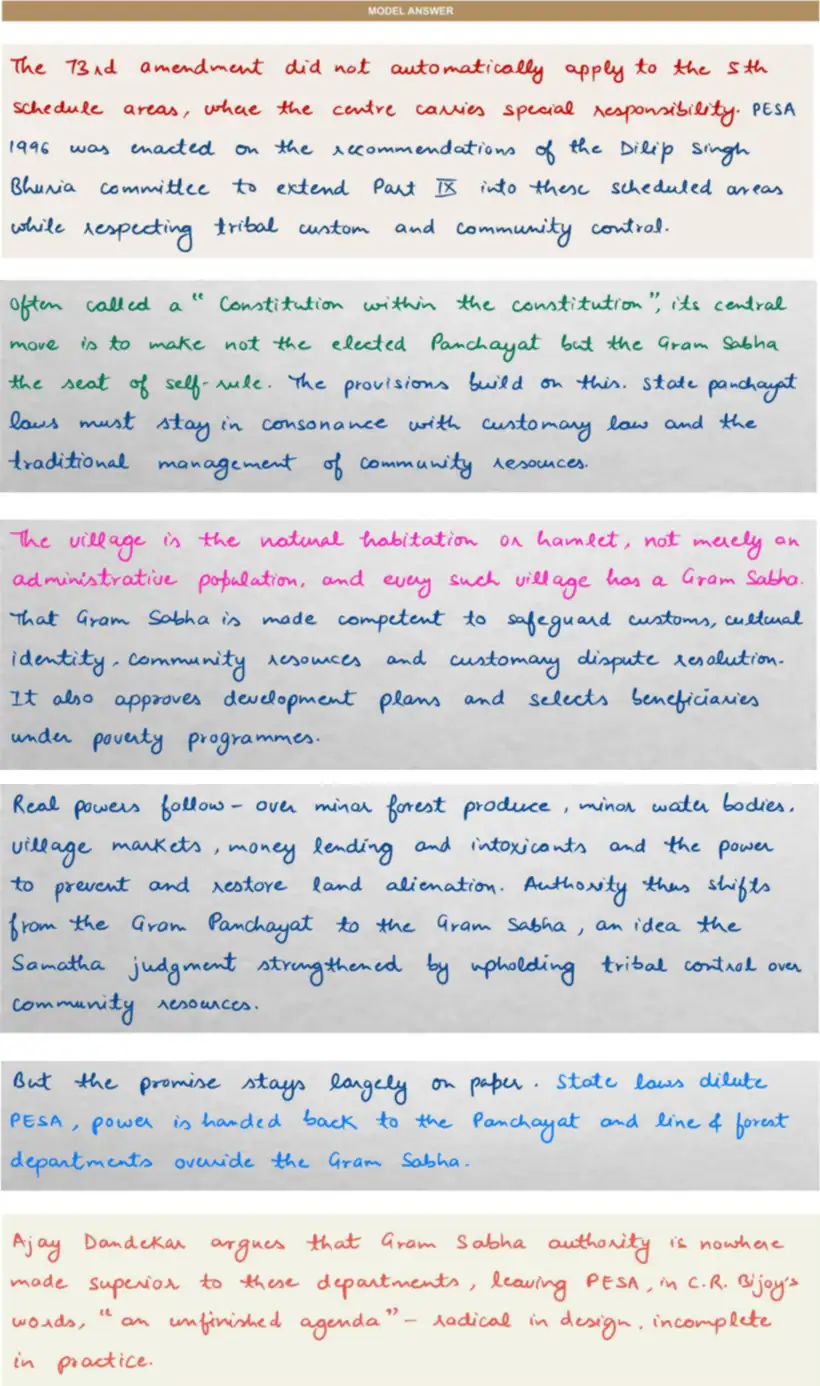
Model answer
Handwritten, in the form it would be written in the examination hall.
Also asked on this head
Grassroots Democracy — 13 questions in the Vault.
- Ending proxy leadership in Panchayati Raj is a necessary step towards true grassroots democracy. Comment. (150 words)
- Enunciate the impediments to women’s participation in local governance in the process of political decentralisation.
- Gram Sabha in the Panchayati Raj system is a forum which gives expression to the collective wisdom, aspirations and the will of the people. Comment.
How this is taught
The same flow snapshot, built for every head of the syllabus, with the answer written in class.
The first session of Foundation 2027 is published in full.
Six programmes across three levels.