
Has the 73rd Constitutional Amendment empowered women in panchayats in India? Discuss
How the answer moves
The flow snapshot — the routes in, the body, the counter-view and the routes out.
Route 1 Art 243D reserves ≥1/3 seats + chairperson posts → frame: has presence become power?
Route 2 reservation = one of India’s largest democratic transformations → but numbers alone ≠ power
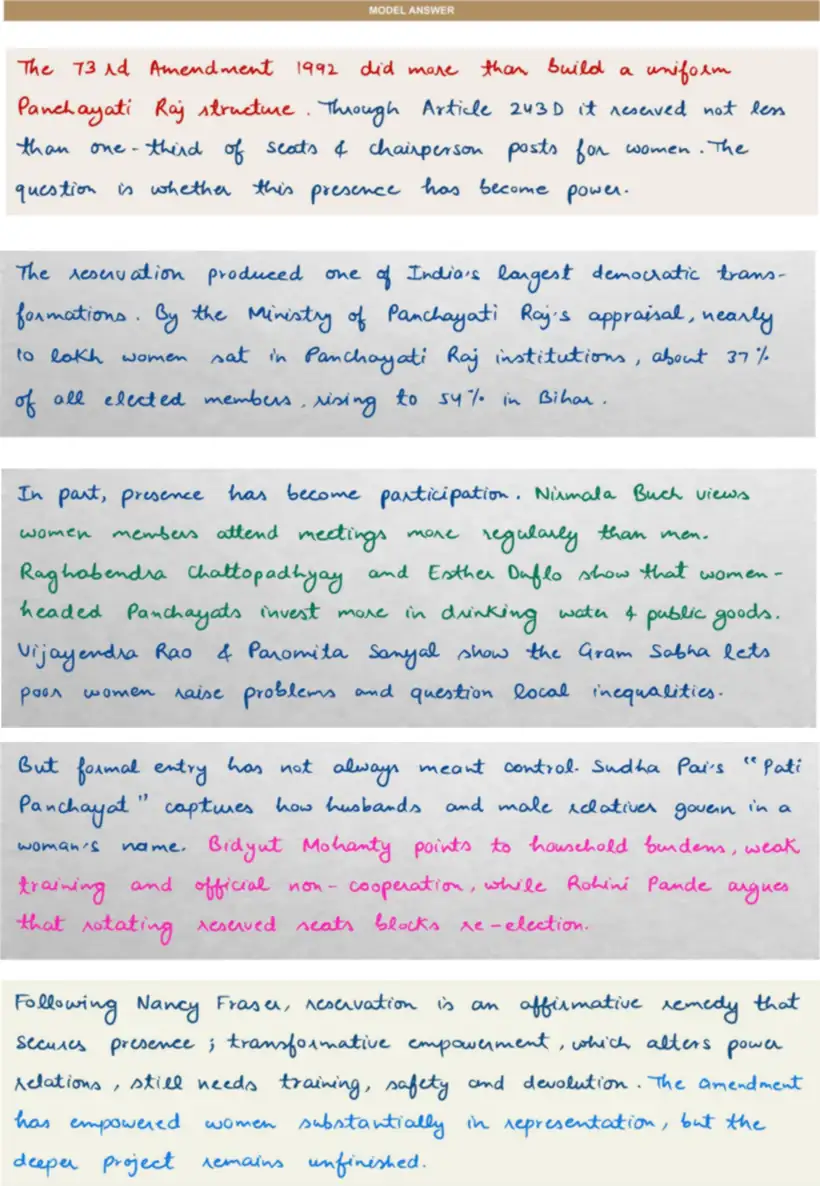
Art 243D reservation → scale: ~10 lakh women, 37%, Bihar 54% → first-time entry incl. SC/ST → presence → participation → Buch (regular attendance) → Chattopadhyay & Duflo (drinking water / public goods) → Rao & Sanyal (Gram Sabha questions local inequalities)
formal entry ≠ control → Pai’s “Pati Panchayat” (husbands / male kin govern in her name) → Mohanty (household burden, weak training, official non-cooperation) → Pande (rotation blocks re-election)
Route 1 Fraser: reservation = affirmative remedy (secures presence); transformative empowerment needs training, safety, devolution
Route 2 real in representation, unfinished in substance → door opened, project incomplete
Model answer
Handwritten, in the form it would be written in the examination hall.
Also asked on this head
Grassroots Democracy — 13 questions in the Vault.
- Ending proxy leadership in Panchayati Raj is a necessary step towards true grassroots democracy. Comment. (150 words)
- Enunciate the impediments to women’s participation in local governance in the process of political decentralisation.
- Gram Sabha in the Panchayati Raj system is a forum which gives expression to the collective wisdom, aspirations and the will of the people. Comment.
How this is taught
The same flow snapshot, built for every head of the syllabus, with the answer written in class.
The first session of Foundation 2027 is published in full.
Six programmes across three levels.