
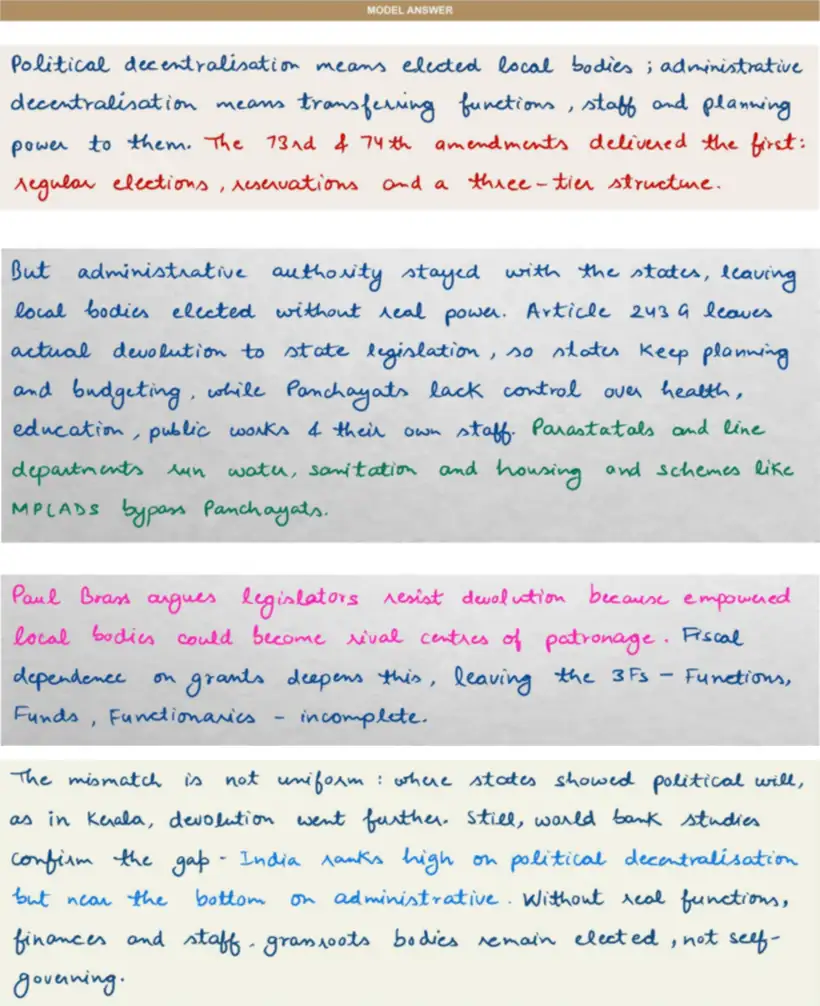
Political decentralization has not been matched by administrative decentralization at the grass roots level. Explain
How the answer moves
The flow snapshot — the routes in, the body, the counter-view and the routes out.
Route 1 political = elected bodies | administrative = functions / staff / planning → 73rd–74th gave elections, reservation, three tiers → administrative power stayed with states
Route 2 India a leader in political decentralisation but a laggard in administrative → why do elected bodies still lack governing power
Art. 243G leaves devolution to state law → states keep planning + budgeting → Panchayats lack control over health, education, public works, staff → parastatals / line departments run core services + MPLADS bypass → Brass: resistance as rival patronage → fiscal dependence on grants → incomplete 3Fs
mismatch not uniform → Kerala’s participatory planning devolved further → cause is political will, not a constitutional bar
Route 1 World Bank gap: high political, low administrative → elected but not self-governing
Route 2 real self-government needs functions + finances + staff, not elections alone
Model answer
Handwritten, in the form it would be written in the examination hall.
Also asked on this head
Grassroots Democracy — 13 questions in the Vault.
- Ending proxy leadership in Panchayati Raj is a necessary step towards true grassroots democracy. Comment. (150 words)
- Enunciate the impediments to women’s participation in local governance in the process of political decentralisation.
- Gram Sabha in the Panchayati Raj system is a forum which gives expression to the collective wisdom, aspirations and the will of the people. Comment.
How this is taught
The same flow snapshot, built for every head of the syllabus, with the answer written in class.
The first session of Foundation 2027 is published in full.
Six programmes across three levels.