
Examine the unique features of the 73rd Constitutional Amendment. Do you think this Amendment would contribute in achieving the goal of empowerment of marginalised sections of the society?
How the answer moves
The flow snapshot — the routes in, the body, the counter-view and the routes out.
Route 1 73rd CAA gave PRIs constitutional life + wrote marginalised entry into the design itself → so empowerment hinges on how far states let it work
Route 2 unique = a mandatory democratic floor fused with guaranteed reservation → real question: does the floor convert into real power?
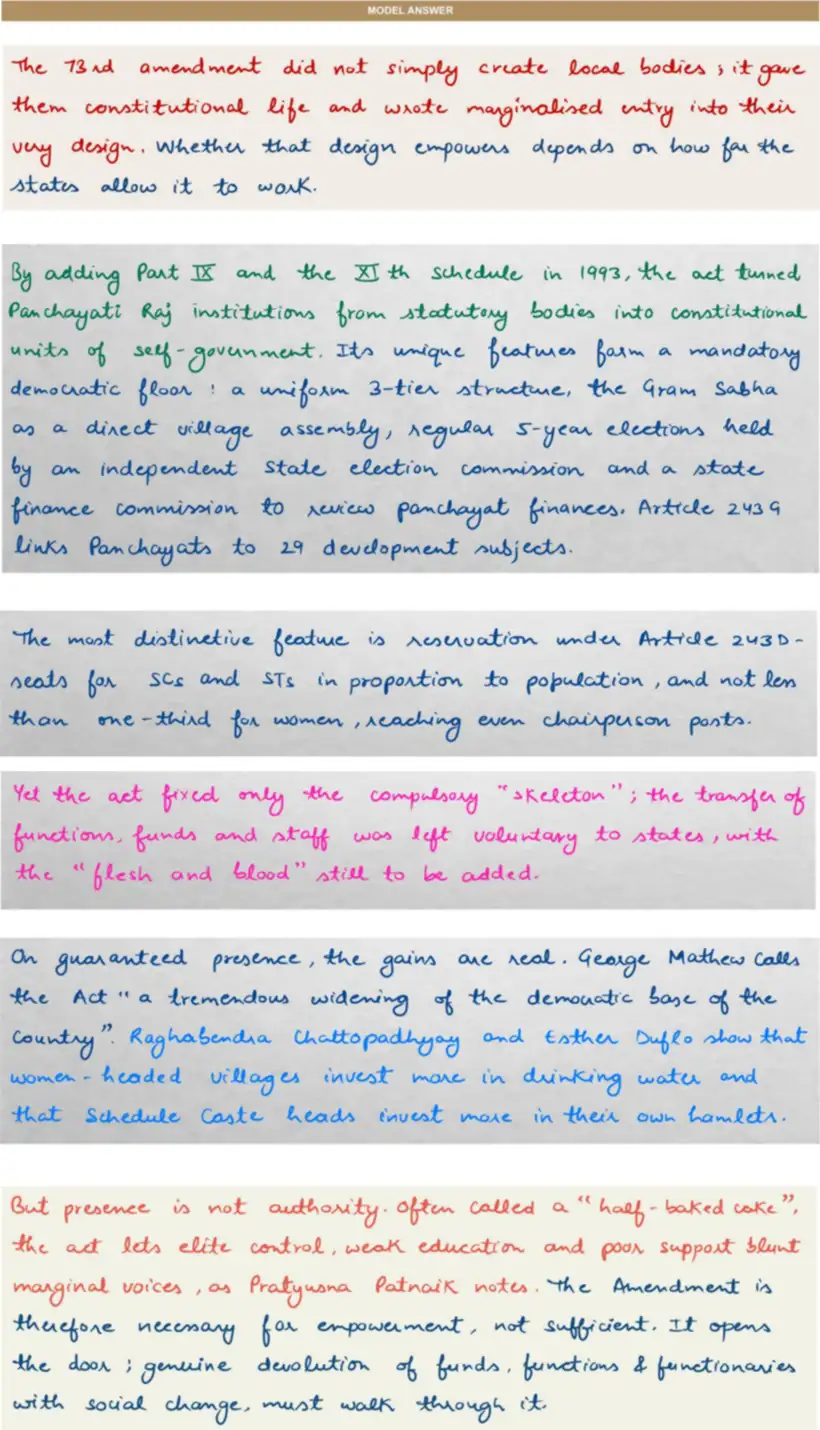
Part IX + Eleventh Schedule (1993) → statutory → constitutional self-government → three-tier + Gram Sabha + five-year SEC elections + State Finance Commission → Art 243G + 29 subjects → Art 243D reservation (SC/ST by population, ≥1/3 women, chairpersons) → compulsory “skeleton” vs voluntary devolution of functions/funds/staff (“flesh and blood”) → Mathew: widening of democratic base → Chattopadhyay & Duflo: women heads → drinking water, SC heads → SC hamlets → presence ≠ authority
“half-baked cake” → elite control, weak education, poor support blunt marginal voices (Patnaik) → reservation gives seats, not authority; real devolution left to states
Route 1 necessary, not sufficient → opens the door; genuine devolution of funds, functions, functionaries + social change must walk through it
Route 2 empowerment enabled by design, delivered only when the skeleton gains flesh — guaranteed presence must become real authority
Model answer
Handwritten, in the form it would be written in the examination hall.
Also asked on this head
Grassroots Democracy — 13 questions in the Vault.
- Ending proxy leadership in Panchayati Raj is a necessary step towards true grassroots democracy. Comment. (150 words)
- Enunciate the impediments to women’s participation in local governance in the process of political decentralisation.
- Gram Sabha in the Panchayati Raj system is a forum which gives expression to the collective wisdom, aspirations and the will of the people. Comment.
How this is taught
The same flow snapshot, built for every head of the syllabus, with the answer written in class.
The first session of Foundation 2027 is published in full.
Six programmes across three levels.