
“The Panchayats with Gram Sabhas should be so organised as to identify the resources locally available for the development in agricultural and industrial
How the answer moves
The flow snapshot — the routes in, the body, the counter-view and the routes out.
Route 1 Gram Swaraj = Gandhi’s self-reliant village reconstruction → statement names its economic core
Route 2 power to people + village meets own needs → organise Panchayats with Gram Sabhas to identify local resources
economic base of Gram Swaraj (efficiency, local resources + workforce, conservation, equity, employment) → Gram Sabha’s direct role (identify land/water/labour/forests/cattle/produce → classify households → set priorities) → village industries on local raw material (oil pressing, soap, dairying, compost) → agriculture–industry link (raw material → absorb unemployment → cut post-harvest loss) → cooperation: All India Village Industries Association → Kuthambakkam / R. Elango network economy
constitutional base ≠ enough → needs devolution of funds, functions, functionaries → weak Gram Sabhas, poor attendance, elite capture cripple resource planning
Route 1 Gram Swaraj = decentralised economic democracy, not merely administrative local government
Route 2 mass employment over mass production → self-reliant, ethical village development
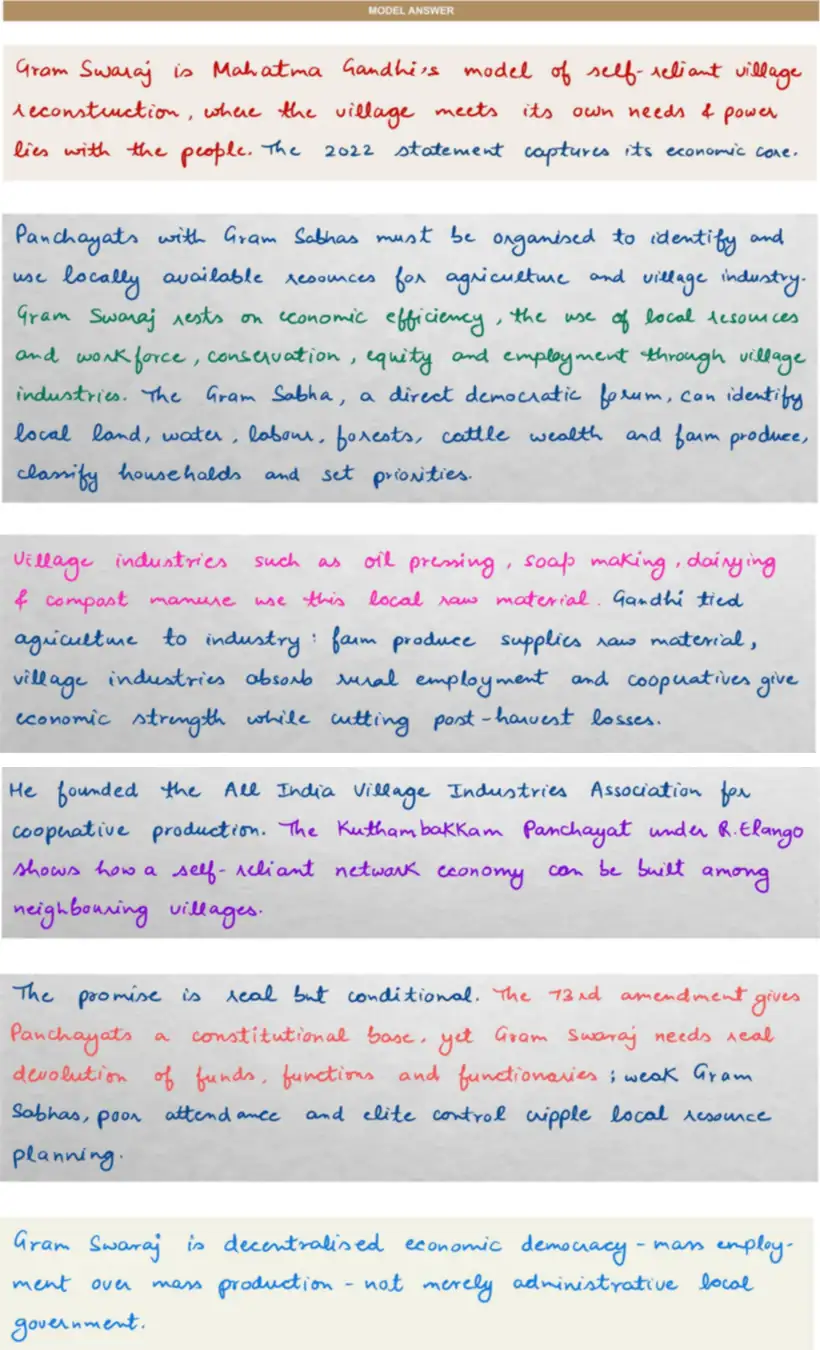
Model answer
Handwritten, in the form it would be written in the examination hall.
Also asked on this head
Grassroots Democracy — 13 questions in the Vault.
- Ending proxy leadership in Panchayati Raj is a necessary step towards true grassroots democracy. Comment. (150 words)
- Enunciate the impediments to women’s participation in local governance in the process of political decentralisation.
- Gram Sabha in the Panchayati Raj system is a forum which gives expression to the collective wisdom, aspirations and the will of the people. Comment.
How this is taught
The same flow snapshot, built for every head of the syllabus, with the answer written in class.
The first session of Foundation 2027 is published in full.
Six programmes across three levels.