
To what extent has 73rd and 74th amendments of the
How the answer moves
The flow snapshot — the routes in, the body, the counter-view and the routes out.
Route 1 one of the largest entries of women into elective office → “to what extent” = how far presence becomes power
Route 2 reservation opened the third tier to women → empowerment tested by the gap between formal entry and substantive power
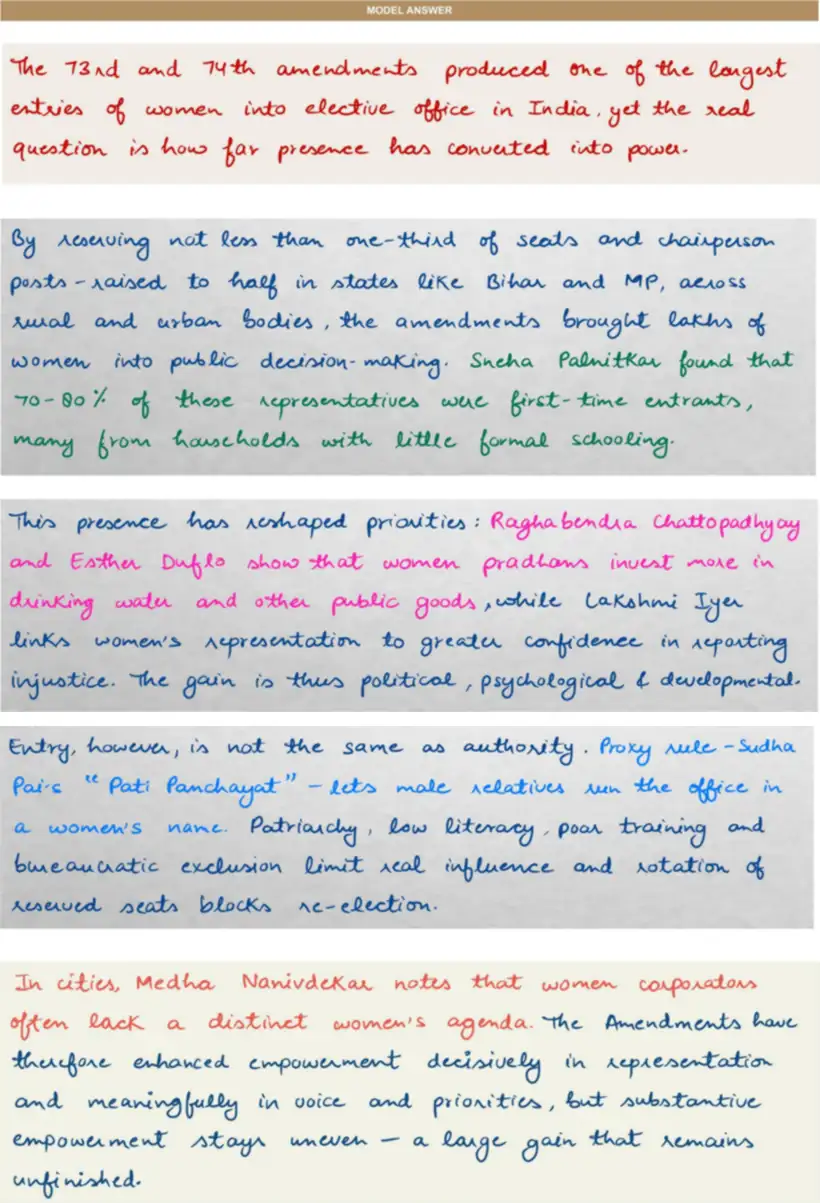
one-third seats + chairperson posts, up to 50% (Bihar, MP), rural and urban → lakhs enter, mostly first-timers (Palnitkar) → presence reshapes priorities: public goods / drinking water (Chattopadhyay & Duflo) + psychological confidence, reporting injustice (Iyer) → gain is political + psychological + developmental
entry ≠ authority → proxy rule, “Pati Panchayat” (Sudha Pai) → patriarchy, low literacy, poor training, bureaucratic exclusion, seat rotation blocks re-election → urban corporators often lack a women’s agenda (Nanivdekar) → substantive empowerment stays uneven
Route 1 decisive in representation, meaningful in voice and priorities → substantive gain still unfinished
Route 2 presence achieved; power contingent on capacity, safety and dismantling patriarchy
Model answer
Handwritten, in the form it would be written in the examination hall.
Also asked on this head
Grassroots Democracy — 13 questions in the Vault.
- Ending proxy leadership in Panchayati Raj is a necessary step towards true grassroots democracy. Comment. (150 words)
- Enunciate the impediments to women’s participation in local governance in the process of political decentralisation.
- Gram Sabha in the Panchayati Raj system is a forum which gives expression to the collective wisdom, aspirations and the will of the people. Comment.
How this is taught
The same flow snapshot, built for every head of the syllabus, with the answer written in class.
The first session of Foundation 2027 is published in full.
Six programmes across three levels.