
“State……… does the greatest harm to mankind by destroying individuality, which lies at the root of all progress.’ — Mahatma Gandhi. Elucidate.
How the answer moves
The flow snapshot — the routes in, the body, the counter-view and the routes out.
Route 1 state = “concentrated, organised violence” / soulless machine → hence fear that its growth destroys individuality
Route 2 the paradox: state “doing good” by curbing exploitation, yet harming most by killing individuality
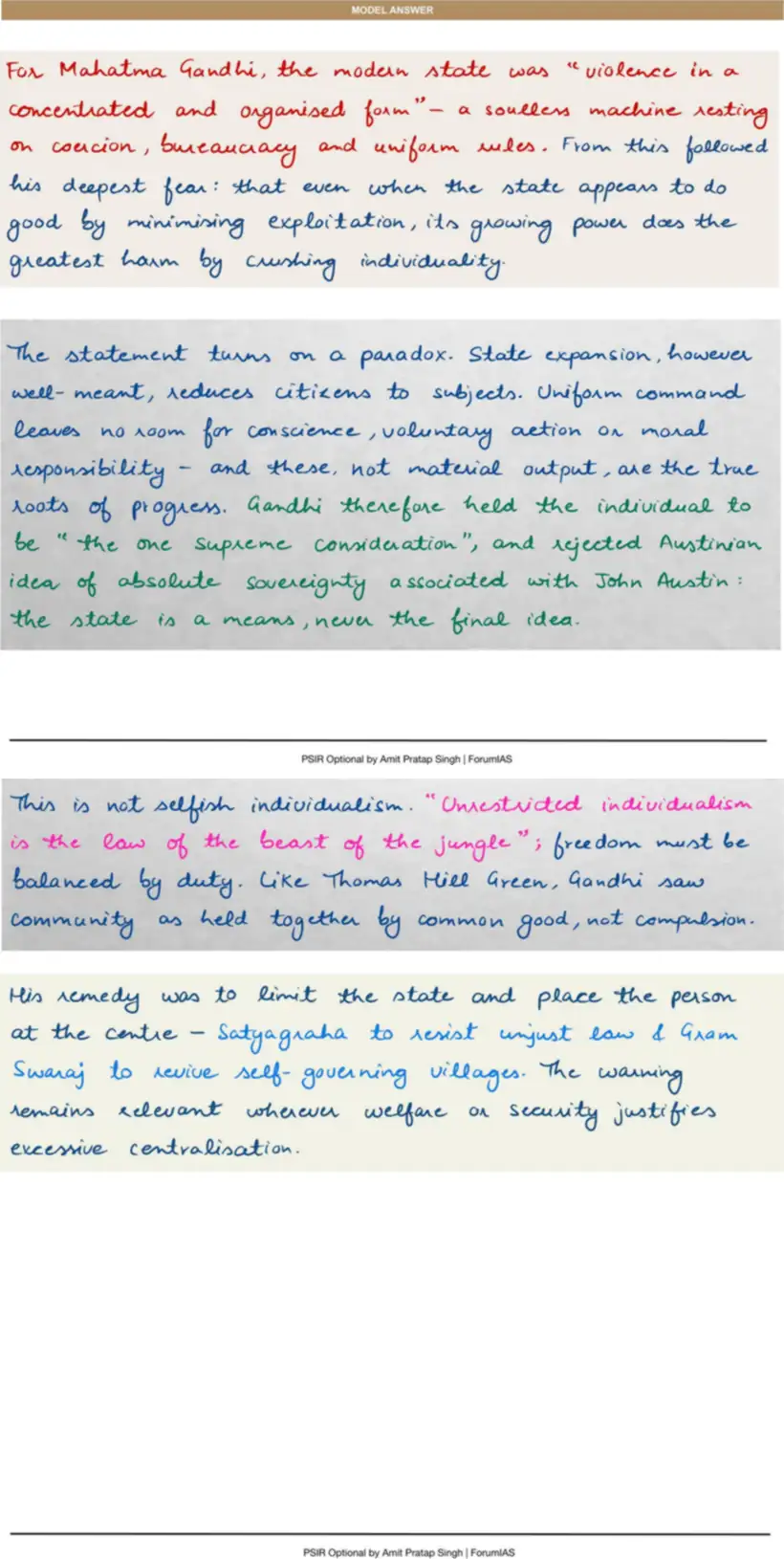
rests on coercion + bureaucracy + uniform rules → expansion reduces citizens to subjects → kills conscience, voluntary action, moral responsibility = true roots of progress → individual “the one supreme consideration” → rejects Austinian absolute sovereignty (Austin) → state a means, not final ideal
individuality ≠ unrestrained individualism → “law of the beast of the jungle” → freedom balanced by duty → Green: community by common good, not compulsion
Route 1 remedy: limit the state → Satyagraha + Gram Swaraj → individual at the centre
Route 2 warning stays relevant wherever welfare / security justify over-centralisation
Model answer
Handwritten, in the form it would be written in the examination hall.
Also asked on this head
Indian Political Thought — 21 questions in the Vault.
- Analyze Kautilya’s Saptanga theory. How do you explain its significance in present-day politics?
- Discuss Gandhi’s approach to property in relation to trusteeship.
- Discuss B. R. Ambedkar’s views on democracy and State socialism.
How this is taught
The same flow snapshot, built for every head of the syllabus, with the answer written in class.
The first session of Foundation 2027 is published in full.
Six programmes across three levels.