
Right to privacy is an intrinsic part of the right to life.
How the answer moves
The flow snapshot — the routes in, the body, the counter-view and the routes out.
Route 1 no textual basis → Court reads privacy into Article 21
Route 2 Brandeis “right to be left alone” → privacy as protection of life, autonomy, information
recognition came slowly → M.P. Sharma / Kharak Singh deny or limit → Gobind links Articles 19 & 21 → Naz Foundation protects personal space → Puttaswamy (2017) nine-judge unanimous → AG’s “common law right” plea rejected → held intrinsic to Article 21 → Alok Prasanna Kumar’s core elements (autonomy, choice, control over information)
privacy as mere common-law right vs full constitutional right → state may still restrict, but only if lawful, necessary, proportionate
Route 1 privacy gives meaning to life and liberty
Route 2 recognition now settled, yet bounded by proportionality
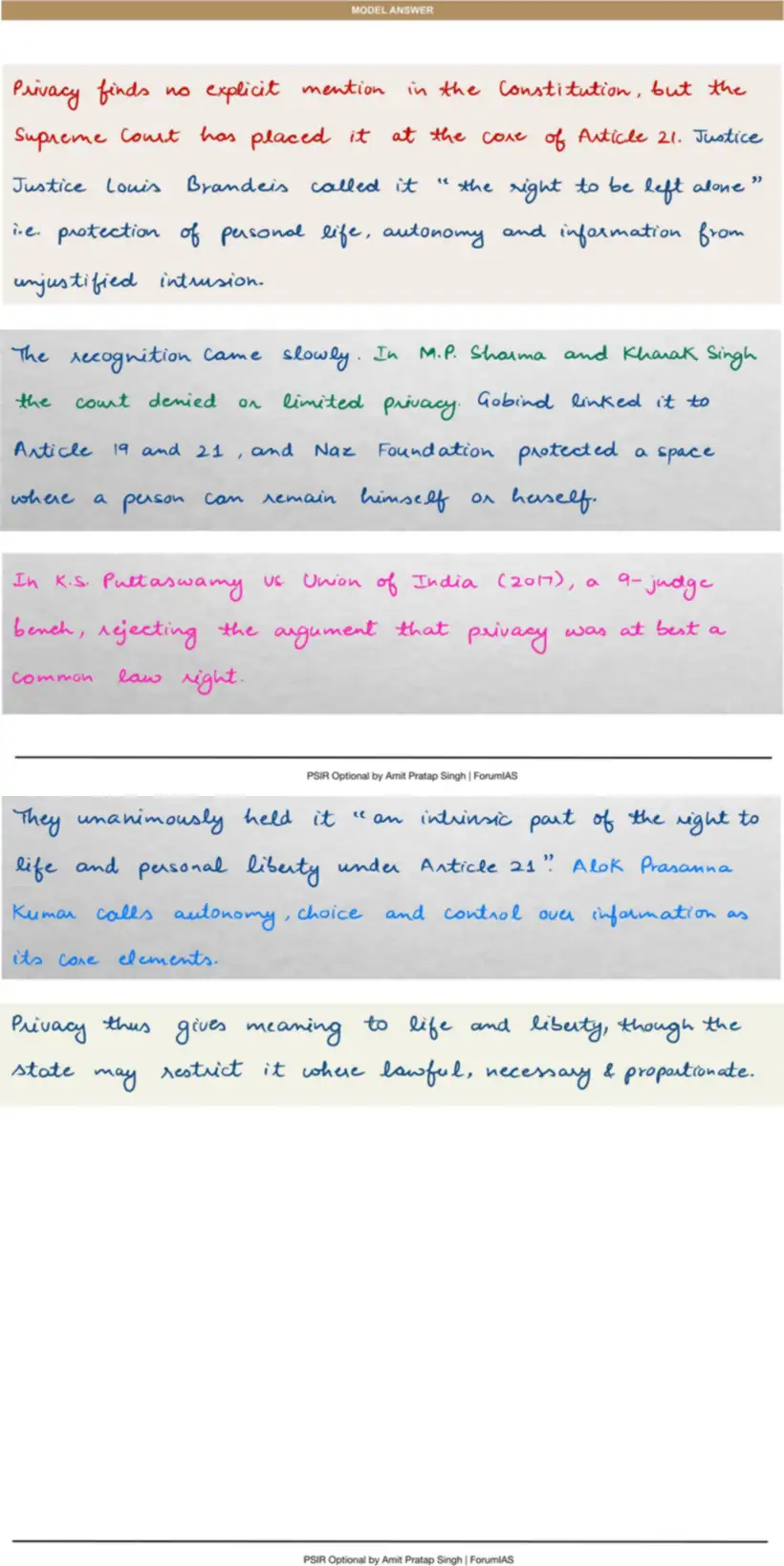
Model answer
Handwritten, in the form it would be written in the examination hall.
Also asked on this head
Salient Features of the Indian Constitution — 17 questions in the Vault.
- The Constitution of India was secular even before the word was included in the Preamble. Comment. (150 words)
- How far do you agree that the Directive Principles of State Policy are more fundamental than the Fundamental Rights in meeting socio-economic justice as mentioned in...
- Legal remedies in Part III of the Constitution of India (150 words)
How this is taught
The same flow snapshot, built for every head of the syllabus, with the answer written in class.
The first session of Foundation 2027 is published in full.
Six programmes across three levels.