
Underline the significance of the first constitutional amendment.
How the answer moves
The flow snapshot — the routes in, the body, the counter-view and the routes out.
Route 1 June 1951 amendment → first use of amending power to protect socio-economic reform from FR
Route 2 triggered by early adverse rulings → reservation, speech, land reform all under strain
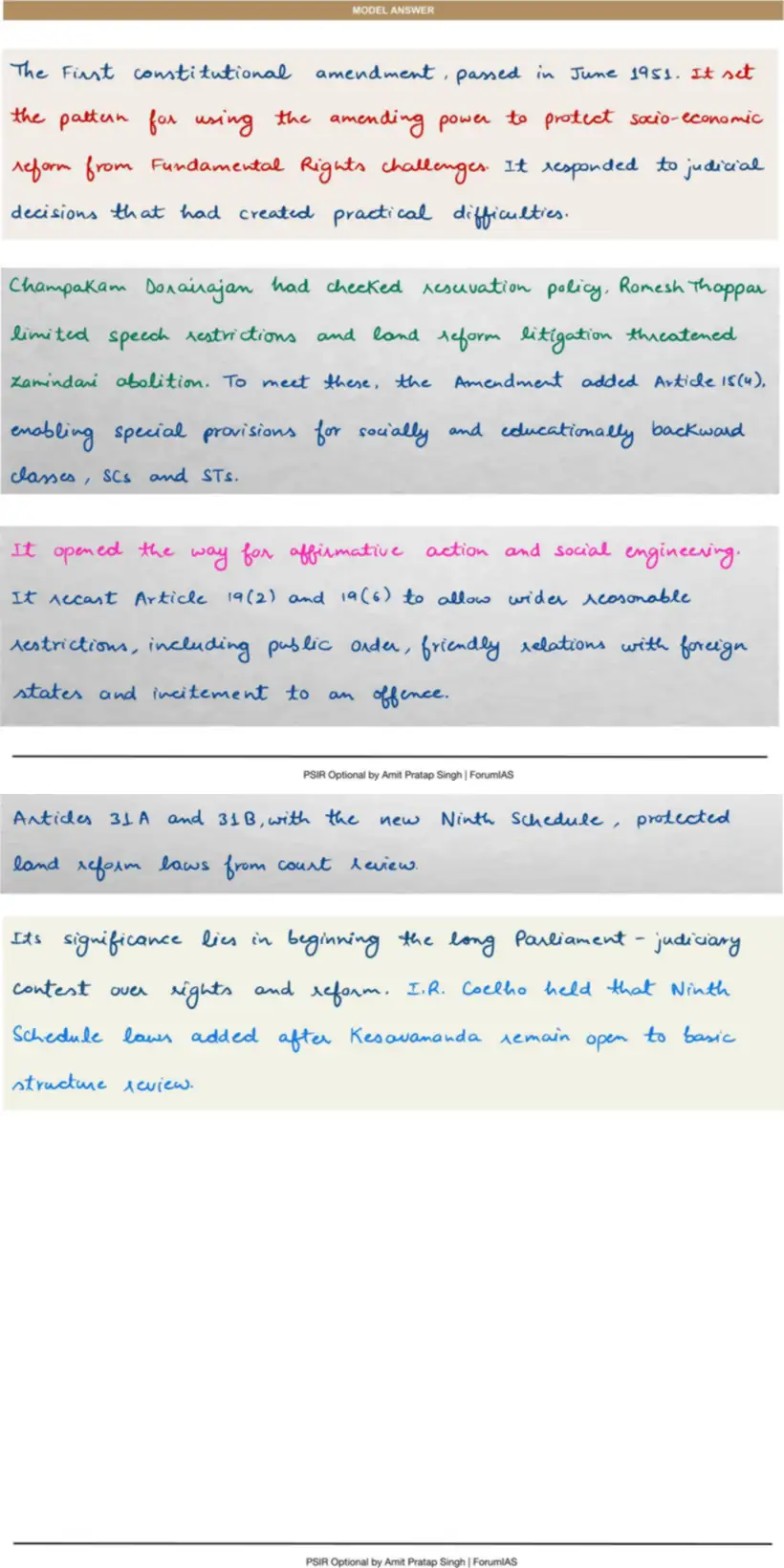
response to Champakam / Romesh Thappar / land-reform litigation → Art 15(4): affirmative action & social engineering → Art 19(2)/19(6): wider reasonable restrictions → Art 31A/31B + Ninth Schedule: shield land-reform laws → opens Parliament–judiciary contest
Ninth Schedule immunity not absolute → I.R. Coelho subjects post-Kesavananda laws to basic structure review
Route 1 significance = template for amendment-driven socio-economic justice
Route 2 significance = origin of the long rights-vs-reform, Parliament-vs-court contest
Model answer
Handwritten, in the form it would be written in the examination hall.
Also asked on this head
Salient Features of the Indian Constitution — 17 questions in the Vault.
- The Constitution of India was secular even before the word was included in the Preamble. Comment. (150 words)
- How far do you agree that the Directive Principles of State Policy are more fundamental than the Fundamental Rights in meeting socio-economic justice as mentioned in...
- Legal remedies in Part III of the Constitution of India (150 words)
How this is taught
The same flow snapshot, built for every head of the syllabus, with the answer written in class.
The first session of Foundation 2027 is published in full.
Six programmes across three levels.