
Mention the founding principles that define India’s Constitution.
How the answer moves
The flow snapshot — the routes in, the body, the counter-view and the routes out.
Route 1 authority belongs to the people, not Crown/class/ruler → sovereignty is the base
Route 2 Austin: “social document” → unity + democracy + social revolution as the frame
popular sovereignty (“We, the People”) → republic + democracy (adult franchise, responsible executive) → rule of law / Article 14 → Fundamental Rights (Part III → political democracy) → DPSP (Part IV → social-economic democracy) → secularism (Articles 25–30, S.R. Bommai) → federalism with strong Union → independent judiciary
Austin’s social aim vs K.T. Shah — Constitution “almost entirely political and not at all social or economic”
Route 1 these principles fuse a plural society into one democratic community
Route 2 political democracy + social democracy together → peaceful social revolution
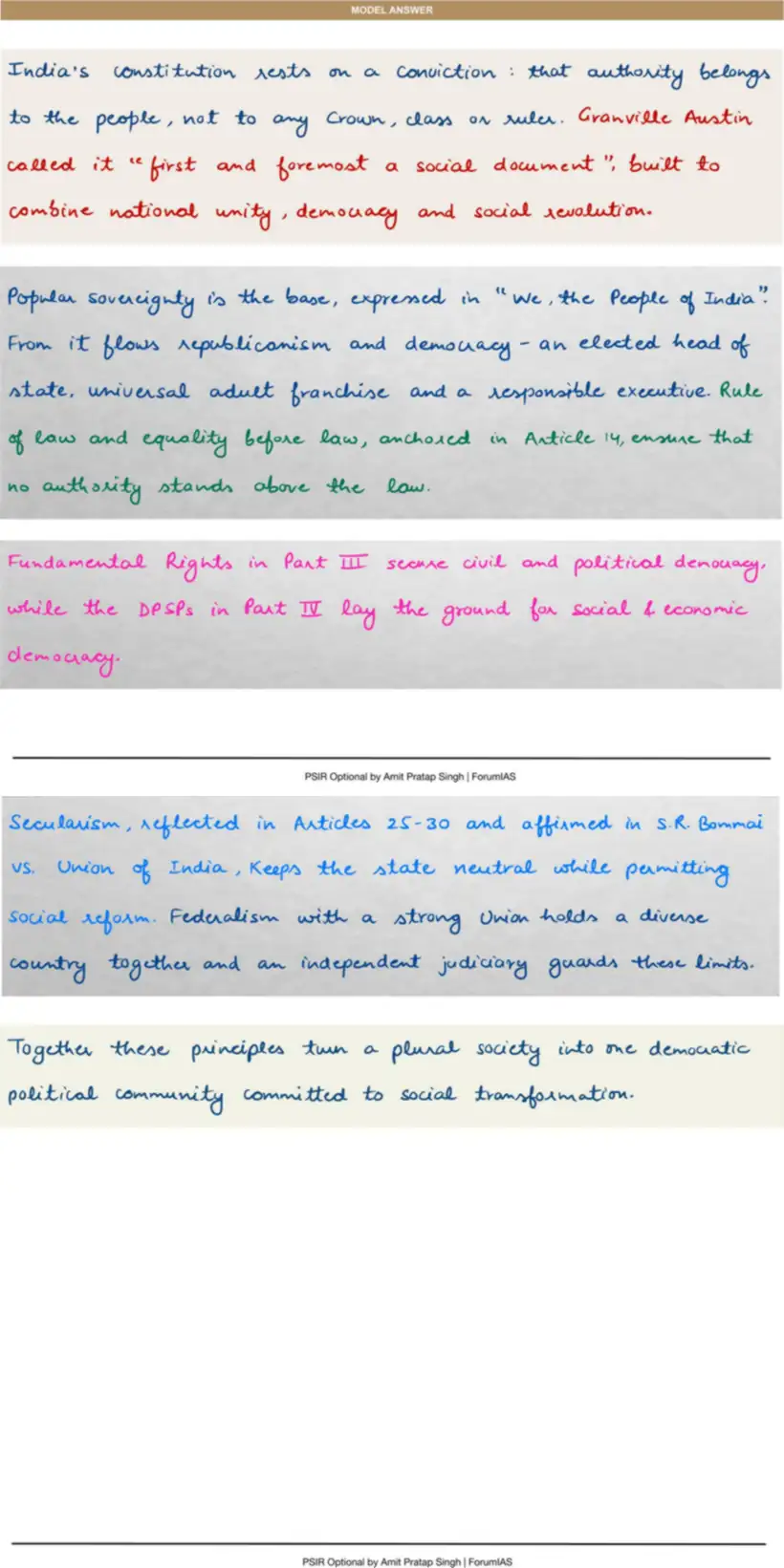
Model answer
Handwritten, in the form it would be written in the examination hall.
Also asked on this head
Salient Features of the Indian Constitution — 17 questions in the Vault.
- The Constitution of India was secular even before the word was included in the Preamble. Comment. (150 words)
- How far do you agree that the Directive Principles of State Policy are more fundamental than the Fundamental Rights in meeting socio-economic justice as mentioned in...
- Legal remedies in Part III of the Constitution of India (150 words)
How this is taught
The same flow snapshot, built for every head of the syllabus, with the answer written in class.
The first session of Foundation 2027 is published in full.
Six programmes across three levels.