
The main goal of the Fundamental Duties in the Indian Constitution is to generate civic responsibility among the citizens. Explain.
How the answer moves
The flow snapshot — the routes in, the body, the counter-view and the routes out.
Route 1 locate FDs (Part IVA, Art 51A, 42nd Amendment / Swaran Singh) → purpose not punishment but civic responsibility
Route 2 rights must be balanced by responsibilities → duties bind rights to responsible conduct
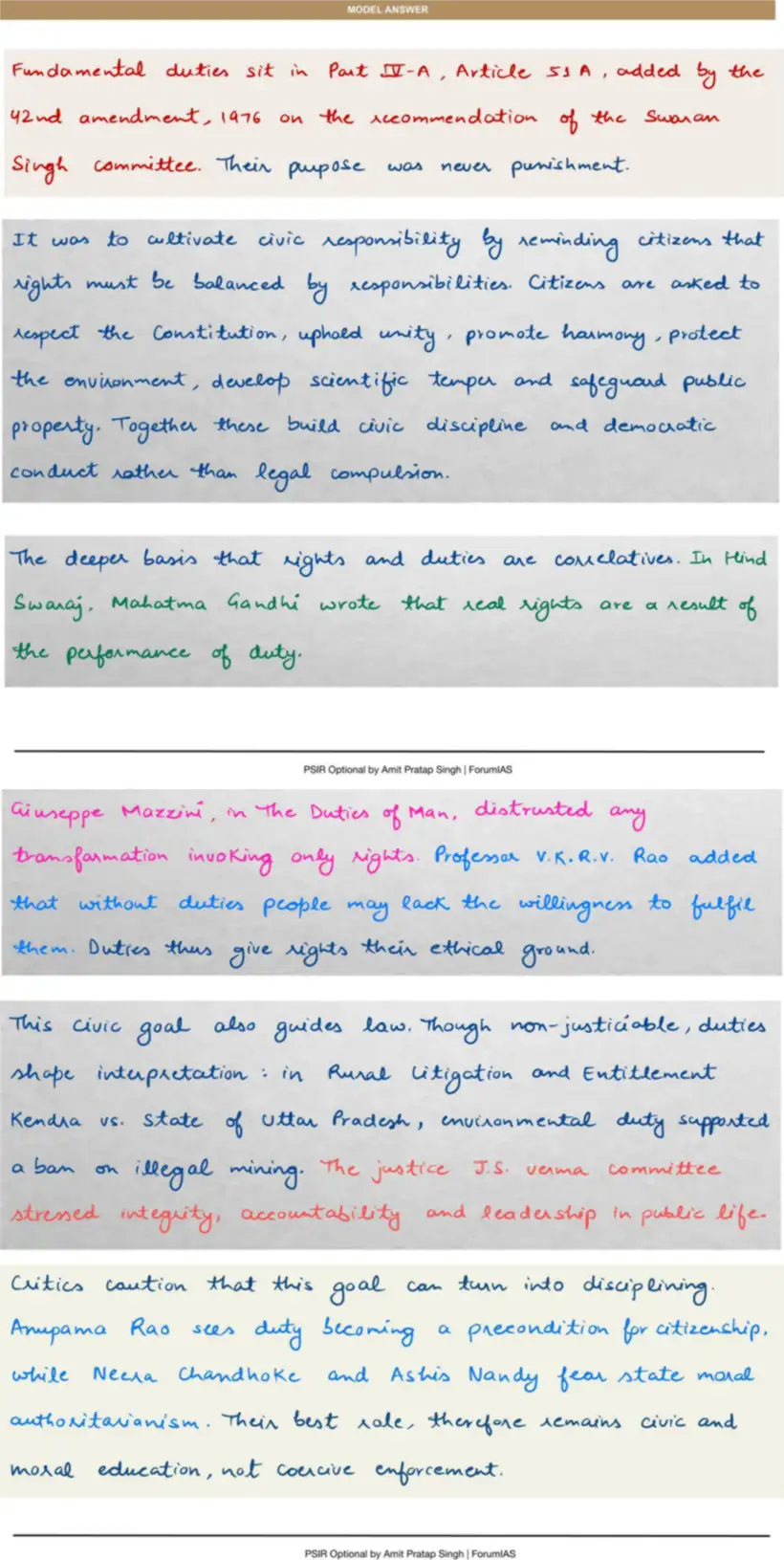
content shows the aim (respect Constitution, unity, harmony, environment, scientific temper, public property → civic discipline) → deeper basis: rights & duties correlatives → Gandhi (Hind Swaraj) / Mazzini (Duties of Man) / V.K.R.V. Rao → duties give rights ethical ground → civic goal guides law (non-justiciable yet directive) → Rural Litigation & Entitlement Kendra (environmental duty) → Verma Committee (integrity, accountability, leadership)
goal can turn into disciplining → Anupama Rao (duty as precondition for citizenship) / Chandhoke / Nandy (state moral authoritarianism)
Route 1 rights without duties = entitlement without accountability; duties without rights = oppression
Route 2 true goal = civic & moral education, not coercive enforcement
Model answer
Handwritten, in the form it would be written in the examination hall.
Also asked on this head
Salient Features of the Indian Constitution — 17 questions in the Vault.
- The Constitution of India was secular even before the word was included in the Preamble. Comment. (150 words)
- How far do you agree that the Directive Principles of State Policy are more fundamental than the Fundamental Rights in meeting socio-economic justice as mentioned in...
- Legal remedies in Part III of the Constitution of India (150 words)
How this is taught
The same flow snapshot, built for every head of the syllabus, with the answer written in class.
The first session of Foundation 2027 is published in full.
Six programmes across three levels.