
Differentiate parliamentary supremacy from parliamentary sovereignty. Would you consider the Indian Parliament as a Sovereign Parliament? Examine.
How the answer moves
The flow snapshot — the routes in, the body, the counter-view and the routes out.
Route 1 two terms used loosely → actually different degrees of legislative power
Route 2 settle the distinction first → then test India against it
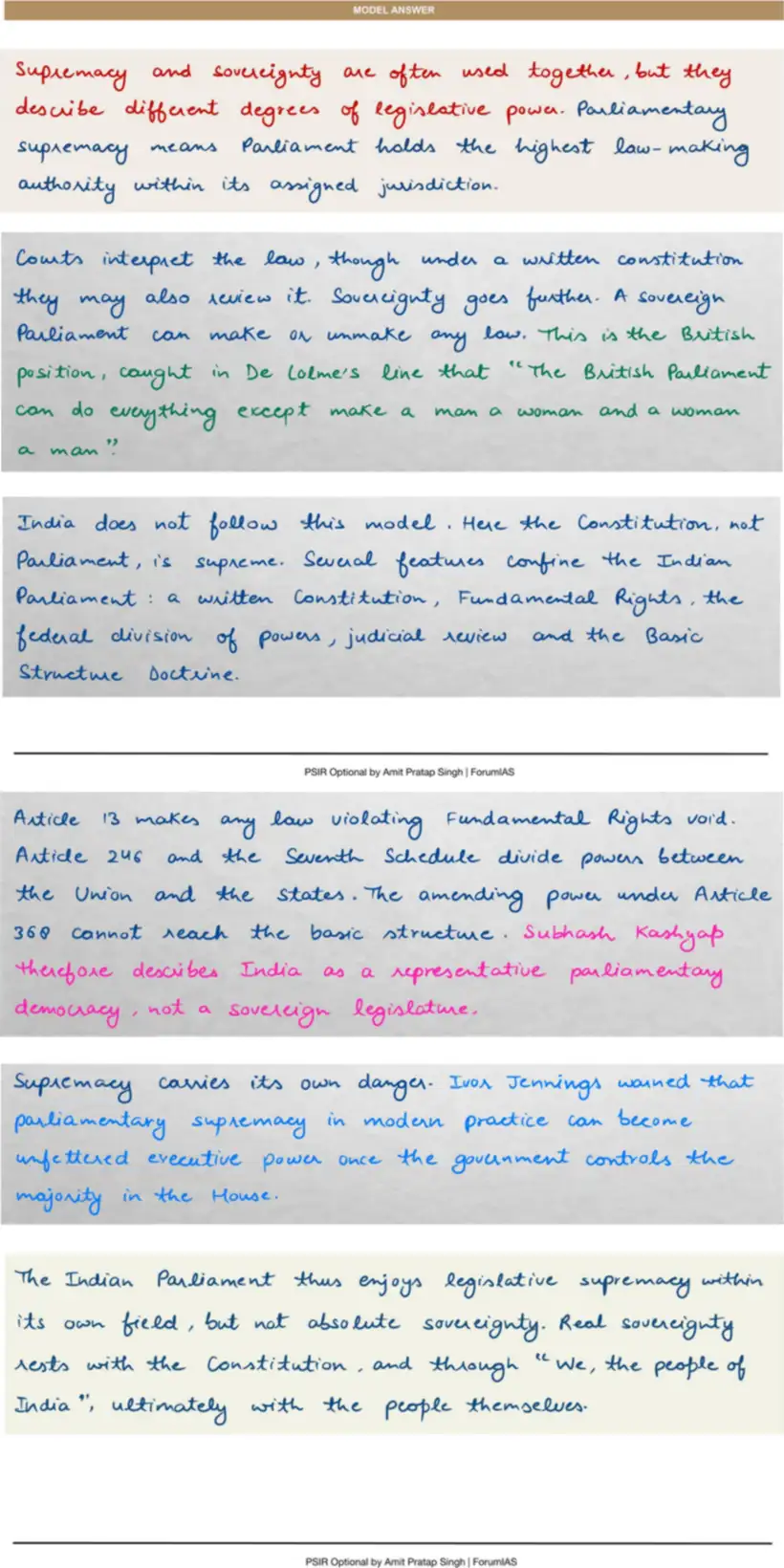
supremacy = highest authority within jurisdiction, courts may review under written constitution → sovereignty = make/unmake any law, no higher limit → British model (De Lolme) → India rejects it: Constitution supreme → confining features (written Constitution, FRs, federal division, judicial review, Basic Structure) → Art 13 voids violating laws → Art 246 + Seventh Schedule split powers → Art 368 cannot touch basic structure → Kashyap: representative parliamentary democracy, not sovereign legislature
Jennings → supremacy itself risky → can slide into unfettered executive power when government controls the House majority
Route 1 supremacy within its field, not absolute sovereignty
Route 2 sovereignty lies with the Constitution and, through “We, the People,” with the people
Model answer
Handwritten, in the form it would be written in the examination hall.
Also asked on this head
Salient Features of the Indian Constitution — 17 questions in the Vault.
- The Constitution of India was secular even before the word was included in the Preamble. Comment. (150 words)
- How far do you agree that the Directive Principles of State Policy are more fundamental than the Fundamental Rights in meeting socio-economic justice as mentioned in...
- Legal remedies in Part III of the Constitution of India (150 words)
How this is taught
The same flow snapshot, built for every head of the syllabus, with the answer written in class.
The first session of Foundation 2027 is published in full.
Six programmes across three levels.