
Discuss the Right to Information and underline challenges being posed before it.
How the answer moves
The flow snapshot — the routes in, the body, the counter-view and the routes out.
Route 1 RTI Act 2005 as a working statute → right to know operationalised
Route 2 right to know rooted in Art 19(1)(a) → Bennett Coleman / Manubhai Shah / PUCL
Art 19(1)(a) base + three cases → ends colonial secrecy → transparency + accountability → tracking funds / welfare / services / records → participatory governance → turn to working gaps → pendency, poor records, weak Section 4 disclosure → 2019 Amendment + commissioner independence → political appointments → Official Secrets Act 1923 + security exemptions → no penalties → activist attacks + resistance on political parties
statutory promise of openness vs ground reality of delay, secrecy and weak enforcement
Route 1 strong in design, weak in delivery → fix enforcement and commission independence
Route 2 transparency becomes real only when commissions are empowered and secrecy laws are aligned
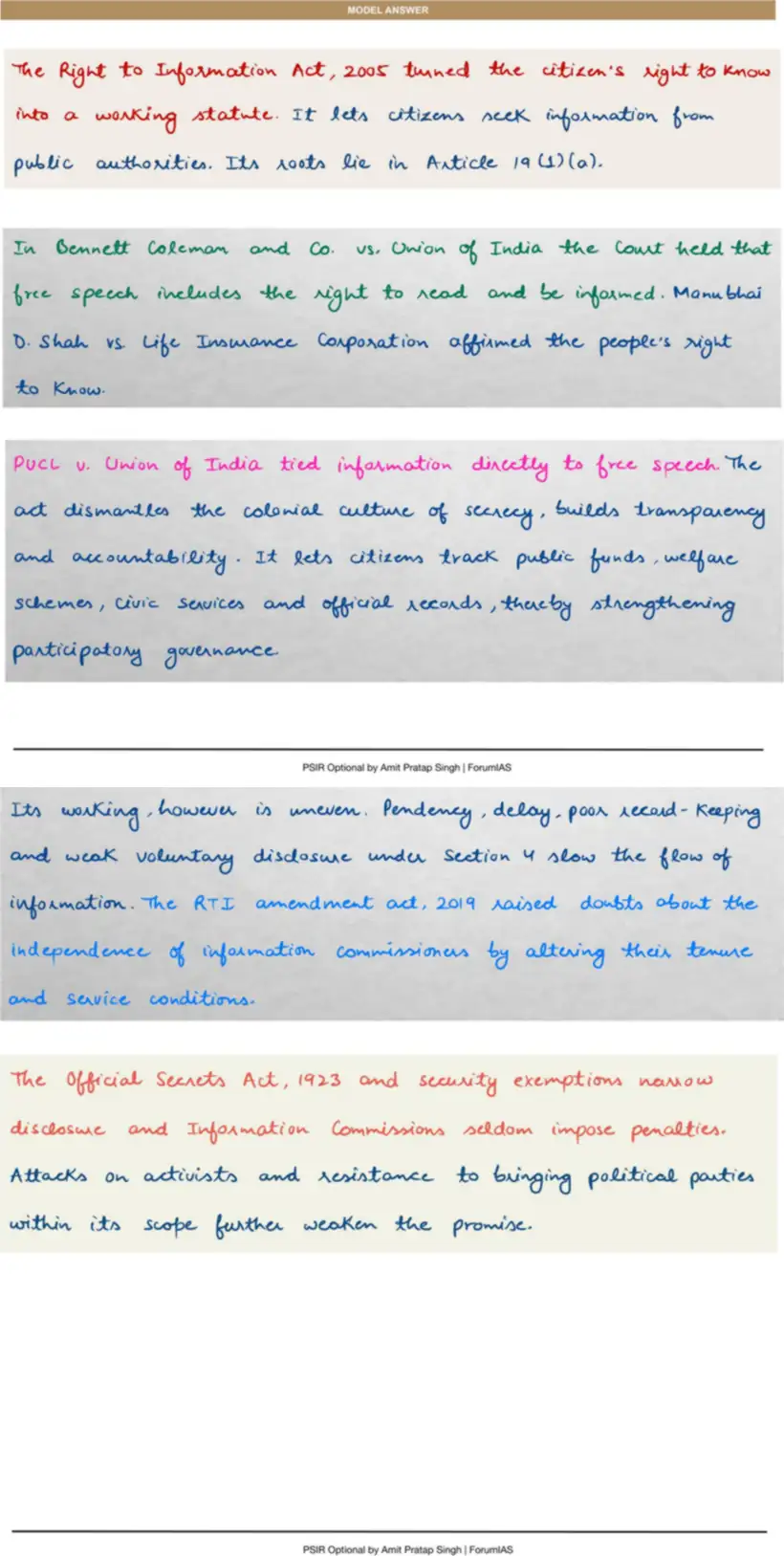
Model answer
Handwritten, in the form it would be written in the examination hall.
Also asked on this head
Salient Features of the Indian Constitution — 17 questions in the Vault.
- The Constitution of India was secular even before the word was included in the Preamble. Comment. (150 words)
- How far do you agree that the Directive Principles of State Policy are more fundamental than the Fundamental Rights in meeting socio-economic justice as mentioned in...
- Legal remedies in Part III of the Constitution of India (150 words)
How this is taught
The same flow snapshot, built for every head of the syllabus, with the answer written in class.
The first session of Foundation 2027 is published in full.
Six programmes across three levels.