
‘Article 368 does not enable Parliament to alter the basic structure or framework of the Constitution’
How the answer moves
The flow snapshot — the routes in, the body, the counter-view and the routes out.
Route 1 Art 368 = constituent power to amend → wide but not unlimited
Route 2 statement settles the debate → amendment ≠ destruction of identity
Shankari Prasad / Sajjan Singh (FRs amendable) → Mudholkar’s “basic features” hint → Golaknath (FRs barred) → Kesavananda Bharati 1973 (any part, not basic structure) → Minerva Mills (limited amending power itself basic) → Chandrachud (donee can’t make limited power unlimited) → elements: supremacy, democracy, secularism, federalism, judicial review
Austin: judicial statesmanship guarding the spirit → Sathe: judicial rewriting without textual basis
Route 1 Art 368 authorizes amendment, not abrogation of identity
Route 2 doctrine preserves constitutional identity against majoritarian amendment
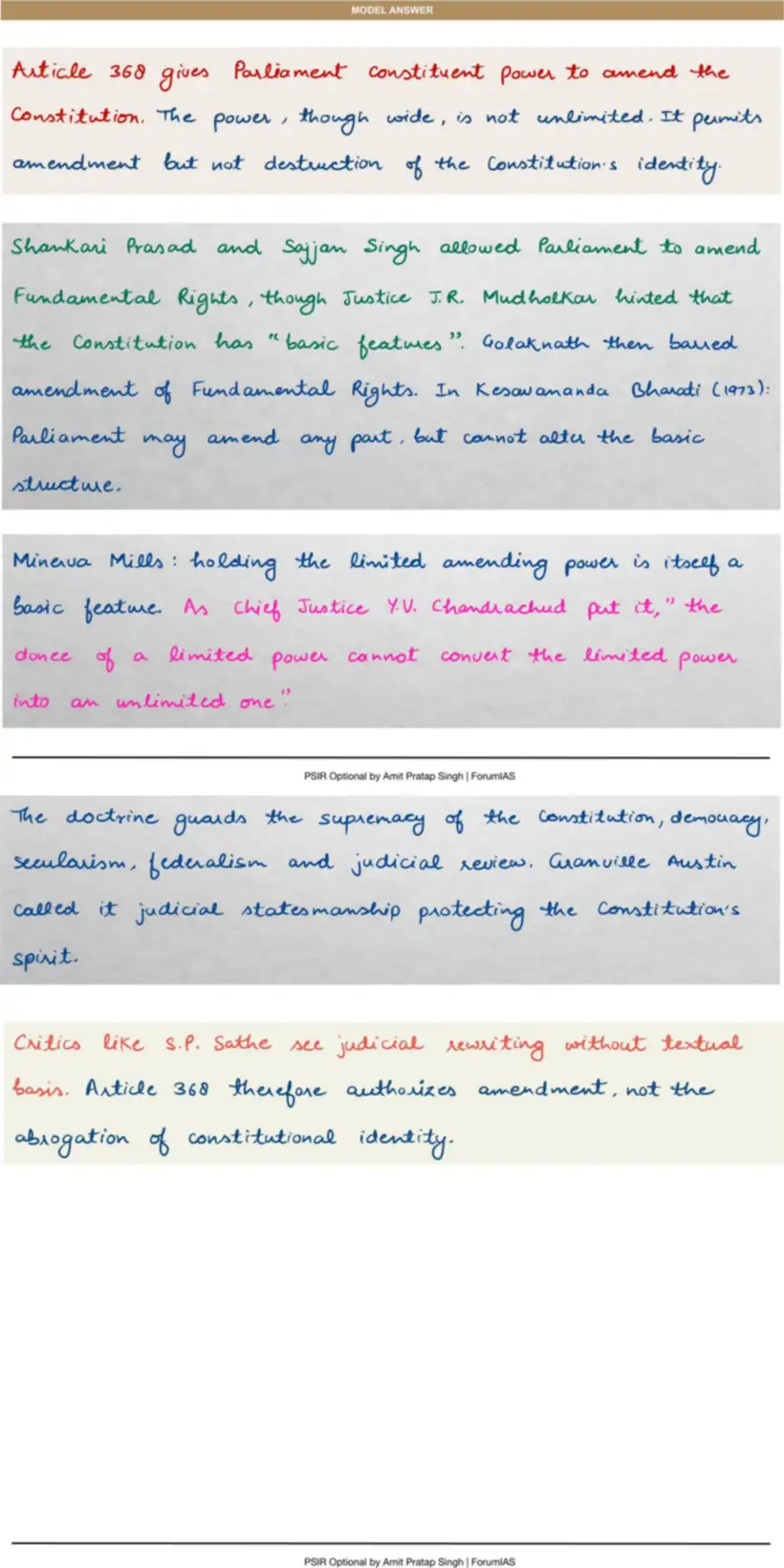
Model answer
Handwritten, in the form it would be written in the examination hall.
Also asked on this head
Salient Features of the Indian Constitution — 17 questions in the Vault.
- The Constitution of India was secular even before the word was included in the Preamble. Comment. (150 words)
- How far do you agree that the Directive Principles of State Policy are more fundamental than the Fundamental Rights in meeting socio-economic justice as mentioned in...
- Legal remedies in Part III of the Constitution of India (150 words)
How this is taught
The same flow snapshot, built for every head of the syllabus, with the answer written in class.
The first session of Foundation 2027 is published in full.
Six programmes across three levels.