
Comment on the Right to constitutional remedies in India
How the answer moves
The flow snapshot — the routes in, the body, the counter-view and the routes out.
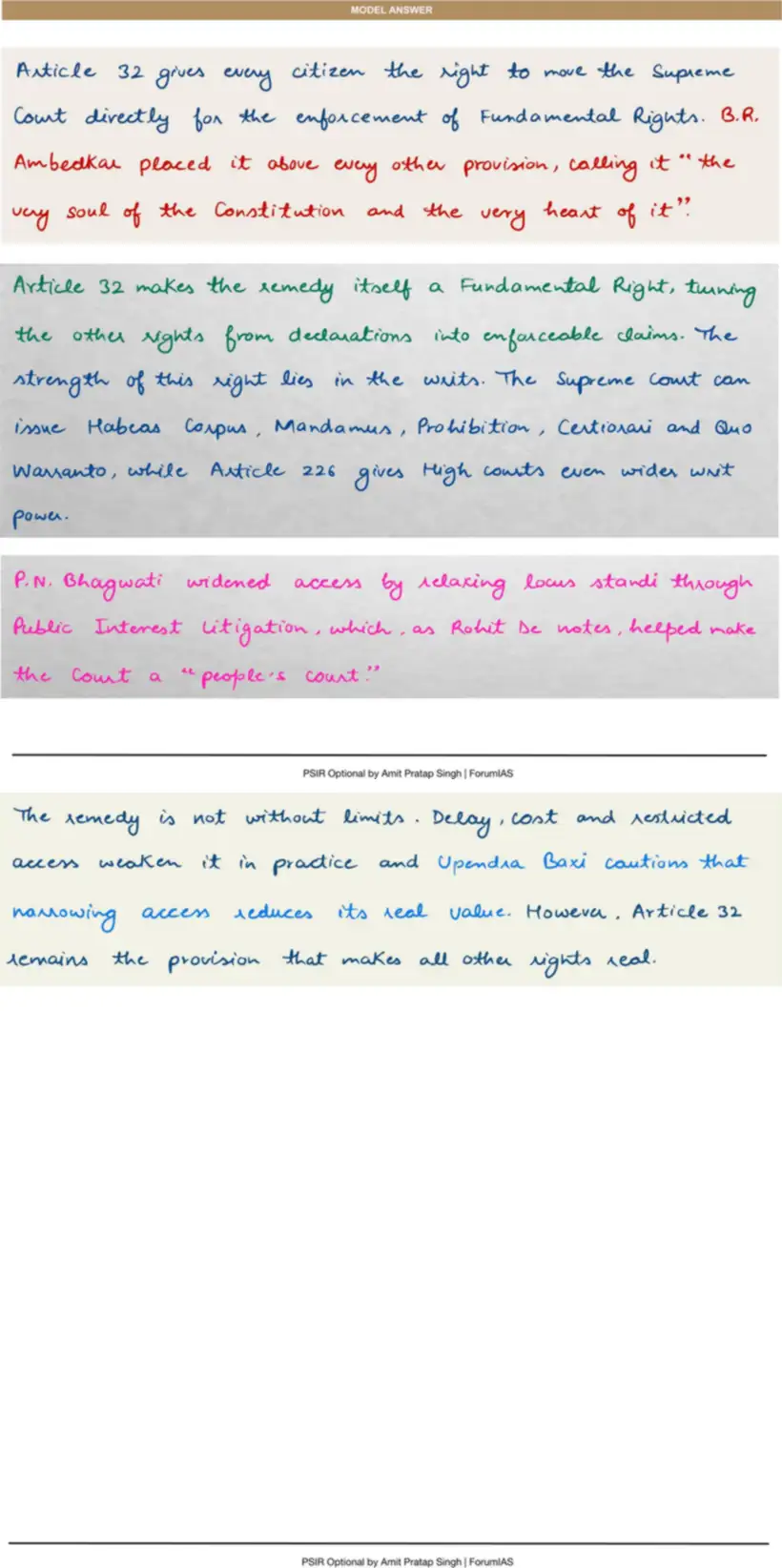
Route 1 Article 32 = direct SC access for FR enforcement → Ambedkar “soul / heart” → remedy itself made a Fundamental Right
Route 2 rights on paper vs enforceable rights → Article 32 converts declarations into claims
writs as the operative strength (Habeas Corpus → Mandamus → Prohibition → Certiorari → Quo Warranto) → Article 226 wider High Court power → Bhagwati / PIL relaxes locus standi → access widens → Rohit De “people’s court”
delay, cost, restricted access weaken the remedy in practice → Baxi: narrowing access cuts its real value
Route 1 enforceability is what makes Part III real → Article 32 the operative core
Route 2 a remedy is only as strong as access to it → guard access to keep rights real
Model answer
Handwritten, in the form it would be written in the examination hall.
Also asked on this head
Salient Features of the Indian Constitution — 17 questions in the Vault.
- The Constitution of India was secular even before the word was included in the Preamble. Comment. (150 words)
- How far do you agree that the Directive Principles of State Policy are more fundamental than the Fundamental Rights in meeting socio-economic justice as mentioned in...
- Legal remedies in Part III of the Constitution of India (150 words)
How this is taught
The same flow snapshot, built for every head of the syllabus, with the answer written in class.
The first session of Foundation 2027 is published in full.
Six programmes across three levels.