
Comment on the judicial overreach in India
How the answer moves
The flow snapshot — the routes in, the body, the counter-view and the routes out.
Route 1 define overreach = activism crossing constitutional limits into legislative/executive functions
Route 2 India = separation of functions + checks and balances → concern is not review but its expansion into governance
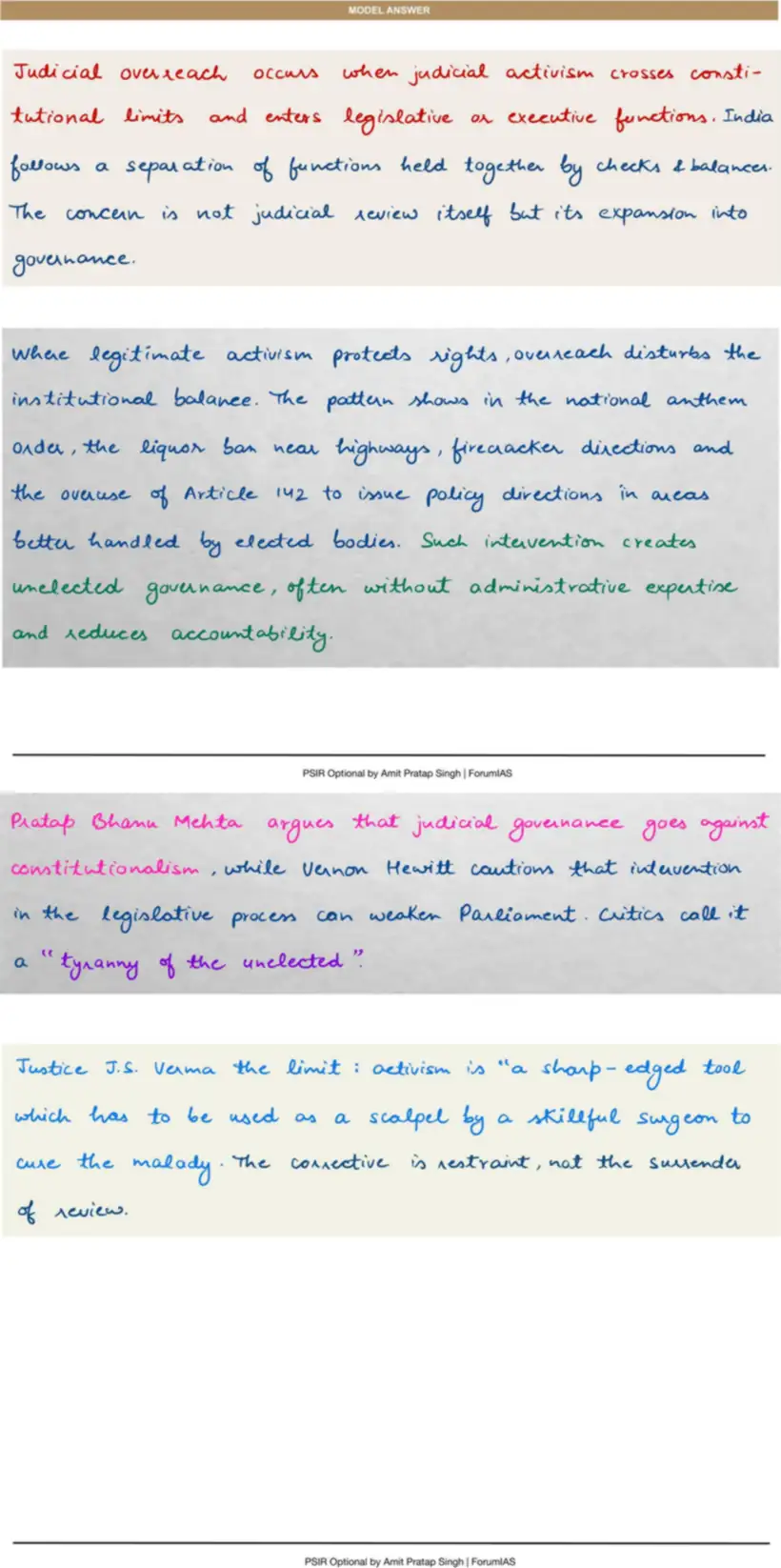
legitimate activism protects rights / overreach disturbs institutional balance → examples: national anthem order, highway liquor ban, firecracker directions, Article 142 overuse → effects: unelected governance, no administrative expertise, reduced accountability → Mehta (against constitutionalism) → Hewitt (weakens Parliament) → “tyranny of the unelected” → Verma’s scalpel-not-Rampuri-knife limit
activism is legitimate where rights are at stake; the problem is the line crossed, not review itself
Route 1 corrective is restraint, not surrender of judicial review
Route 2 curb the excess while preserving rights protection and review
Model answer
Handwritten, in the form it would be written in the examination hall.
Also asked on this head
Salient Features of the Indian Constitution — 17 questions in the Vault.
- The Constitution of India was secular even before the word was included in the Preamble. Comment. (150 words)
- How far do you agree that the Directive Principles of State Policy are more fundamental than the Fundamental Rights in meeting socio-economic justice as mentioned in...
- Legal remedies in Part III of the Constitution of India (150 words)
How this is taught
The same flow snapshot, built for every head of the syllabus, with the answer written in class.
The first session of Foundation 2027 is published in full.
Six programmes across three levels.