
The Preamble of the Indian Constitution reflects itself as a ‘social contract’. Elucidate.
How the answer moves
The flow snapshot — the routes in, the body, the counter-view and the routes out.
Route 1 “We, the People” → Constitution an act of the people, not imposed → popular sovereignty
Route 2 Preamble as a constitutional covenant → citizens constitute authority, state promises the four ideals
adopted / enacted / given to themselves → covenant: citizens create authority + accept democratic rule → state secures justice–liberty–equality–fraternity → people retain sovereignty → social-contract frame: Hobbes (order) → Locke (rights, limited govt) → Rousseau (general will) → Rawls (justice as fairness) → Indian traditions (Manu / Kautilya / Buddhist: obligation, public order)
not a purely Western import; Indian traditions widen the idea → and the contract here is constitutional + democratic + welfare-oriented, not a Hobbesian surrender of liberty
Route 1 Preamble not passive → it fixes legitimacy, purpose and limits of government
Route 2 covenant binding citizens and state → a constitutional, democratic, welfare-oriented social contract
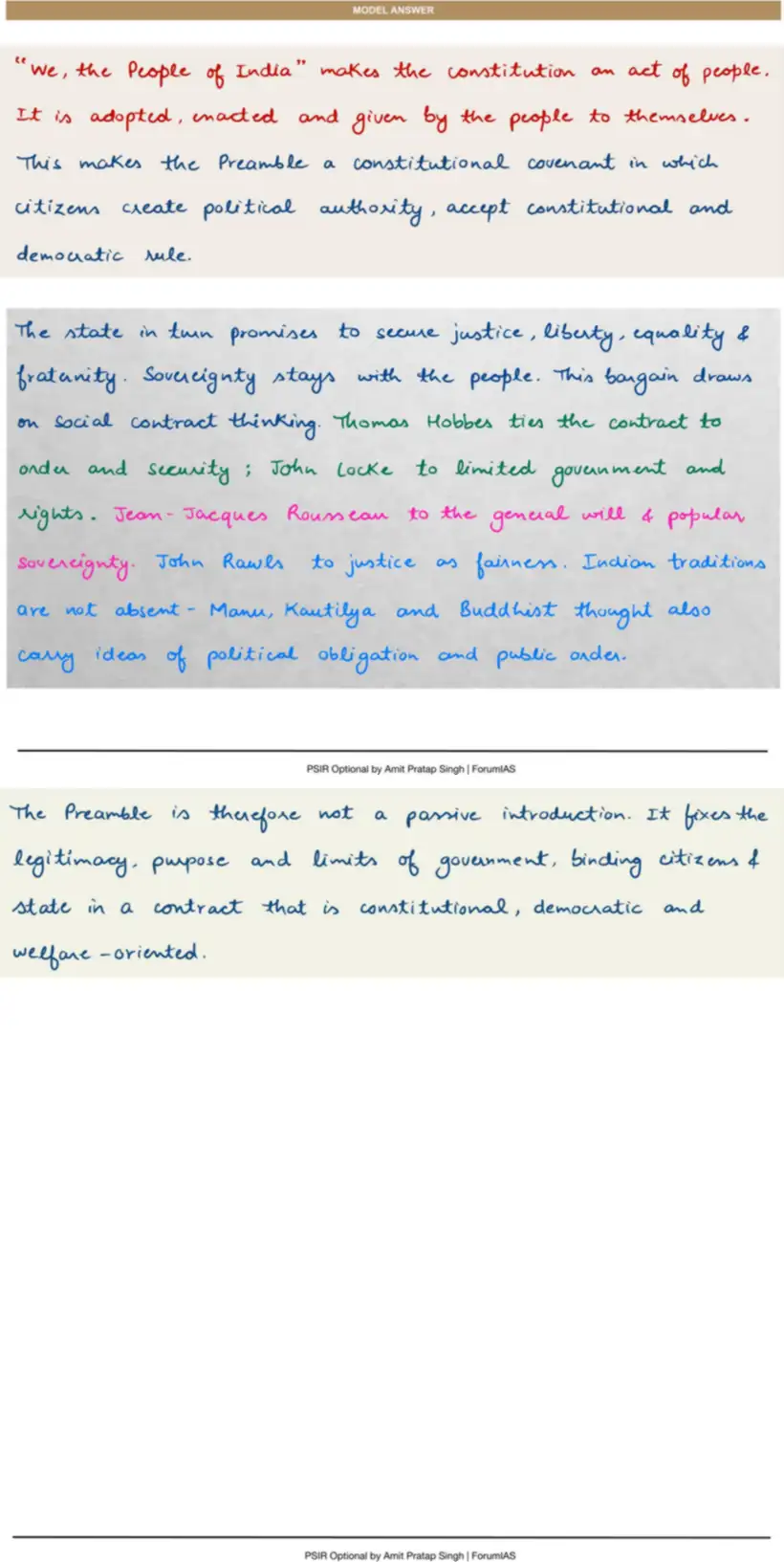
Model answer
Handwritten, in the form it would be written in the examination hall.
Also asked on this head
Salient Features of the Indian Constitution — 17 questions in the Vault.
- The Constitution of India was secular even before the word was included in the Preamble. Comment. (150 words)
- How far do you agree that the Directive Principles of State Policy are more fundamental than the Fundamental Rights in meeting socio-economic justice as mentioned in...
- Legal remedies in Part III of the Constitution of India (150 words)
How this is taught
The same flow snapshot, built for every head of the syllabus, with the answer written in class.
The first session of Foundation 2027 is published in full.
Six programmes across three levels.