
Enunciate the impediments to women’s participation in local governance in the process of political decentralisation.
How the answer moves
The flow snapshot — the routes in, the body, the counter-view and the routes out.
Route 1 73rd/74th reserved 1/3 seats + chairperson posts → 10 lakh+ women entered → presence achieved
Route 2 decentralisation widened entry, not participation → impediments sit in the gap between presence and power
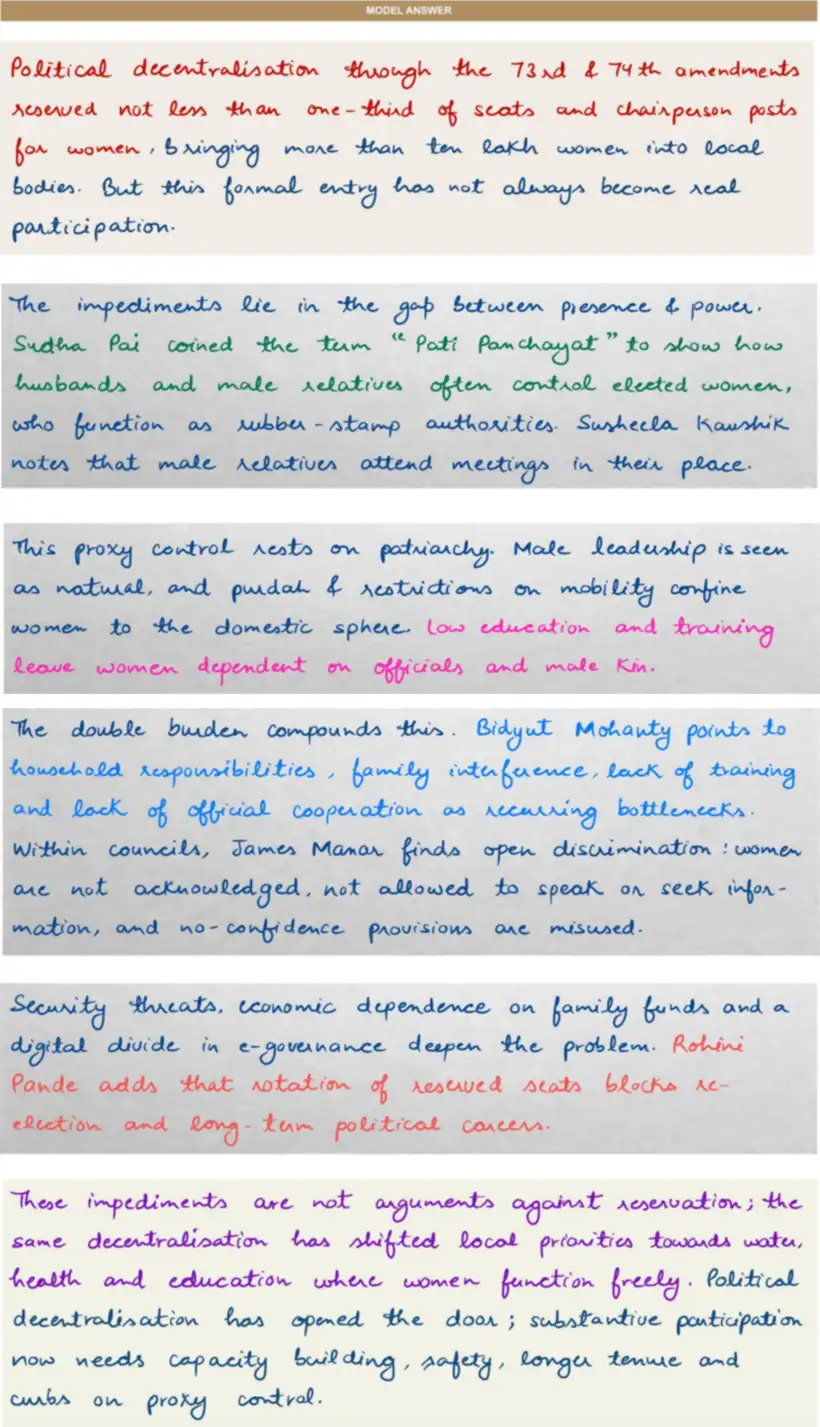
proxy control most visible (“Pati Panchayat”, Sudha Pai; male relatives attend — Susheela Kaushik) → rests on patriarchy (purdah, mobility curbs, male-leadership-as-natural; 2004 Haryana study) → capability deficit (low education/training → dependence on officials + male kin) → double burden (household + family interference + no official cooperation — Bidyut Mohanty) → institutional hostility inside councils (presence unacknowledged, not allowed to speak/seek info, no-confidence misused — James Manor) → security + economic dependence + digital divide → structural flaw: rotation of reserved seats blocks re-election (Rohini Pande)
impediments are not a case against reservation → same decentralisation shifted local priorities (water/health/education) where women act freely → barriers are removable, not inherent
Route 1 door opened by decentralisation; substantive participation needs the second step — capacity, safety, longer tenure, curbing proxy
Route 2 reservation gave the seat; converting seat into voice means breaking patriarchy + institutional resistance
Model answer
Handwritten, in the form it would be written in the examination hall.
Also asked on this head
Grassroots Democracy — 13 questions in the Vault.
- Ending proxy leadership in Panchayati Raj is a necessary step towards true grassroots democracy. Comment. (150 words)
- Gram Sabha in the Panchayati Raj system is a forum which gives expression to the collective wisdom, aspirations and the will of the people. Comment.
- Discuss the major provisions of the 74th Constitutional Amendment Act. Do you think that the Act remains an ‘unfulfilled dream’? Argue your case.
How this is taught
The same flow snapshot, built for every head of the syllabus, with the answer written in class.
The first session of Foundation 2027 is published in full.
Six programmes across three levels.