
Has the increased participation of the underprivileged in the political process of the developing societies strengthened democracy or created political chaos and conflict? Comment.
How the answer moves
The flow snapshot — the routes in, the body, the counter-view and the routes out.
Route 1 post-1980s democratisation wave → participation central to democracy → underprivileged drawn in → deepening, not decay
Route 2 entry of the excluded looks like disorder → but it is democracy widening its base → strengthening, not breakdown
inclusion widened → Yadav “democratic upsurge” → Kothari caste mobilisation → electoral integration → raised negotiating power → chaos surfaces: Mandal reservation clash + communal violence + mobocracy (Naipaul) → Huntington: not political decay → Riggs: not a “development trap” → India deepens democracy through the churn → weak democracies (Pakistan/Myanmar) = military-bureaucratic oligarchy, not mass participation → Gramsci: subaltern participation = first condition of emancipation
participation as mobocracy — caste-reservation and communal conflict, competitive identity politics (Naipaul) → set against participation as empowerment and democratic deepening (Yadav, Kothari, Gramsci)
Route 1 underprivileged strengthened democracy → conflict is the friction of deepening, not chaos
Route 2 churn is the price of inclusion → contained within democracy → empowerment over decay
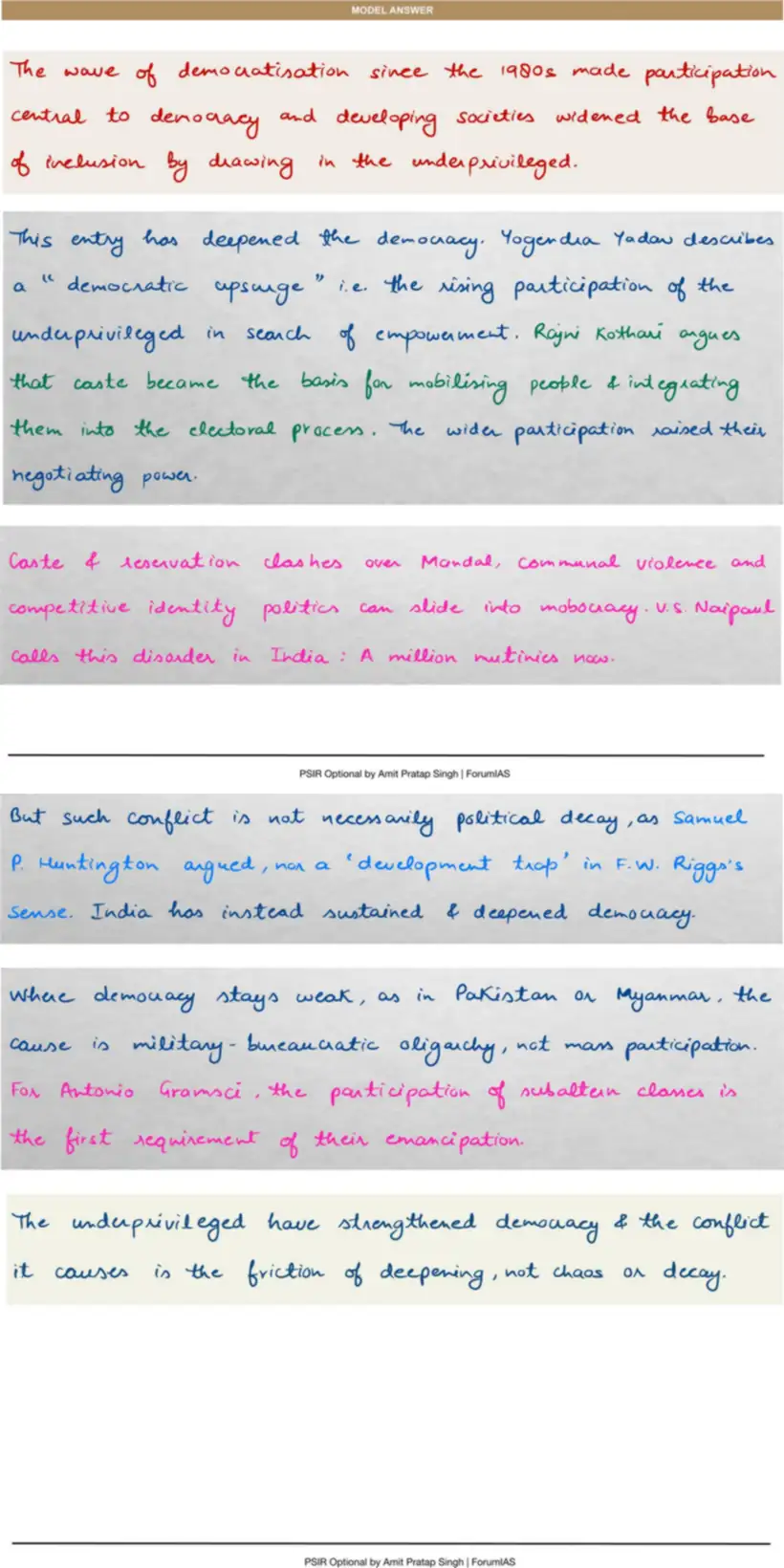
Model answer
Handwritten, in the form it would be written in the examination hall.
Also asked on this head
Politics of Representation and Participation — 14 questions in the Vault.
- Clientilism (150 words)
- How does democratic politics construct citizenship? (150 words)
- Of late, centrist and centre-left political parties have been facing setbacks while centre-right parties have been in ascendency the world over. Comment.
How this is taught
The same flow snapshot, built for every head of the syllabus, with the answer written in class.
The first session of Foundation 2027 is published in full.
Six programmes across three levels.