
Discuss the role of social movements in strengthening the democratic processes in developing societies.
How the answer moves
The flow snapshot — the routes in, the body, the counter-view and the routes out.
Route 1 developing democracy often procedural, limited to voting → movements as the chief non-party channel carrying democracy beyond the ballot
Route 2 define social movement (change / new order / resist) → excluded sections unheard between elections → movements give democracy real content
Kothari: social movements as non-party political processes → marginalised bypass elite-captured institutions, shape policy from outside → platform for minorities adds legitimacy + effectiveness → Tarrow: spread of democratic rights makes the state the target → Tilly: high-capacity states absorb collective action, low-capacity states breed violence → illustrations: Myanmar / Section 377–LGBT gap parties ignored / Anna Hazare → AAP → new communication tech fuels more direct democracy
role not unqualified → movements can turn anti-democratic (Nepal, parts of Africa → civil war) → Bayat: without deeper political-economic change, goals stay out of reach
Route 1 movements deepen participation beyond procedure → strengthen democracy in developing societies
Route 2 outcome hinges on state capacity + restraint → supplement, not replace, formal channels
Model answer
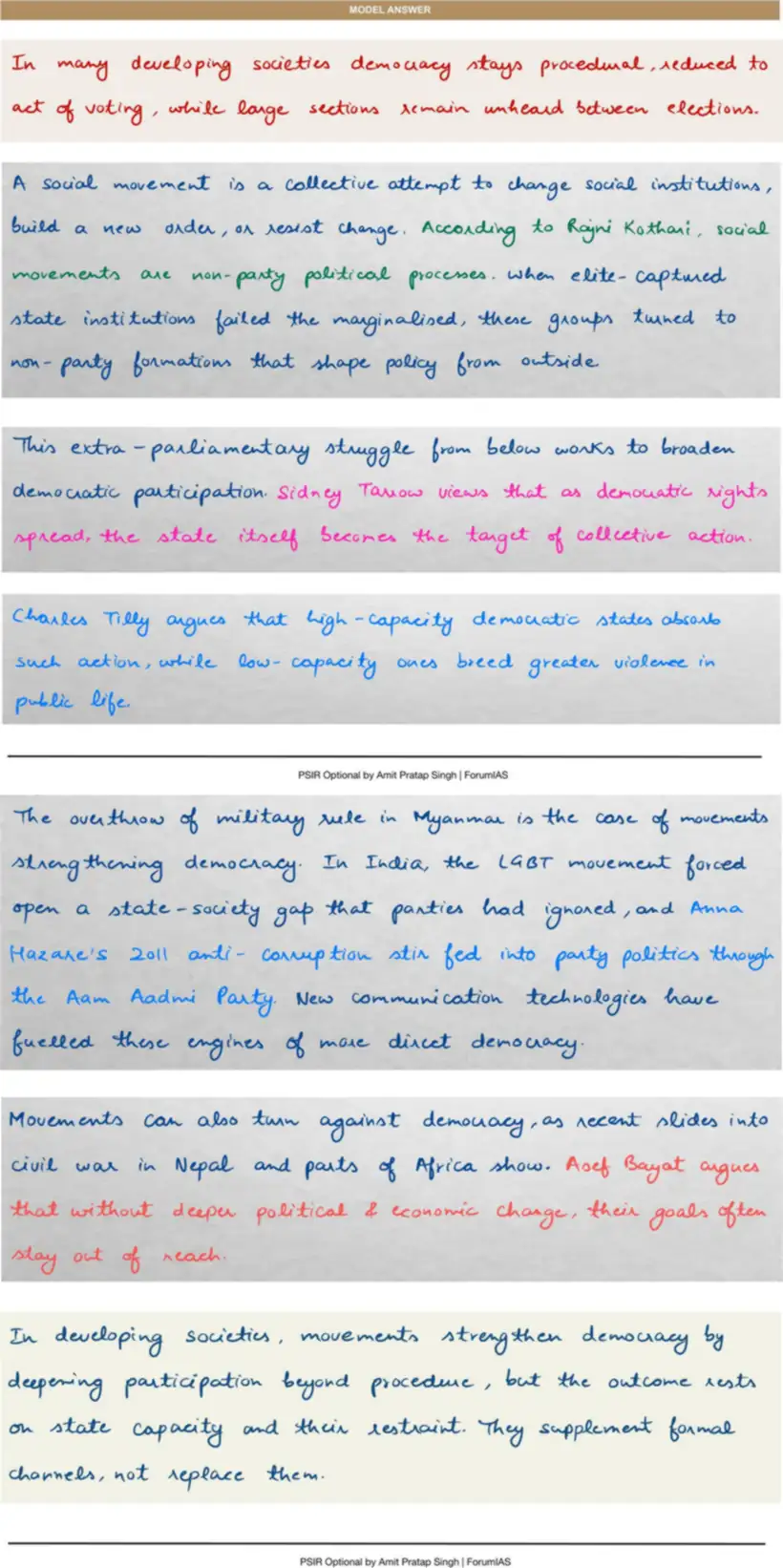
Handwritten, in the form it would be written in the examination hall.
Also asked on this head
Politics of Representation and Participation — 14 questions in the Vault.
- Clientilism (150 words)
- How does democratic politics construct citizenship? (150 words)
- Of late, centrist and centre-left political parties have been facing setbacks while centre-right parties have been in ascendency the world over. Comment.
How this is taught
The same flow snapshot, built for every head of the syllabus, with the answer written in class.
The first session of Foundation 2027 is published in full.
Six programmes across three levels.