
How big a role does identity play in determining political participation in the developing countries? Discuss your answer with suitable illustrations.
How the answer moves
The flow snapshot — the routes in, the body, the counter-view and the routes out.
Route 1 West runs on rule of law → developing world runs on identity → identity fills the gap
Route 2 legal institutions weakly rooted → identity becomes the key channel of participation → decisive role
Pye: non-Western process communal / loyalty-based → mobilise on identity, not issues → Chatterjee: civil society vs political society → political society (hawkers, slum dwellers) thrives on identity → India (Kothari’s caste + Ambedkar’s Dalit mobilisation, affirmative action) → Nigeria (Anderson’s “imagined communities” / ethnic) → Lebanon (confessional sectarian quota)
Huntington’s double edge → empowers the marginalised vs deepens divisions / weakens national unity
Route 1 role large and defining, not marginal
Route 2 worth conditional → widens participation or hardens cleavages
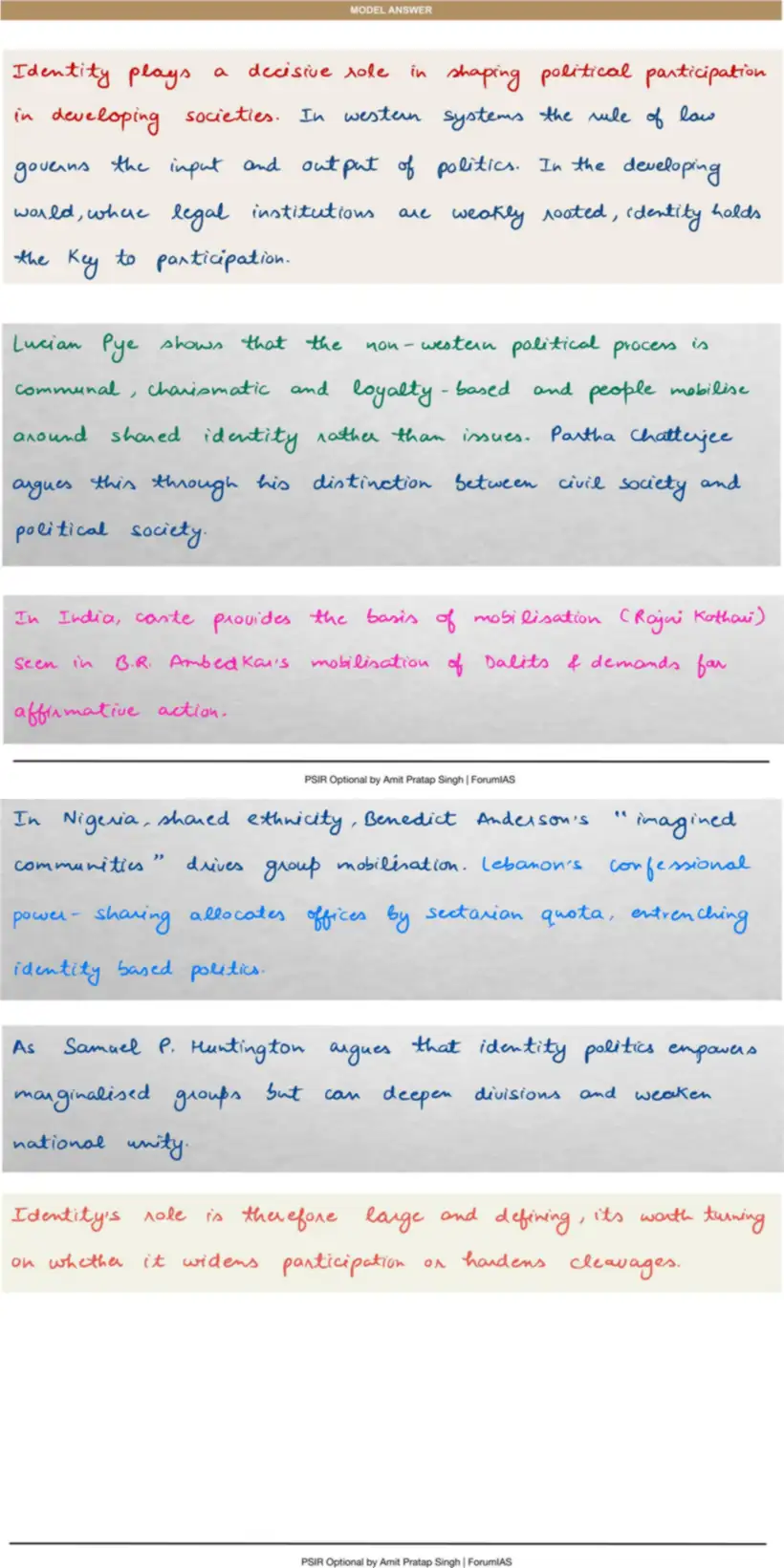
Model answer
Handwritten, in the form it would be written in the examination hall.
Also asked on this head
Politics of Representation and Participation — 14 questions in the Vault.
- Clientilism (150 words)
- How does democratic politics construct citizenship? (150 words)
- Of late, centrist and centre-left political parties have been facing setbacks while centre-right parties have been in ascendency the world over. Comment.
How this is taught
The same flow snapshot, built for every head of the syllabus, with the answer written in class.
The first session of Foundation 2027 is published in full.
Six programmes across three levels.