
Explain the reasons for low voter turnout in democratic countries with suitable examples.
How the answer moves
The flow snapshot — the routes in, the body, the counter-view and the routes out.
Route 1 turnout read as a health-check of democracy → its steady fall has no single cause → symptom of a widening citizen–institution distance
Route 2 voting = the minimal act of democratic participation → decline across mature democracies → citizens quietly drifting from the ballot
disillusionment / apathy (Putnam — falling social capital, EU Parliament polls) → institutional barriers (Piven & Cloward — registration, timing, voter-ID; low-income & minority hit) → voter fatigue (Franklin — Switzerland) → contentment (Inglehart — post-materialism, Japan) → crisis of legitimacy (Habermas — Occupy / Yellow Vests → far-right resentment, Trump / Le Pen → distant political class)
low turnout not always decay → contentment, not only disaffection or exclusion → some abstention signals satisfaction with the status quo
Route 1 cure lies in substance, not compulsion → Sen — democracy as a good in itself → electoral-funding reform, wider representation, civil society
Route 2 turnout a mixed signal → exclusion + disaffection outweigh contentment → reconnect citizens to institutions to revive the vote
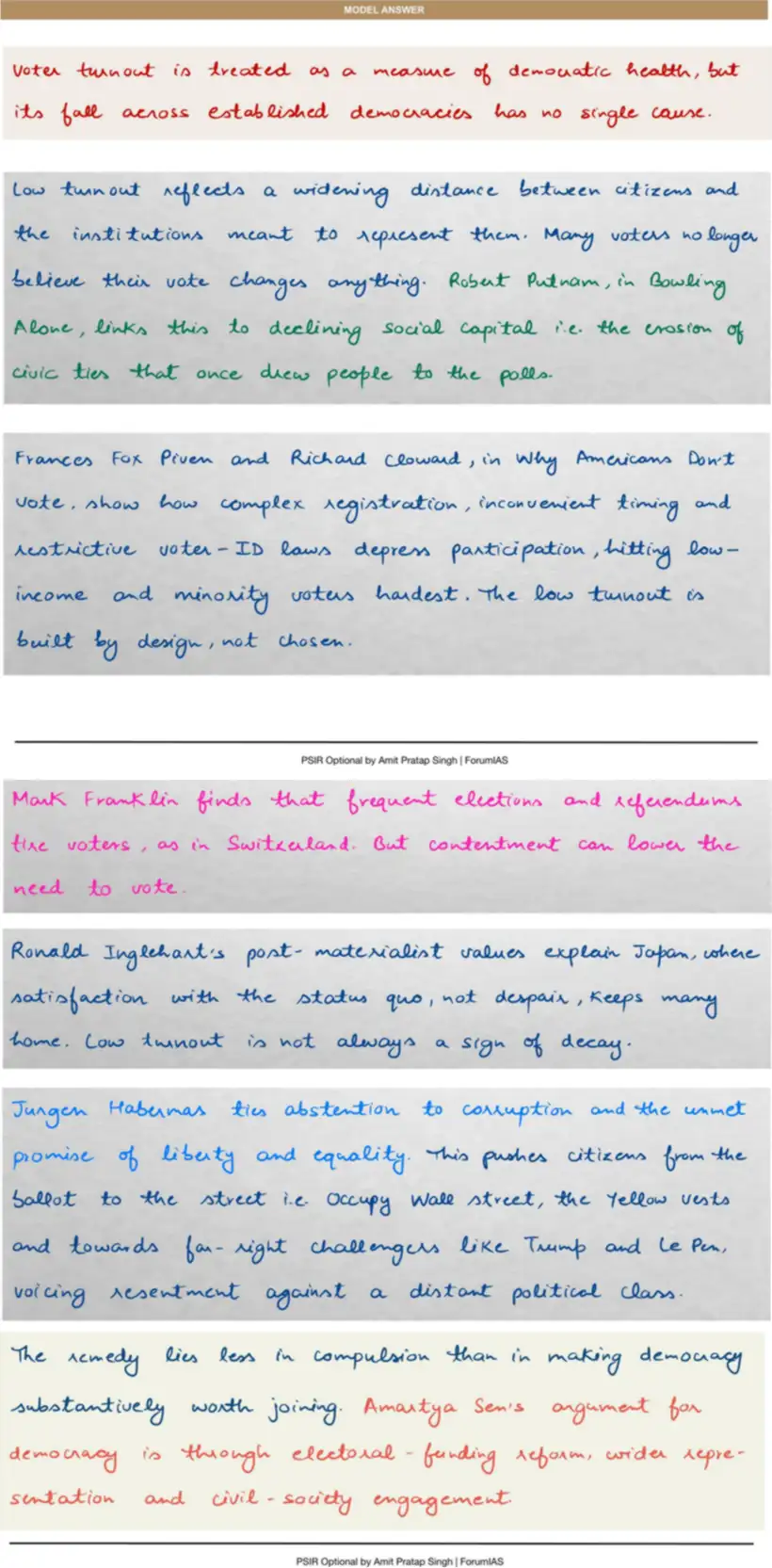
Model answer
Handwritten, in the form it would be written in the examination hall.
Also asked on this head
Politics of Representation and Participation — 14 questions in the Vault.
- Clientilism (150 words)
- How does democratic politics construct citizenship? (150 words)
- Of late, centrist and centre-left political parties have been facing setbacks while centre-right parties have been in ascendency the world over. Comment.
How this is taught
The same flow snapshot, built for every head of the syllabus, with the answer written in class.
The first session of Foundation 2027 is published in full.
Six programmes across three levels.