
“Political parties and pressure groups are sine qua non of democracy.’ Comment.
How the answer moves
The flow snapshot — the routes in, the body, the counter-view and the routes out.
Route 1 democracy = organised choice → parties + pressure groups the two channels that make choice possible
Route 2 claim restated → both are the indispensable machinery linking citizens to power
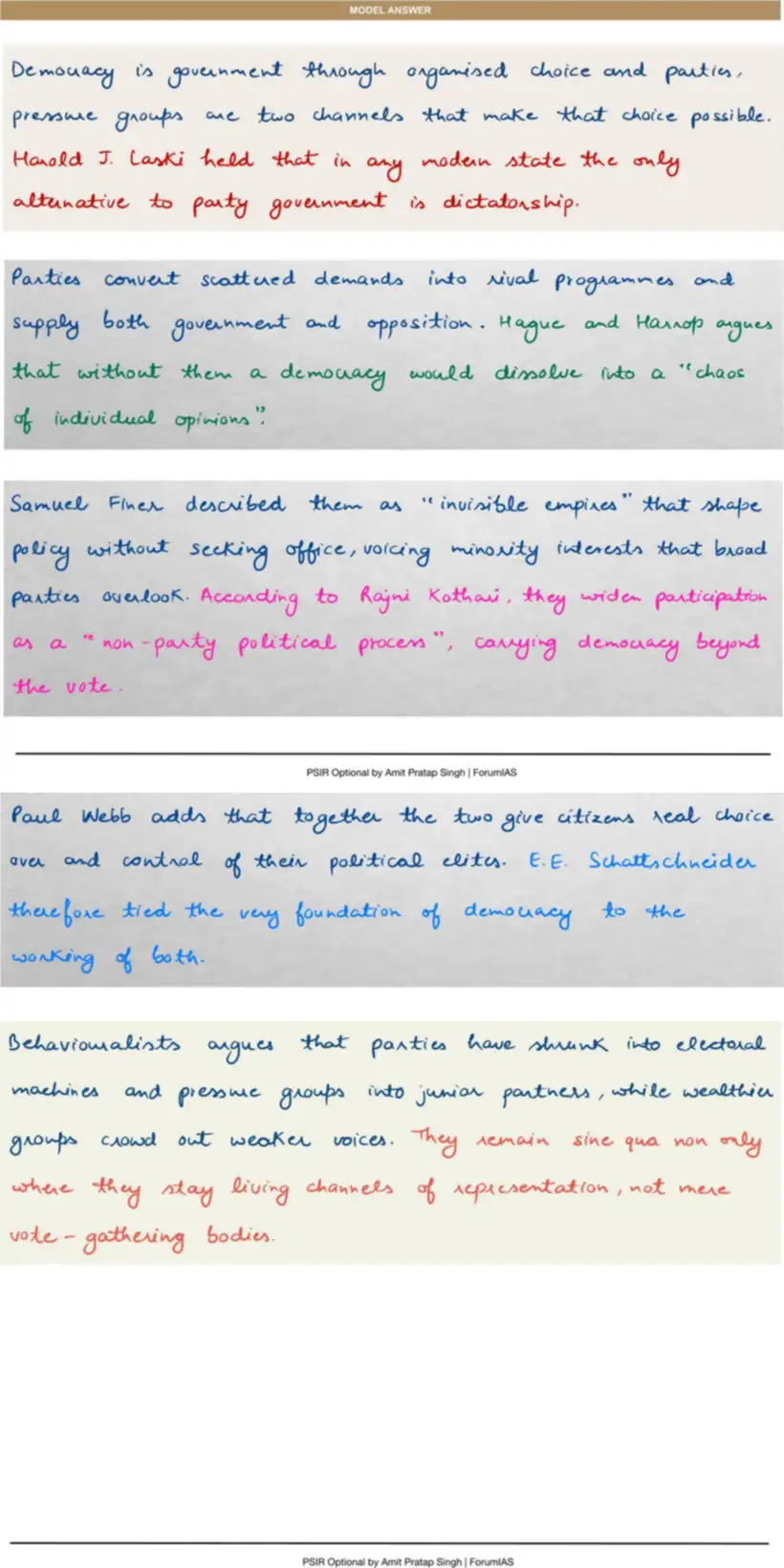
Laski: only alternative to party government is dictatorship → parties convert demands → programmes, supply govt + opposition → Hague & Harrop: without parties, “chaos of individual opinions” → pressure groups complete the machinery → Finer “invisible empires”: policy influence without office, voice minorities parties overlook → Kothari: widen participation, “non-party political process,” beyond the vote → Webb: together they give citizens control over elites → Schattschneider: democracy’s foundation tied to both
behaviouralist caution: parties → electoral machines, pressure groups → junior partners → wealthier groups crowd out weaker voices → indispensability is conditional
Route 1 sine qua non only as living channels of representation, not vote-gathering bodies
Route 2 statement holds, but form must serve function — revive the representative/movement character
Model answer
Handwritten, in the form it would be written in the examination hall.
Also asked on this head
Politics of Representation and Participation — 14 questions in the Vault.
- Clientilism (150 words)
- How does democratic politics construct citizenship? (150 words)
- Of late, centrist and centre-left political parties have been facing setbacks while centre-right parties have been in ascendency the world over. Comment.
How this is taught
The same flow snapshot, built for every head of the syllabus, with the answer written in class.
The first session of Foundation 2027 is published in full.
Six programmes across three levels.