
Examine the LGBT (Lesbian, Gay, Bisexual and Transgender) movement in developed societies and how it is affecting the political participation in developing societies.
How the answer moves
The flow snapshot — the routes in, the body, the counter-view and the routes out.
Route 1 LGBT movement = new social movement of the developed West → quality of life over material demand
Route 2 its real weight for developing societies → how it widens who takes part in politics
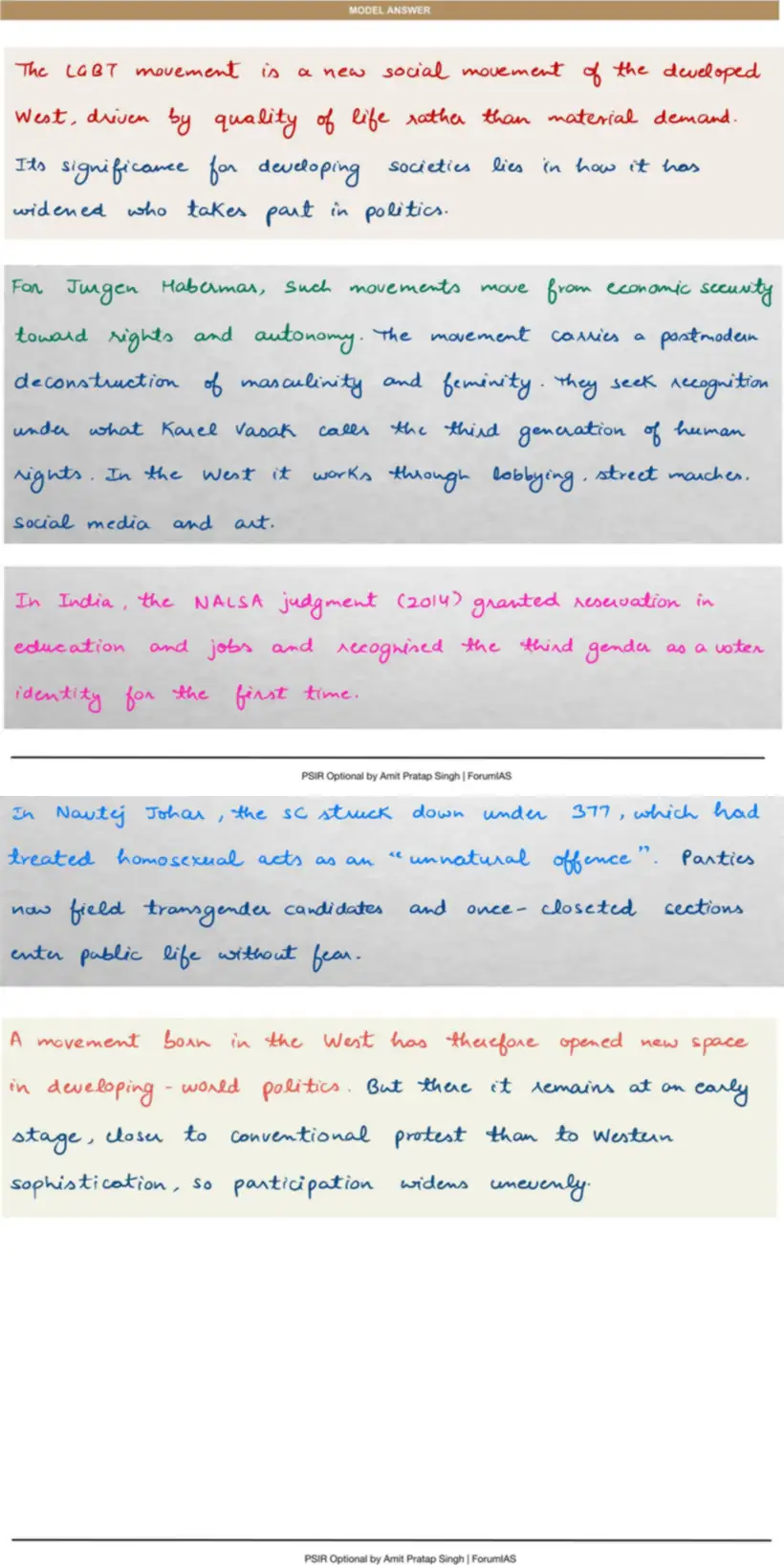
Habermas: economic security → rights + autonomy → postmodern deconstruction of masculinity/femininity → recognition under the third generation of human rights (Vasak) → Western methods: lobbying / marches / social media / art → fills state-society gap parties ignored → India: NALSA 2014 (reservation + third gender as first-time voter identity) → Navtej Singh Johar (Section 377 struck down) → participation widens: transgender candidates, closeted sections enter public life
in developing societies NSMs still nascent → closer to conventional protest than Western sophistication → gains uneven
Route 1 Western-born movement opens new political space in the developing world
Route 2 recognition abroad → participation at home, but widening stays uneven
Model answer
Handwritten, in the form it would be written in the examination hall.
Also asked on this head
Politics of Representation and Participation — 14 questions in the Vault.
- Clientilism (150 words)
- How does democratic politics construct citizenship? (150 words)
- Of late, centrist and centre-left political parties have been facing setbacks while centre-right parties have been in ascendency the world over. Comment.
How this is taught
The same flow snapshot, built for every head of the syllabus, with the answer written in class.
The first session of Foundation 2027 is published in full.
Six programmes across three levels.