
Critically examine the role of political parties in sustaining and stabilising democracies in the developing societies.
How the answer moves
The flow snapshot — the routes in, the body, the counter-view and the routes out.
Route 1 parties = bridge between State & citizenry → participation, representation, accountability
Route 2 survival of democracy turns on party institutionalisation, not mere presence
Huntington: parties institutionalise mass participation = order → mobilisation outrunning institutions = disorder, party-less = coup-prone → Dahl (polyarchy): plurality bridges social/economic/ethnic groups, cuts marginalisation → Diamond: party competition = accountability = long-term stability
developing-world reality blunts these functions → Sandbrook: personalism over ideology + Webb: parties as personal/dynastic property → erodes accountability → Migdal (“strong societies, weak states”): clientelism/patronage stalls consolidation → Horowitz (“ethnic outbidding”): parties deepen polarisation instead of bridging cleavages
Route 1 role genuine but conditional → not parties as such but institutionalised parties sustain democracy
Route 2 India holds democracy through party churn → institutionalisation the deciding factor; without it, parties destabilise
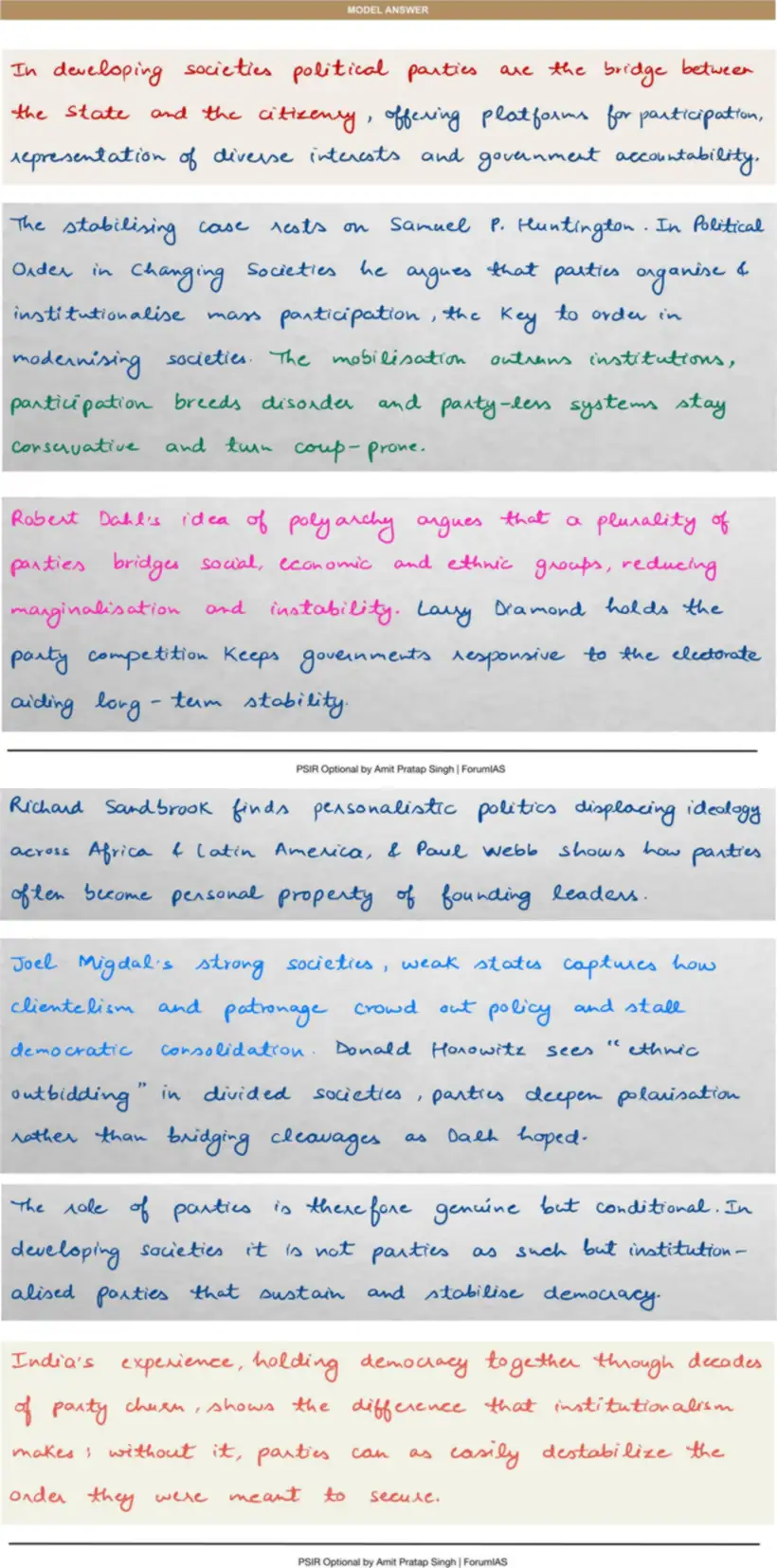
Model answer
Handwritten, in the form it would be written in the examination hall.
Also asked on this head
Politics of Representation and Participation — 14 questions in the Vault.
- Clientilism (150 words)
- How does democratic politics construct citizenship? (150 words)
- Of late, centrist and centre-left political parties have been facing setbacks while centre-right parties have been in ascendency the world over. Comment.
How this is taught
The same flow snapshot, built for every head of the syllabus, with the answer written in class.
The first session of Foundation 2027 is published in full.
Six programmes across three levels.