
Explain the impact of electoral systems and cleavages in shaping party systems with reference to developing countries.
How the answer moves
The flow snapshot — the routes in, the body, the counter-view and the routes out.
Route 1 party system = relevant parties (Sartori), not raw count → two shapers: electoral rules + cleavages
Route 2 electoral design vs social division → their interaction, not either alone → developing ≠ West
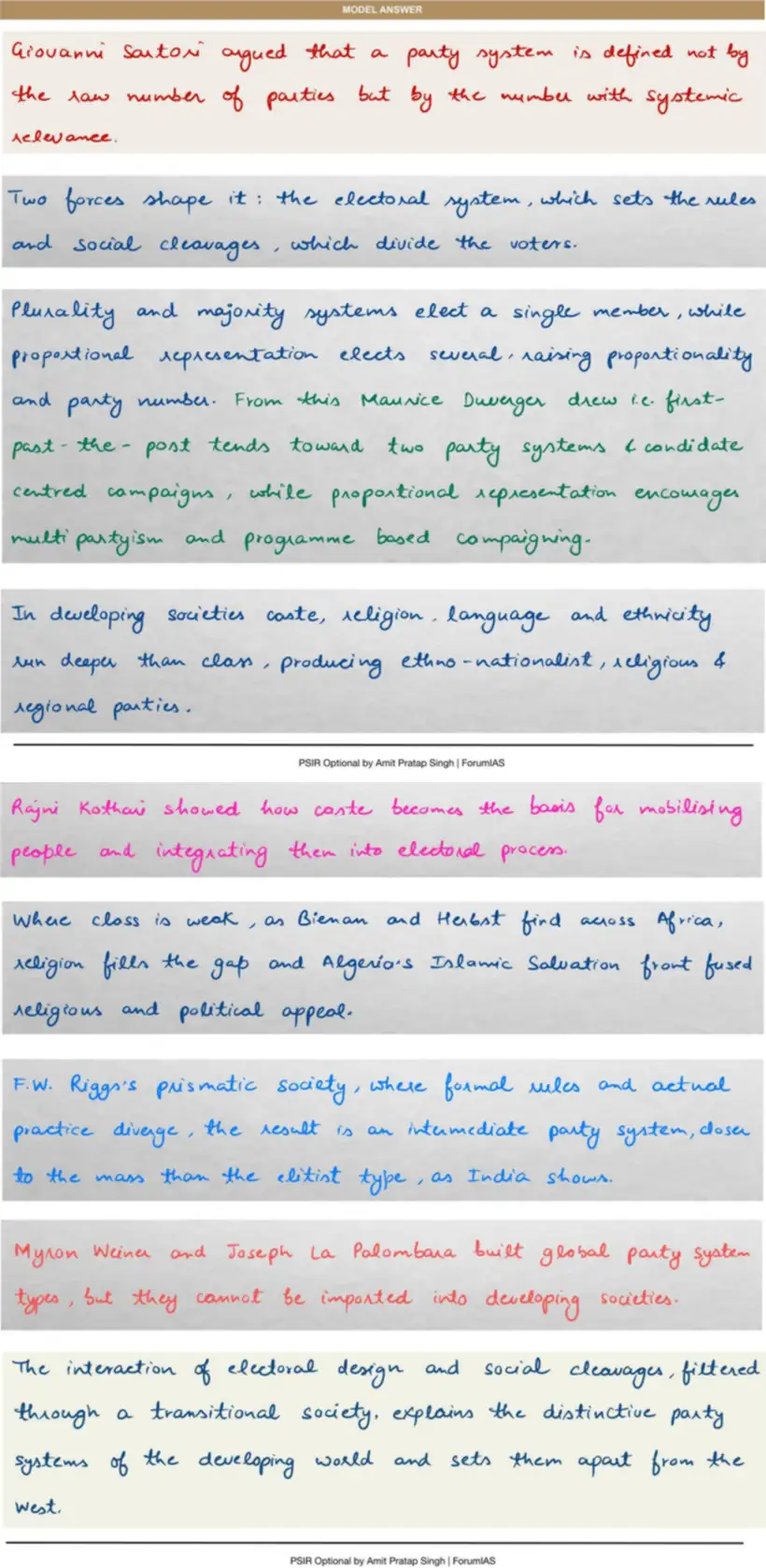
district magnitude decisive → FPTP single-member vs PR multi-member → Duverger’s law (FPTP → two-party + candidate-centred; PR → multiparty + programme-based) → India deviation (no clean two-party; dominant-party ↔ coalition) → rule alone insufficient → cleavage = historical social line → caste/religion/language/ethnicity deeper than class → ethno-nationalist/religious/regional parties → Kothari (caste as mobilisation + electoral integration) → Bienen & Herbst (class weak in Africa) → religion fills gap (Algeria’s ISF) → FPTP + cleavages + Riggs’s prismatic society/formalism → intermediate party (closer to mass than elitist; India)
universal typologies exist (Weiner & La Palombara) vs same design + deep cleavages give context-specific systems that cannot be imported
Route 1 electoral design × cleavages, filtered through transitional society → distinctive developing-country systems
Route 2 interaction, not electoral rule alone → sets developing world apart from the West
Model answer
Handwritten, in the form it would be written in the examination hall.
Also asked on this head
Politics of Representation and Participation — 14 questions in the Vault.
- Clientilism (150 words)
- How does democratic politics construct citizenship? (150 words)
- Of late, centrist and centre-left political parties have been facing setbacks while centre-right parties have been in ascendency the world over. Comment.
How this is taught
The same flow snapshot, built for every head of the syllabus, with the answer written in class.
The first session of Foundation 2027 is published in full.
Six programmes across three levels.