
How the answer moves
The flow snapshot — the routes in, the body, the counter-view and the routes out.
Route 1 liberal-egalitarian puzzle → how can fairness permit any inequality
Route 2 discrimination just only if it lifts the least advantaged → inequality as instrument of equality
moral arbitrariness of talent / birth → Difference Principle = democratic equality → not charity but reciprocity → Barry’s chain principle → forms: affirmative action, taxation, welfare, reservations → liberty lexically prior → sits between socialism and libertarianism
Nozick (talents as common assets, entitlement violated) vs Sen (primary goods miss capability)
Route 1 inequality conditional on the good of the worst-off → corrective for arbitrary disadvantage
Route 2 discrimination defensible only as correction → makes liberalism more humane
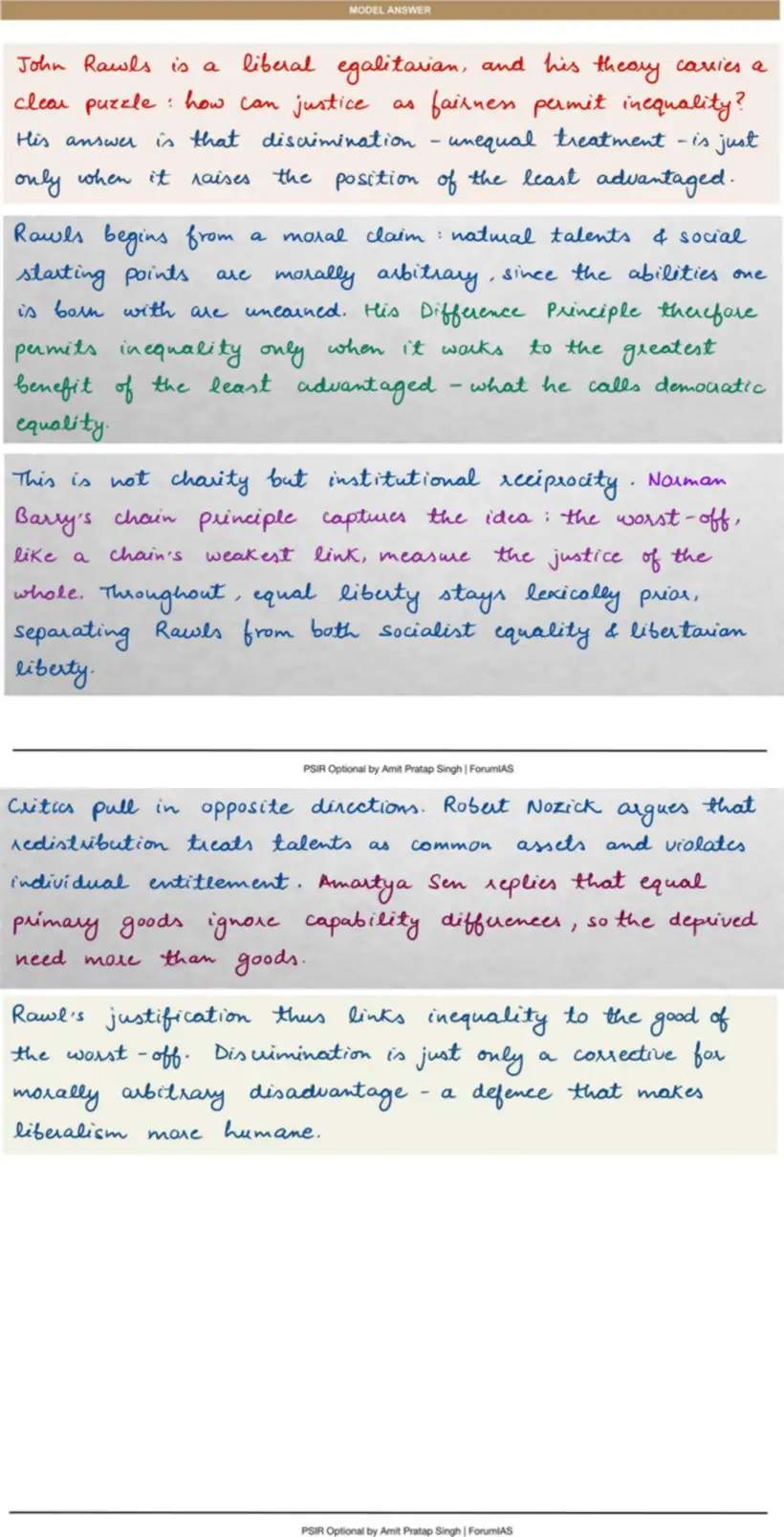
Model answer
Handwritten, in the form it would be written in the examination hall.
Also asked on this head
Justice — 11 questions in the Vault.
- Explain how Rawls used the liberal and egalitarian perspective to develop his concept of distributive justice.
- Rawls’ idea of the ‘liberal self’ is too individualistic. Explain, in this context, the communitarian critique of Rawls’ theory of justice.
- Dr. Ambedkar’s idea of social justice leads to ‘egalitarian justice’ as compared to Rawls’ ‘justice as fairness’ which aims at the notion of ‘pure procedural justice’....
How this is taught
The same flow snapshot, built for every head of the syllabus, with the answer written in class.
The first session of Foundation 2027 is published in full.
Six programmes across three levels.