
How the answer moves
The flow snapshot — the routes in, the body, the counter-view and the routes out.
Route 1 fair allocation of benefits + burdens → Aristotle’s classical form, distinct from corrective justice
Route 2 not whether to distribute but on what basis → the criterion is the real question
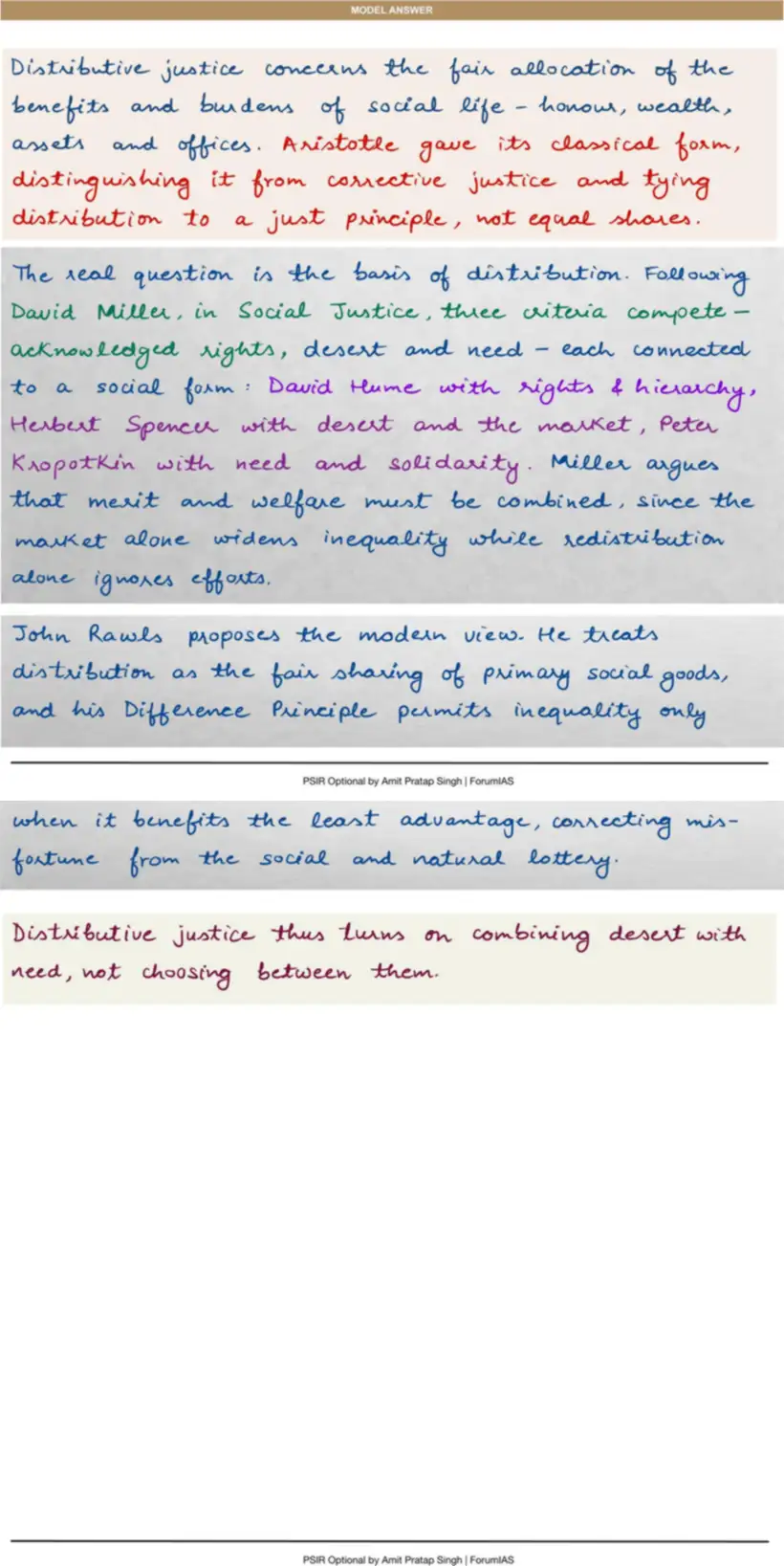
definition (honour / wealth / assets / offices) → Miller’s three criteria: rights / desert / need → mapping: Hume-rights-hierarchy / Spencer-desert-market / Kropotkin-need-solidarity → Miller’s synthesis (merit + welfare) → Rawls: primary goods → Difference Principle → least advantaged → social + natural lottery
single-criterion positions pull apart → market-desert (Spencer) vs need (Kropotkin) → neither market alone nor redistribution alone suffices
Route 1 distributive justice = combining desert with need, not choosing
Route 2 modern theory (Miller, Rawls) leans to synthesis — efficiency with fairness for the worst-off
Model answer
Handwritten, in the form it would be written in the examination hall.
Also asked on this head
Justice — 11 questions in the Vault.
- Explain how Rawls used the liberal and egalitarian perspective to develop his concept of distributive justice.
- Rawls’ idea of the ‘liberal self’ is too individualistic. Explain, in this context, the communitarian critique of Rawls’ theory of justice.
- Dr. Ambedkar’s idea of social justice leads to ‘egalitarian justice’ as compared to Rawls’ ‘justice as fairness’ which aims at the notion of ‘pure procedural justice’....
How this is taught
The same flow snapshot, built for every head of the syllabus, with the answer written in class.
The first session of Foundation 2027 is published in full.
Six programmes across three levels.