
How the answer moves
The flow snapshot — the routes in, the body, the counter-view and the routes out.
Route 1 justice as history of holdings, not a pattern → Locke, inviolable rights
Route 2 entitlement vs patterned / end-state justice → just history, not just shape
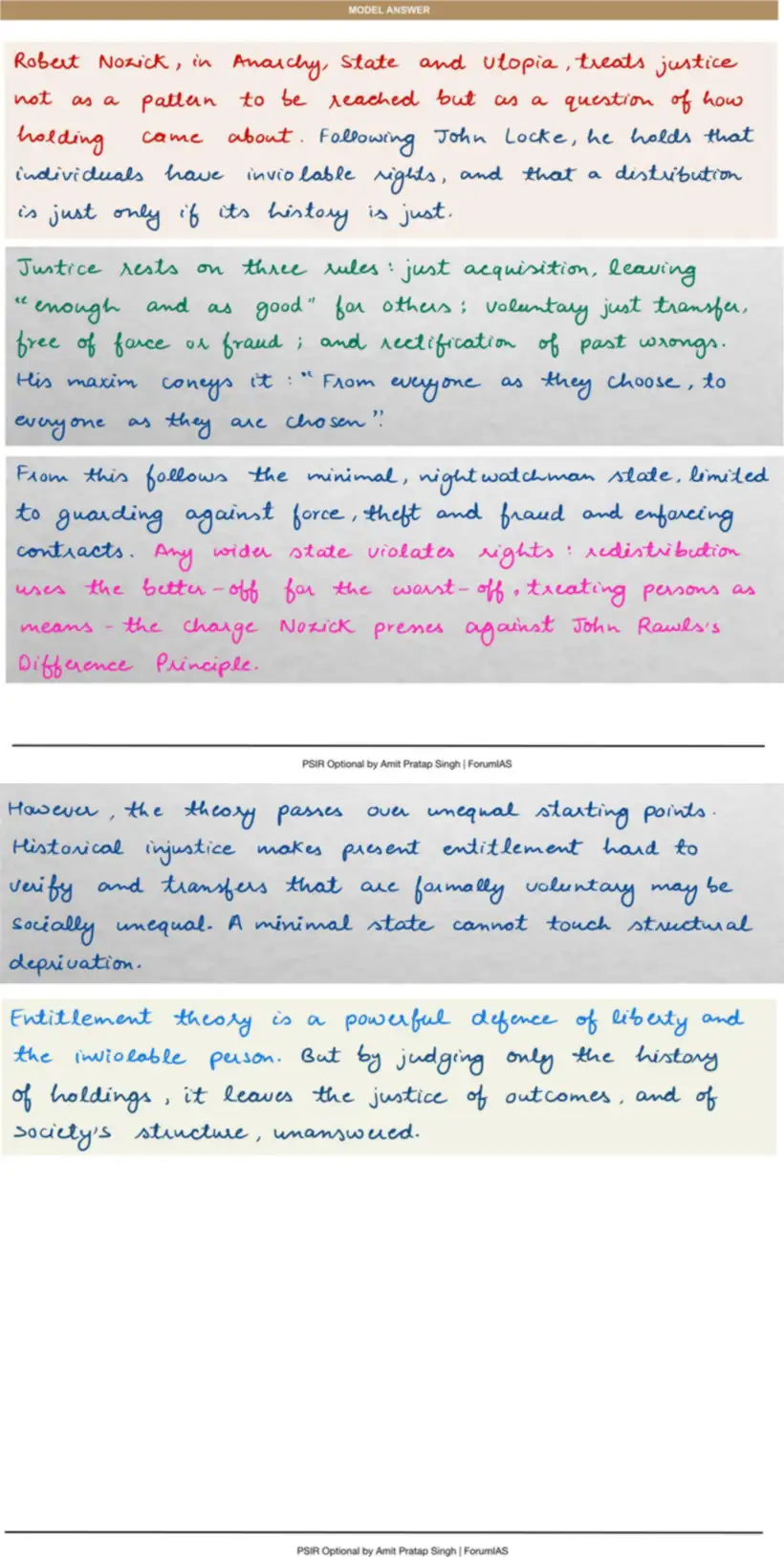
reject patterned / end-state → three principles (acquisition → transfer → rectification) → maxim → fair process makes inequality untroubling → minimal nightwatchman state → redistribution as means-to-ends → critique of Rawls’ Difference Principle
ignores unequal starting points → historical injustice unverifiable → “voluntary” transfers may be socially unequal → minimal state blind to structural deprivation
Route 1 strong defence of liberty / silent on outcomes
Route 2 protects the person / leaves society’s basic structure unjudged
Model answer
Handwritten, in the form it would be written in the examination hall.
Also asked on this head
Justice — 11 questions in the Vault.
- Explain how Rawls used the liberal and egalitarian perspective to develop his concept of distributive justice.
- Rawls’ idea of the ‘liberal self’ is too individualistic. Explain, in this context, the communitarian critique of Rawls’ theory of justice.
- Dr. Ambedkar’s idea of social justice leads to ‘egalitarian justice’ as compared to Rawls’ ‘justice as fairness’ which aims at the notion of ‘pure procedural justice’....
How this is taught
The same flow snapshot, built for every head of the syllabus, with the answer written in class.
The first session of Foundation 2027 is published in full.
Six programmes across three levels.