
How the answer moves
The flow snapshot — the routes in, the body, the counter-view and the routes out.
Route 1 both are egalitarians → share the end, differ in route → substantive vs procedural
Route 2 question separates two routes to equality → Ambedkar reshapes outcomes / Rawls designs a fair procedure and accepts its result
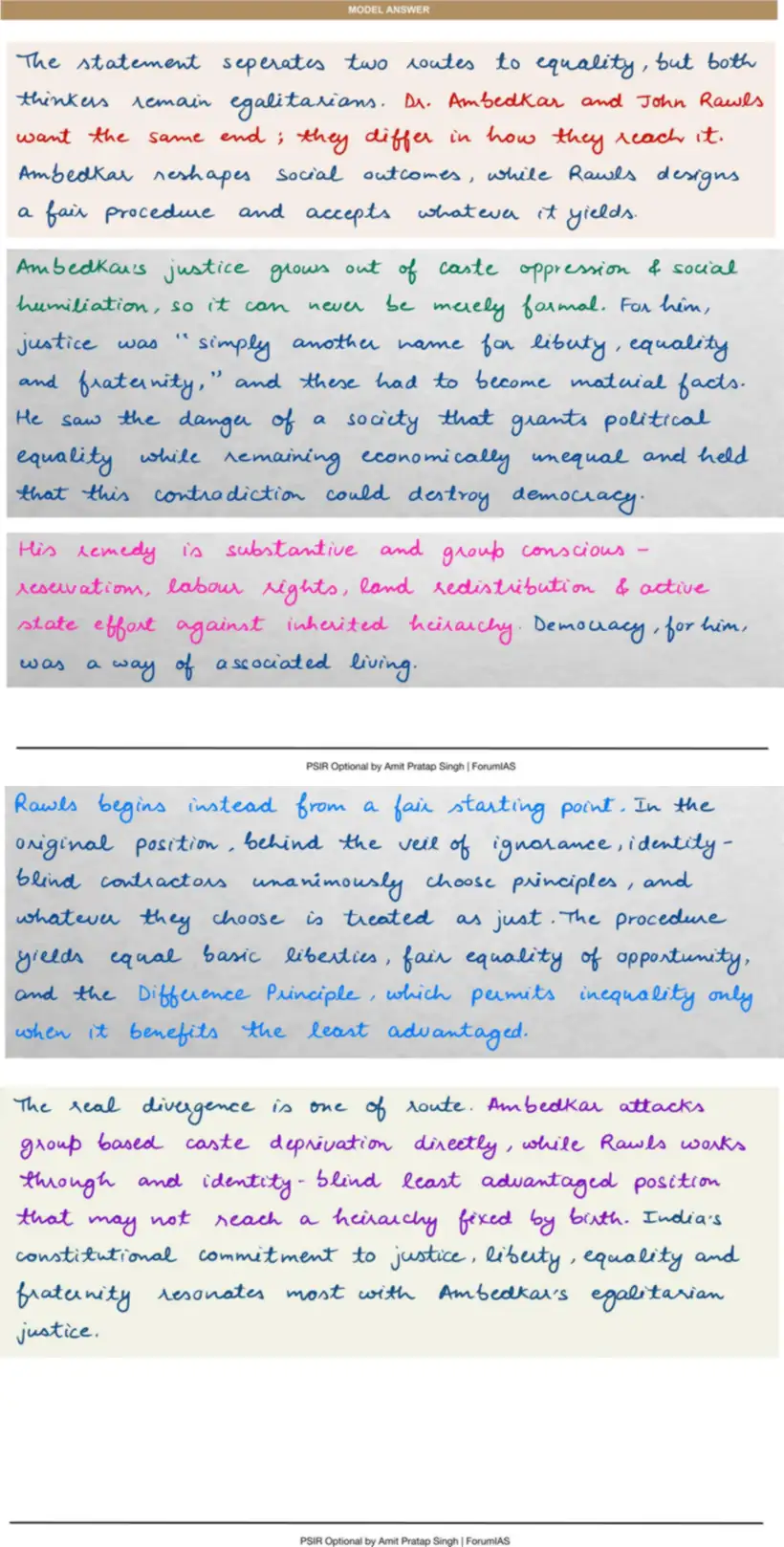
Ambedkar: caste oppression + social humiliation → justice never merely formal → “simply another name for liberty, equality, fraternity” → must become material facts → political equality vs economic inequality threatens democracy → substantive, group-conscious remedy (reservations, labour rights, land redistribution, state action) → Rawls: fair starting point → original position + veil of ignorance → identity-blind, unanimous choice → whatever chosen is just → equal liberties + fair opportunity + Difference Principle → inequality only if it helps the least advantaged
contrast must be qualified → Rawls’ procedure is already egalitarian → Difference Principle can itself justify reservations / welfare → so divergence is route, not goal → Ambedkar = direct, group-based caste correction / Rawls = identity-blind least-advantaged standard → identity-blindness may miss a birth-fixed hierarchy
Route 1 shared egalitarian aim, different routes (group correction vs fair procedure)
Route 2 Indian Constitution (justice, liberty, equality, fraternity) resonates most with Ambedkar’s egalitarian justice
Model answer
Handwritten, in the form it would be written in the examination hall.
Also asked on this head
Justice — 11 questions in the Vault.
- Explain how Rawls used the liberal and egalitarian perspective to develop his concept of distributive justice.
- Rawls’ idea of the ‘liberal self’ is too individualistic. Explain, in this context, the communitarian critique of Rawls’ theory of justice.
- Examine the entitlement theory of justice.
How this is taught
The same flow snapshot, built for every head of the syllabus, with the answer written in class.
The first session of Foundation 2027 is published in full.
Six programmes across three levels.