
How the answer moves
The flow snapshot — the routes in, the body, the counter-view and the routes out.
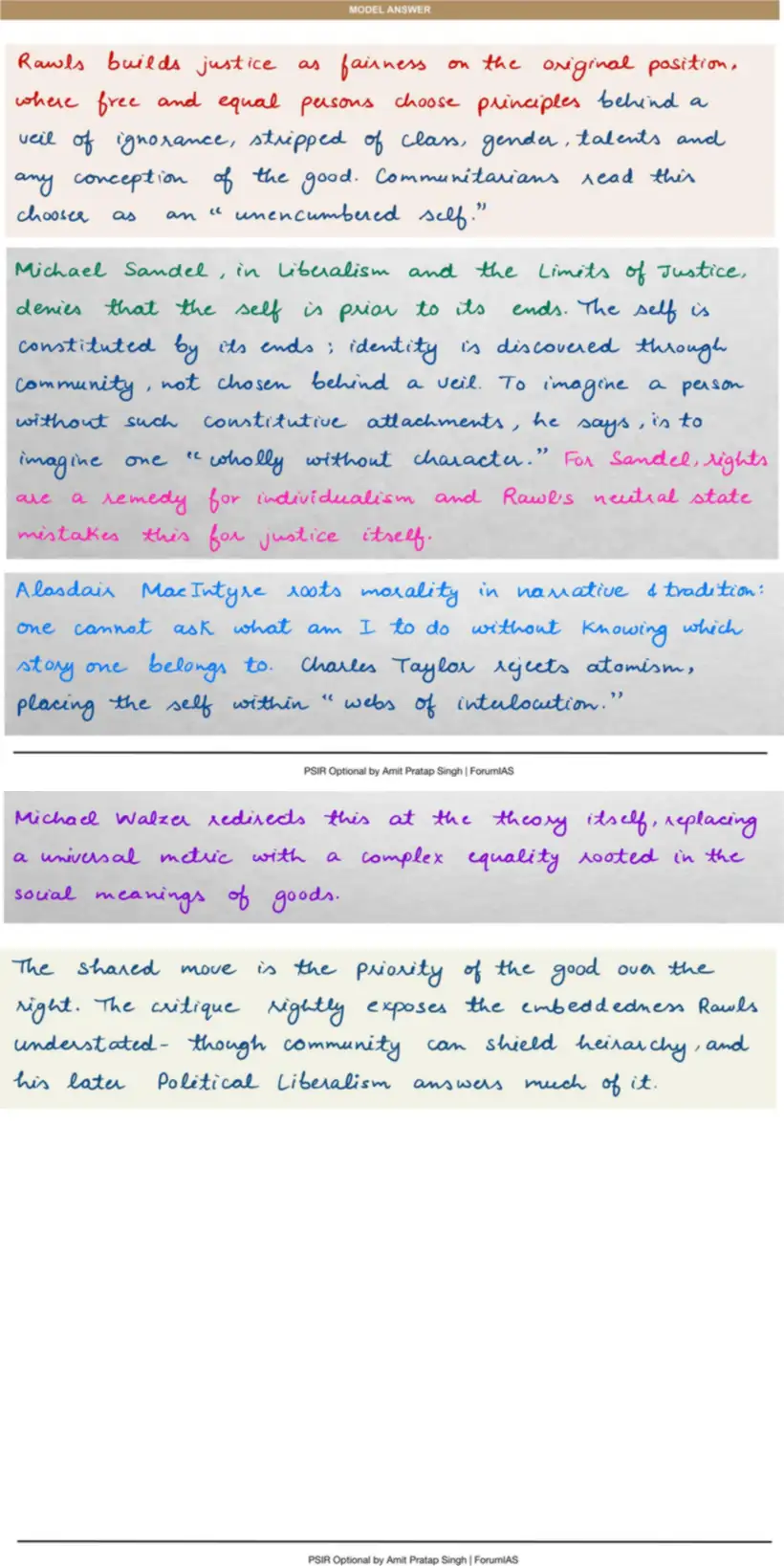
Route 1 original position + veil of ignorance → chooser stripped of class / gender / talents / good → the “unencumbered self”
Route 2 liberal self too individualistic → a theory built on it misreads moral life → communitarian charge staked
Sandel: self constituted by its ends, not prior → “wholly without character” → neutral state misreads justice, rights only a remedy for individualism → MacIntyre: morality lives in narrative + tradition → Taylor: anti-atomism, self within webs of interlocution → Walzer: no universal metric, complex equality from social meanings of goods → unifying move: good prior to right
community norms can shield hierarchy / patriarchy / caste → Rawls’ Political Liberalism (overlapping consensus) answers the metaphysical-self charge
Route 1 critique exposes the embeddedness Rawls understated, without destroying justice as fairness
Route 2 it sharpens liberalism toward a more situated self rather than replacing it
Model answer
Handwritten, in the form it would be written in the examination hall.
Also asked on this head
Justice — 11 questions in the Vault.
- Explain how Rawls used the liberal and egalitarian perspective to develop his concept of distributive justice.
- Dr. Ambedkar’s idea of social justice leads to ‘egalitarian justice’ as compared to Rawls’ ‘justice as fairness’ which aims at the notion of ‘pure procedural justice’....
- Examine the entitlement theory of justice.
How this is taught
The same flow snapshot, built for every head of the syllabus, with the answer written in class.
The first session of Foundation 2027 is published in full.
Six programmes across three levels.