
How the answer moves
The flow snapshot — the routes in, the body, the counter-view and the routes out.
Route 1 both treat justice as organising principle of political life → but opposite foundations (good-first vs right-first)
Route 2 Greek fits person to a settled role → Rawls secures fair terms among free equals → good precedes right vs right precedes good
Plato: harmony / each to his own function / no meddling → Aristotle: justice as central virtue + distributive justice by merit / proportional equality → Greek = teleological, duty-centred, hierarchical, inequality accepted → Rawls: moral equality → original position + veil of ignorance → equal liberty first + Difference Principle → Barry’s chain principle / weakest link → right precedes good / free to pursue own conception of the good
Greek rootedness in virtue and common good vs Rawlsian moral equality and protection of the least advantaged → perfecting the citizen vs guaranteeing fair terms among those who disagree on the good
Route 1 movement from polis ethics to constitutional pluralism
Route 2 from a justice that assigns roles to a justice that guarantees equality and freedom
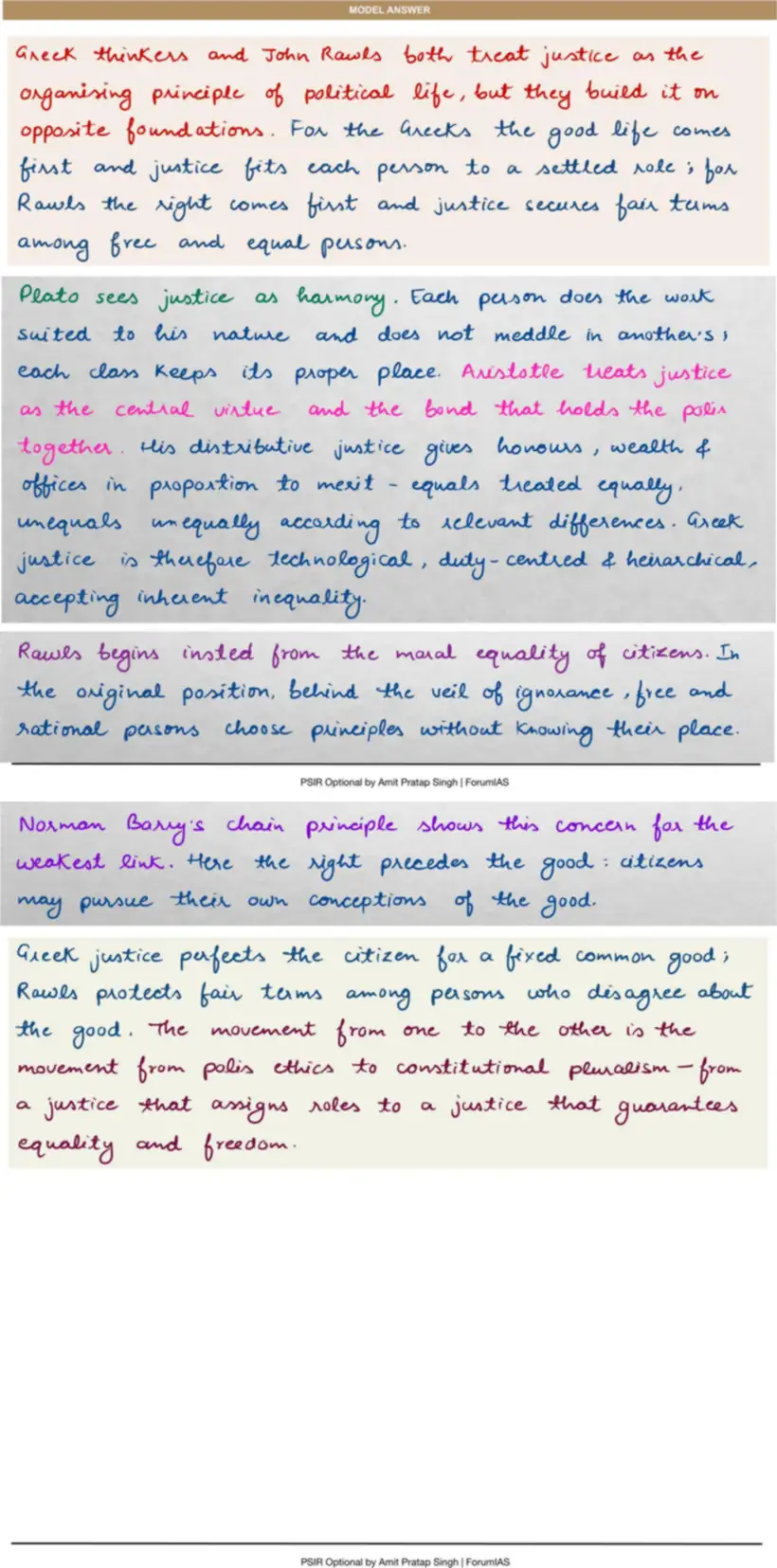
Model answer
Handwritten, in the form it would be written in the examination hall.
Also asked on this head
Justice — 11 questions in the Vault.
- Explain how Rawls used the liberal and egalitarian perspective to develop his concept of distributive justice.
- Rawls’ idea of the ‘liberal self’ is too individualistic. Explain, in this context, the communitarian critique of Rawls’ theory of justice.
- Dr. Ambedkar’s idea of social justice leads to ‘egalitarian justice’ as compared to Rawls’ ‘justice as fairness’ which aims at the notion of ‘pure procedural justice’....
How this is taught
The same flow snapshot, built for every head of the syllabus, with the answer written in class.
The first session of Foundation 2027 is published in full.
Six programmes across three levels.