
How the answer moves
The flow snapshot — the routes in, the body, the counter-view and the routes out.
Route 1 reject liberal abstract self → justice from the situated self → good over right
Route 2 liberalism = individual + right prior → communitarian turn = community + good prior → justice must be socially grounded
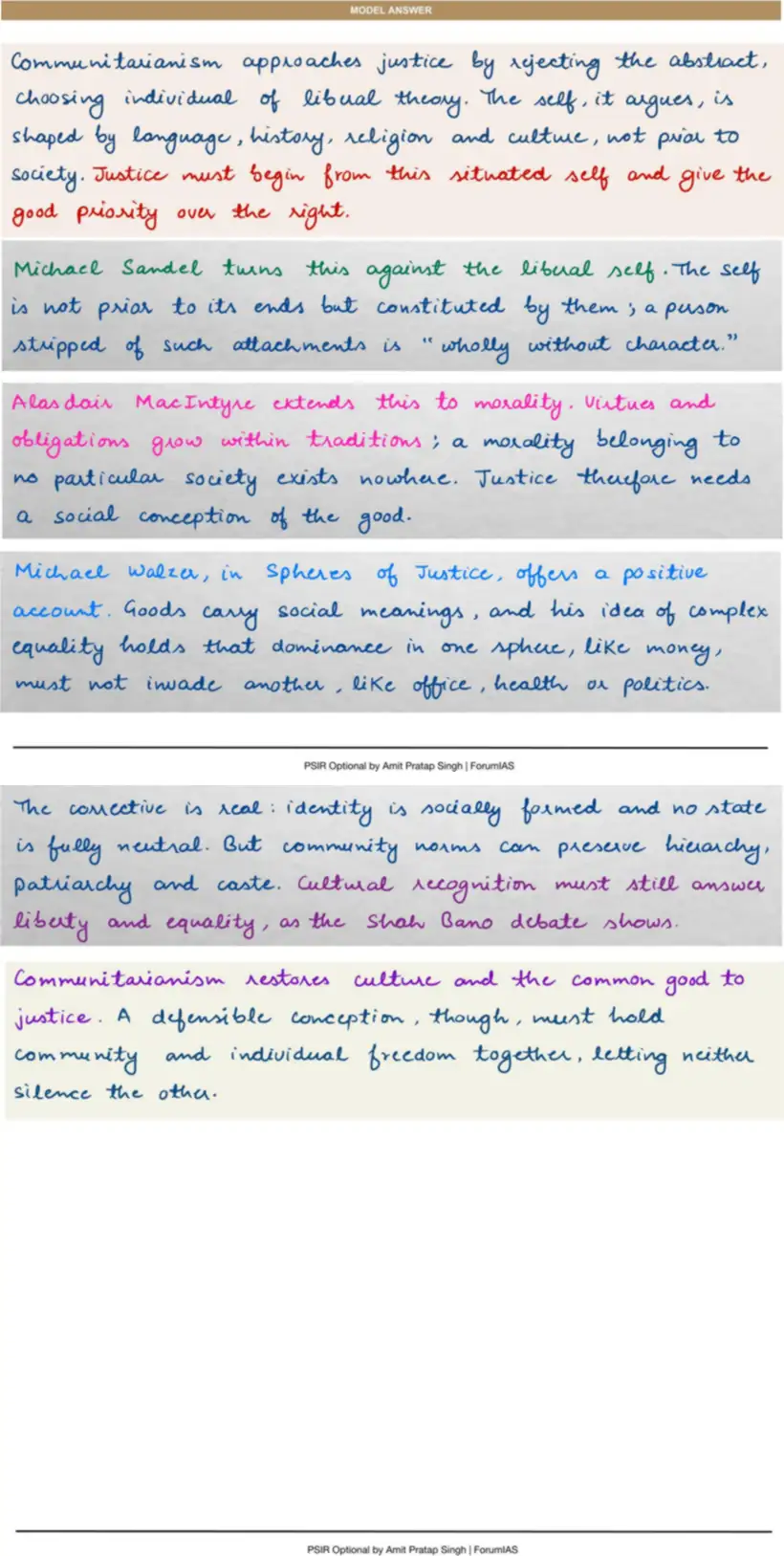
Sandel: self constituted by ends, “wholly without character,” identity discovered in community → MacIntyre: virtues / obligations within traditions, no society-less morality, justice needs social conception of good → Walzer: positive account, goods carry social meanings, complex equality (no sphere dominates another)
corrective real (identity social, state not neutral) vs community norms preserve hierarchy / patriarchy / caste; recognition must still answer liberty + equality (Shah Bano)
Route 1 communitarianism restores culture + common good to justice
Route 2 defensible justice holds community + individual freedom together, neither silencing the other
Model answer
Handwritten, in the form it would be written in the examination hall.
Also asked on this head
Justice — 11 questions in the Vault.
- Explain how Rawls used the liberal and egalitarian perspective to develop his concept of distributive justice.
- Rawls’ idea of the ‘liberal self’ is too individualistic. Explain, in this context, the communitarian critique of Rawls’ theory of justice.
- Dr. Ambedkar’s idea of social justice leads to ‘egalitarian justice’ as compared to Rawls’ ‘justice as fairness’ which aims at the notion of ‘pure procedural justice’....
How this is taught
The same flow snapshot, built for every head of the syllabus, with the answer written in class.
The first session of Foundation 2027 is published in full.
Six programmes across three levels.