
How the answer moves
The flow snapshot — the routes in, the body, the counter-view and the routes out.
Route 1 pre-Rawls liberal justice = liberty + formal equality + procedural fairness → thin on distribution
Route 2 utilitarianism widens to aggregate welfare → minority sacrificed → Rawls keeps liberty, adds egalitarian correction
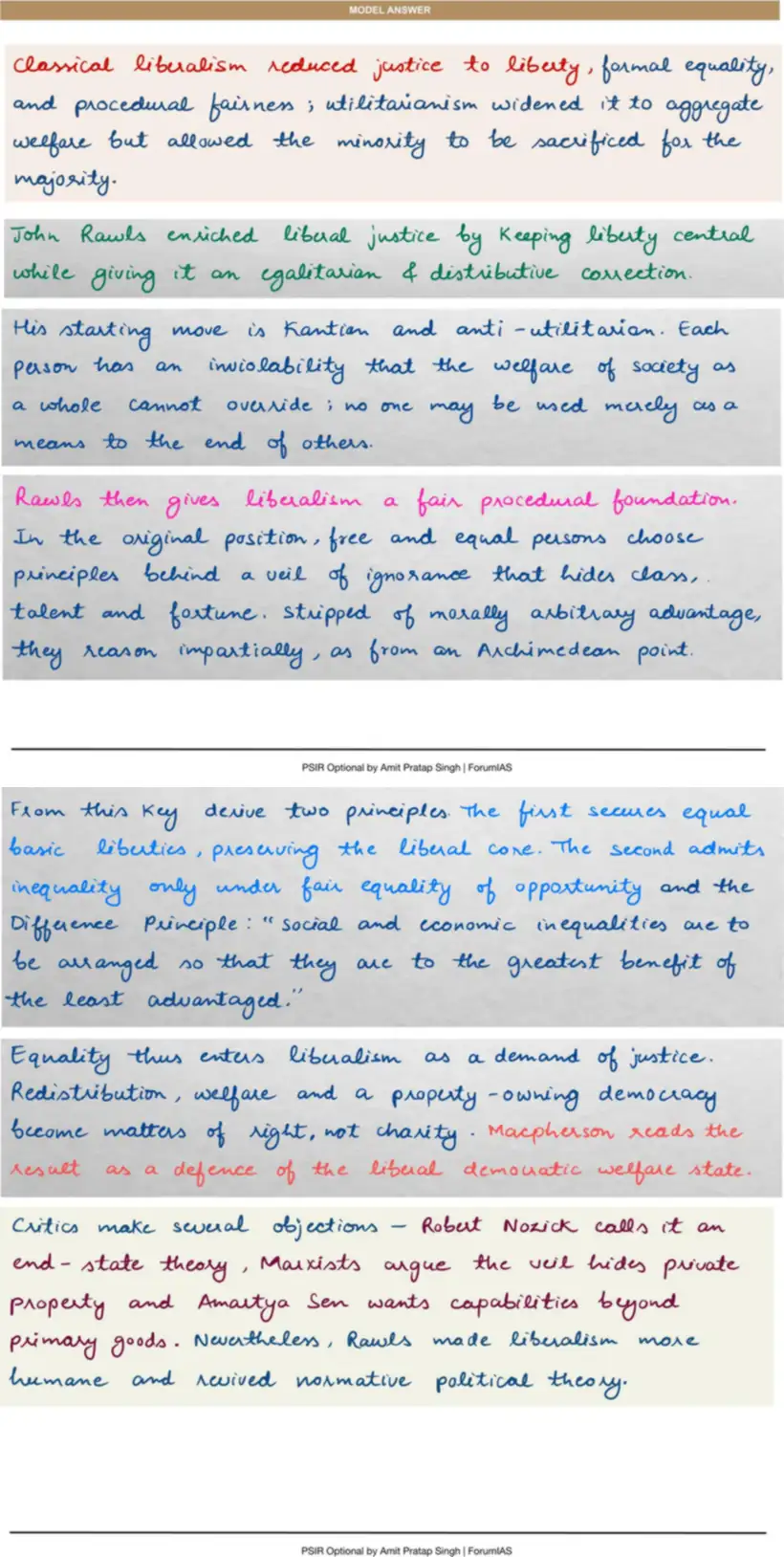
Kantian inviolability / anti-utilitarian → original position + veil of ignorance → impartial, Archimedean standpoint → two principles → liberty lexically first (liberal core) + fair equality of opportunity + Difference Principle → equality enters as a demand of justice → welfare + property-owning democracy as right, not charity → Macpherson: liberal democratic welfare state
Nozick (end-state, violates entitlement) vs Sen (capabilities beyond primary goods); Marxist line — veil hides private property
Route 1 liberty given grounding, equality given direction
Route 2 more humane liberalism + revival of normative theory → reset the terms of the justice debate
Model answer
Handwritten, in the form it would be written in the examination hall.
Also asked on this head
Justice — 11 questions in the Vault.
- Explain how Rawls used the liberal and egalitarian perspective to develop his concept of distributive justice.
- Rawls’ idea of the ‘liberal self’ is too individualistic. Explain, in this context, the communitarian critique of Rawls’ theory of justice.
- Dr. Ambedkar’s idea of social justice leads to ‘egalitarian justice’ as compared to Rawls’ ‘justice as fairness’ which aims at the notion of ‘pure procedural justice’....
How this is taught
The same flow snapshot, built for every head of the syllabus, with the answer written in class.
The first session of Foundation 2027 is published in full.
Six programmes across three levels.