
Caste remains a vital axis for political mobilisation in India. How would the caste census address the aspirations of people? Discuss.
How the answer moves
The flow snapshot — the routes in, the body, the counter-view and the routes out.
Route 1 caste no longer ritual hierarchy → a secular resource for bargaining (Kothari: politicisation of caste)
Route 2 reservation / representation / welfare rest on caste location → caste = axis of mobilisation
the census extends this logic → credible data for aspirations → Mandal Commission: OBC share 52% vs 36–65% estimates → replaces guesswork → Rohini Commission: uneven OBC benefit → sub-categorisation protects EBCs from dominant segments → exposes upper-caste over-representation → evidence-based welfare / education / employment → being counted = recognition + dignity (Bihar survey)
fear of sharpened caste competition → benefits captured by better-placed groups → must balance social justice with constitutional equality
Route 1 arithmetic must become responsiveness, not fresh division
Route 2 recognition deepens democracy only if it serves justice over division
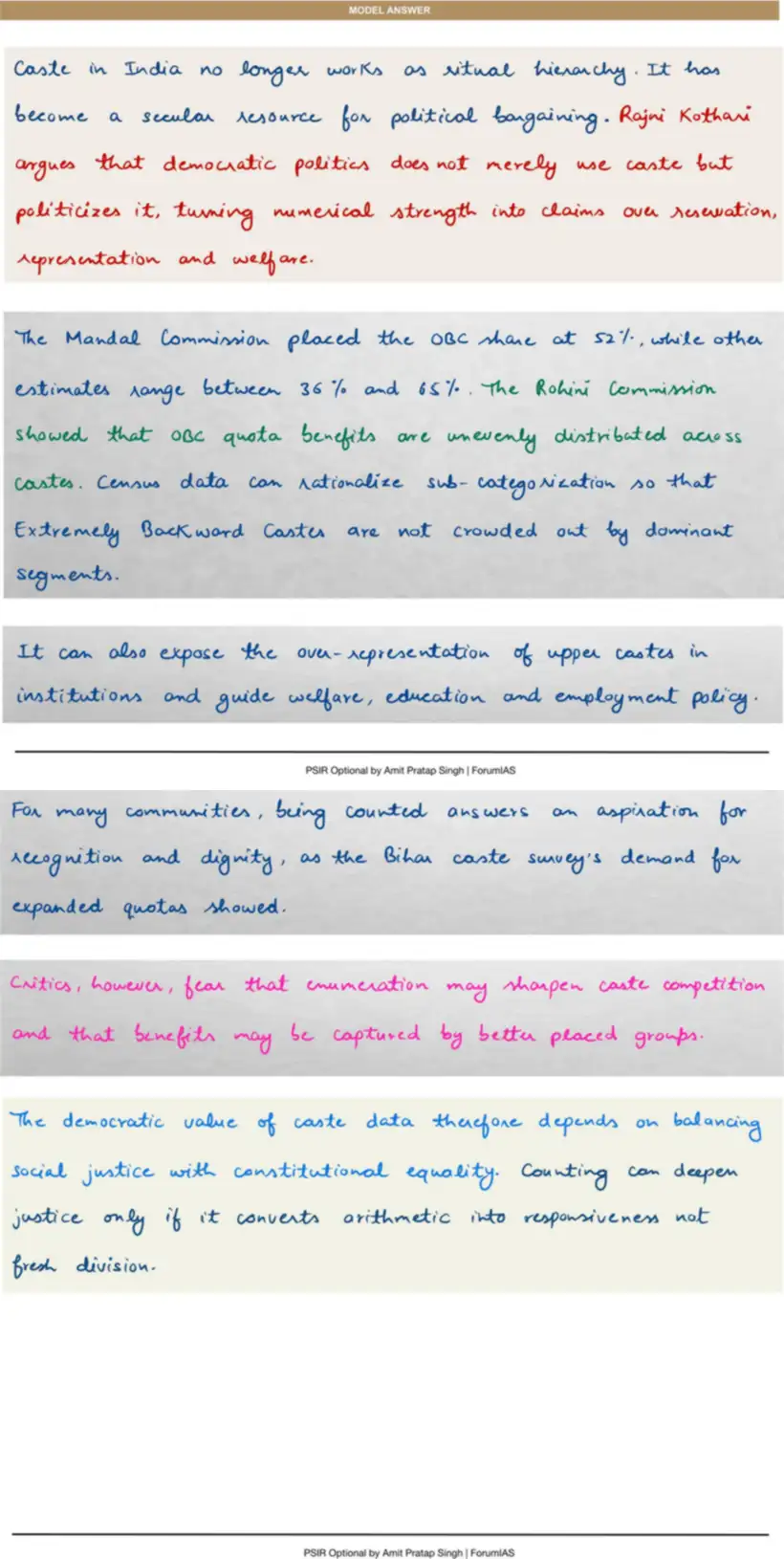
Model answer
Handwritten, in the form it would be written in the examination hall.
Also asked on this head
Caste, Religion and Ethnicity in Indian Politics — 12 questions in the Vault.
- Map the different types of ethnic conflicts that have emerged in 21st century India.
- Identity has become an important phenomenon in the modern politics in India. Discuss. (150 words)
- Delineate the key factors that have shaped the evolving political landscape in Jammu and Kashmir post 2019.
How this is taught
The same flow snapshot, built for every head of the syllabus, with the answer written in class.
The first session of Foundation 2027 is published in full.
Six programmes across three levels.