
Critically examine the ethnic conflicts in North-East India.
How the answer moves
The flow snapshot — the routes in, the body, the counter-view and the routes out.
Route 1 NE = one of India’s most ethnically diverse regions → a long cycle of autonomy, insurgency and inter-ethnic violence
Route 2 Varshney defines ethnic conflict → stake the question: born of diversity, or of state-building?
forms of conflict → Nagaland (sovereignty demand / rejected Constitution / 1952 boycott / NSCN) → Assam (ULFA / anti-migrant / Bodoland) → Manipur (Meitei–Naga–Kuki) → Tripura (tribes vs Bengali migrants) → why? development school (Weiner: gaps, aspirations, unmet expectations) → instrumentalist turn (Muni: “creation of vested political interests”) → federation-building critique (Baruah: nation-state building ignored small communities; centralisation + AFSPA → alienation → “genuine federation-building”)
the state’s accommodation (Sixth Schedule, Art 371, statehood, Assam & Mizo Accords, development packages) vs the persistence of coercion
Route 1 Kohli: in a multicultural democracy assertion is expected → accommodation over force
Route 2 conflicts are less natural to diversity than made by state-building → resolution lies in genuine federation-building
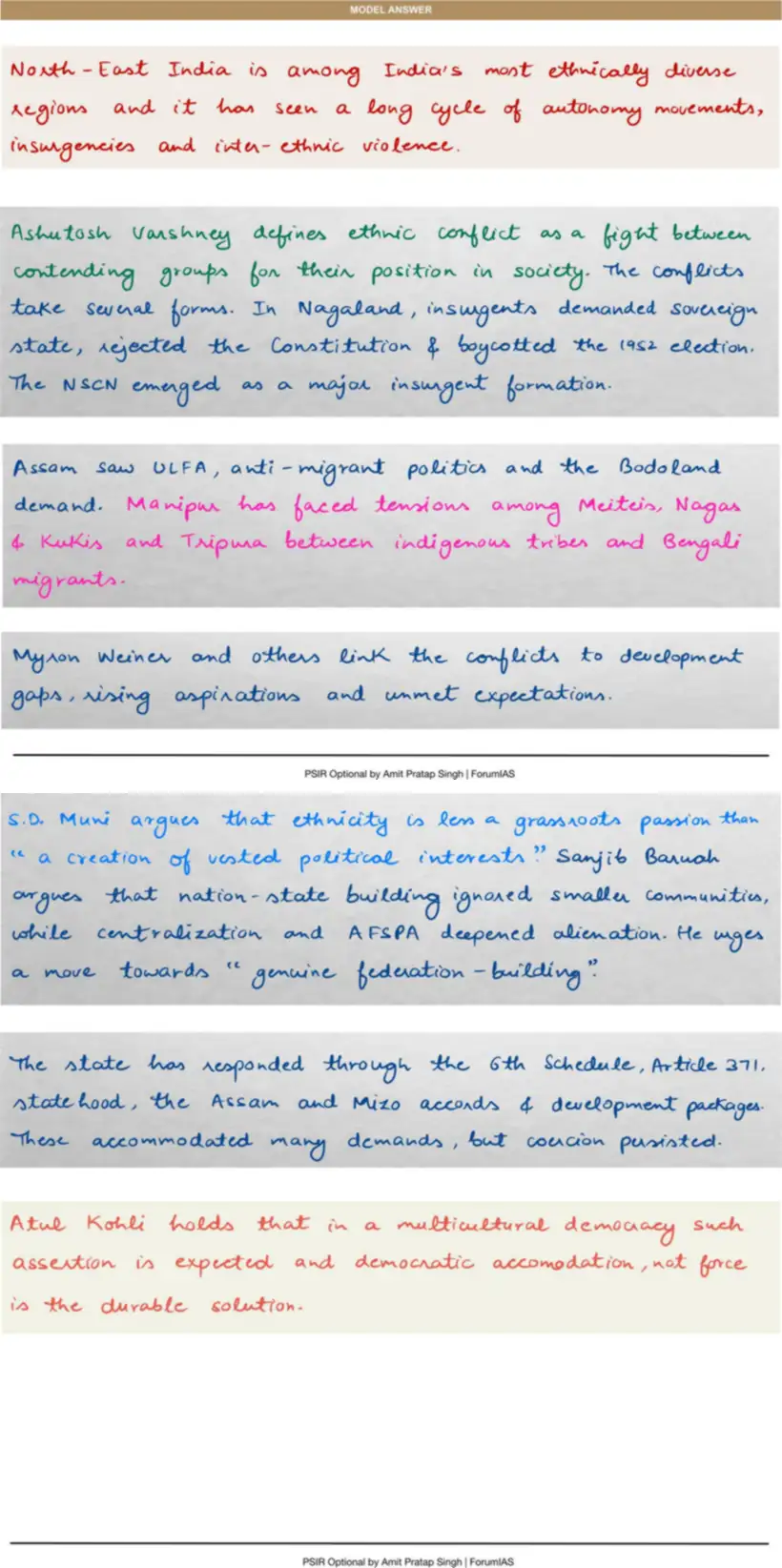
Model answer
Handwritten, in the form it would be written in the examination hall.
Also asked on this head
Caste, Religion and Ethnicity in Indian Politics — 12 questions in the Vault.
- Map the different types of ethnic conflicts that have emerged in 21st century India.
- Identity has become an important phenomenon in the modern politics in India. Discuss. (150 words)
- Caste remains a vital axis for political mobilisation in India. How would the caste census address the aspirations of people? Discuss.
How this is taught
The same flow snapshot, built for every head of the syllabus, with the answer written in class.
The first session of Foundation 2027 is published in full.
Six programmes across three levels.