
Religion is still an important factor in Indian politics. Discuss.
How the answer moves
The flow snapshot — the routes in, the body, the counter-view and the routes out.
Route 1 secularism adopted, communal electorates abolished → yet religion never left → Arts. 25–28 protect belief; faith still drives mobilisation, identity, voting
Route 2 start from live flashpoints (Ram Mandir / CAA / NRC) → religion visibly active today → trace it back to its colonial embedding
colonial inheritance → Bipan Chandra’s three stages of communalism → divide-and-rule + separate electorates + Partition institutionalise it → contemporary majoritarian turn → Savarkar’s Hindutva → ethnic-territorial nation, minorities outside the core → mobilisation through conflict → Brass: organised, managed violence → fear converted into vote polarisation → religion not only communal → Gandhi’s ethical use → Bhargava’s “principled distance” as the state’s response
religion rarely acts alone → it competes and combines with caste, welfare, development
Route 1 remains important but not the sole driver → guard religious freedom without polarisation weakening citizenship
Route 2 religion has moved from colonial communal representation → contemporary ideological nationalism → important, but works with governance and development
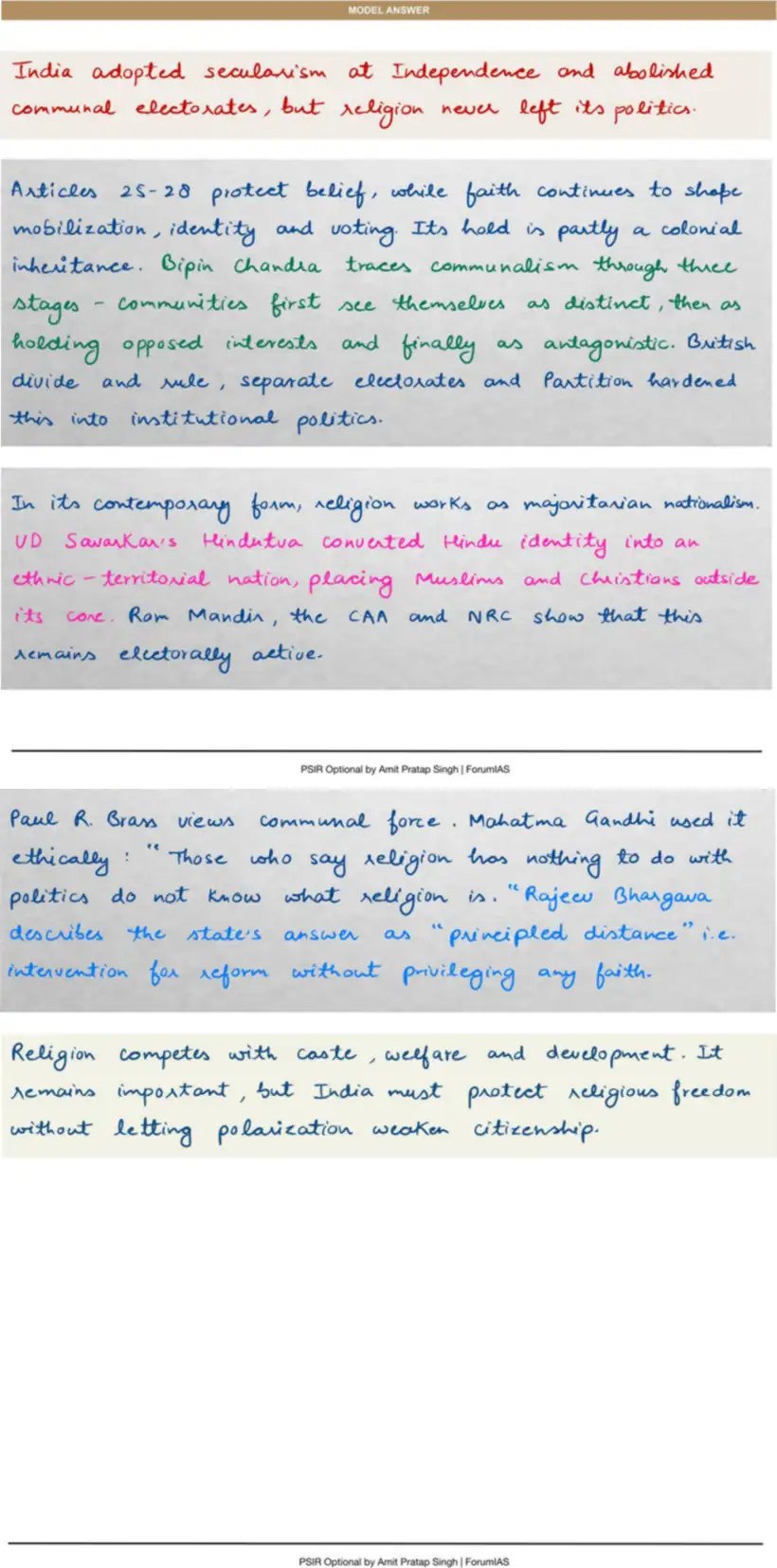
Model answer
Handwritten, in the form it would be written in the examination hall.
Also asked on this head
Caste, Religion and Ethnicity in Indian Politics — 12 questions in the Vault.
- Map the different types of ethnic conflicts that have emerged in 21st century India.
- Identity has become an important phenomenon in the modern politics in India. Discuss. (150 words)
- Caste remains a vital axis for political mobilisation in India. How would the caste census address the aspirations of people? Discuss.
How this is taught
The same flow snapshot, built for every head of the syllabus, with the answer written in class.
The first session of Foundation 2027 is published in full.
Six programmes across three levels.