
Ethnicity is the underlying cause which poses a great challenge in the resolution of the problems in the North- East region of India. Comment.
How the answer moves
The flow snapshot — the routes in, the body, the counter-view and the routes out.
Route 1 NE = India’s most ethnically diverse region → Weber: ethnicity as a subjective belief in common descent → the claim is partly right, but ethnicity is the language of conflict, not its root
Route 2 the statement overstates ethnicity as “the underlying cause” → ethnic assertion is visible on the surface, deprivation + neglect lie beneath
four forms: autonomy / secession / insurgency / identity riots → NE cases: Nagaland (sovereignty, Greater Nagalim), Assam (Bodo, migrant), Manipur (Meitei–Kuki–Naga) → overlapping, zero-sum claims → resolution hard → but ethnicity rarely erupts alone → instrumentalist view: elites activate identity → Muni: creation of vested political interests → deeper cause = deprivation + neglect → Gurr: relative deprivation (‘ought’ vs ‘is’, “disposes men to violence”); NE insurgencies = neglect + weak development → federation-building (Baruah): central neglect + lost autonomy, not ethnicity → shift from nation-state building to genuine federation-building → India’s record: managed better than many post-colonial states (Sixth Schedule, Article 371, statehood, accords) → Kohli: accommodation best in a multicultural democracy
primordial reading (ethnicity as given root; overlapping identities make conflict intractable) ↔ instrumentalist + relative-deprivation reading (ethnicity as a mobilised symptom of neglect and denied autonomy)
Route 1 ethnicity is a real challenge, but a demand for recognition, not a fixed cause → remedy: more democracy, not less
Route 2 conflict deepens only when accommodation is delayed and coercion replaces it → genuine federation-building achieves what coercion cannot
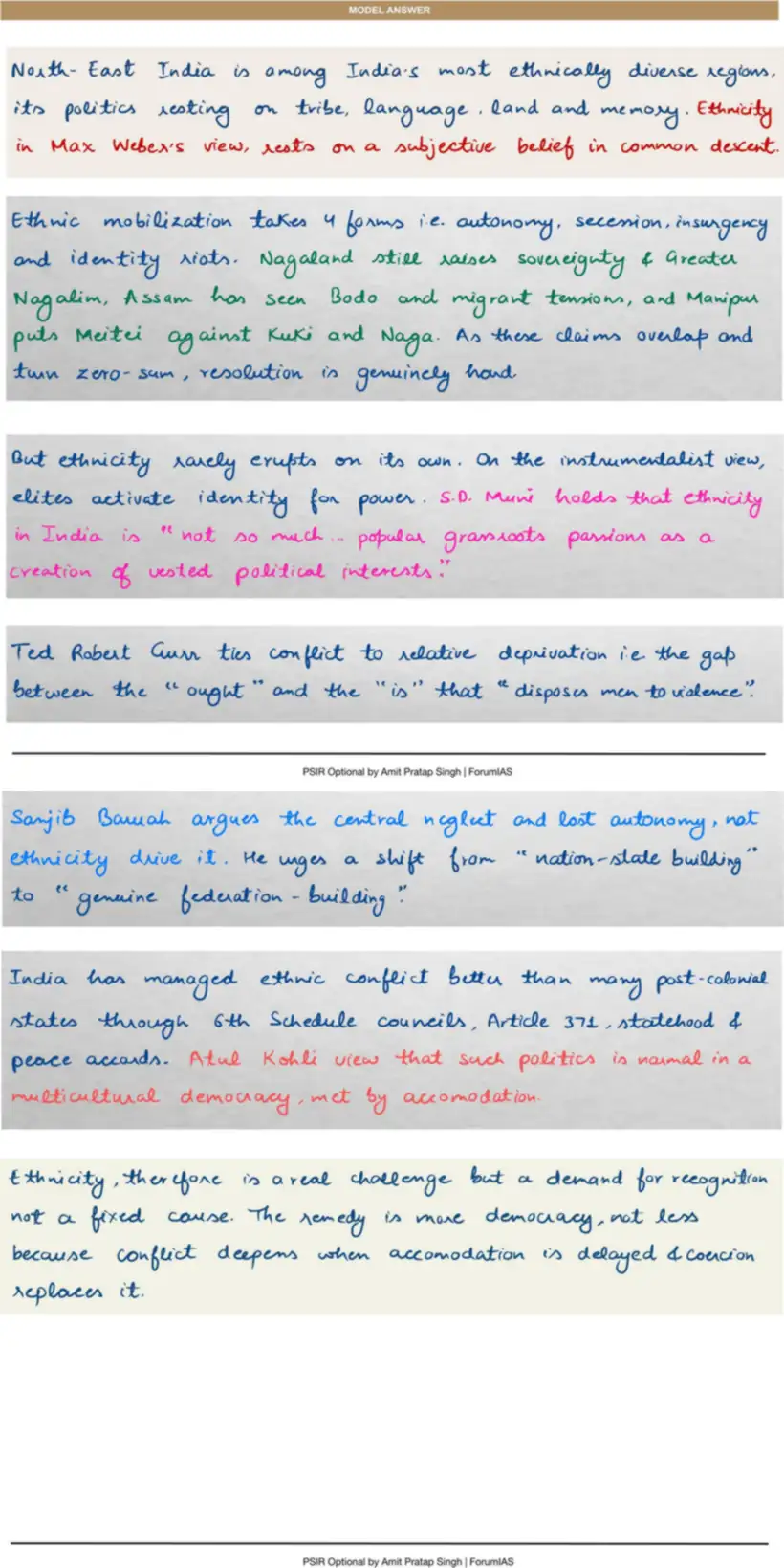
Model answer
Handwritten, in the form it would be written in the examination hall.
Also asked on this head
Caste, Religion and Ethnicity in Indian Politics — 12 questions in the Vault.
- Map the different types of ethnic conflicts that have emerged in 21st century India.
- Identity has become an important phenomenon in the modern politics in India. Discuss. (150 words)
- Caste remains a vital axis for political mobilisation in India. How would the caste census address the aspirations of people? Discuss.
How this is taught
The same flow snapshot, built for every head of the syllabus, with the answer written in class.
The first session of Foundation 2027 is published in full.
Six programmes across three levels.