
The rise of caste politics is to be attributed to both regional aspirations and electoral manifestations. Comment.
How the answer moves
The flow snapshot — the routes in, the body, the counter-view and the routes out.
Route 1 rise ≠ survival of hierarchy → transformation by democracy → Kothari’s “politicisation of caste”
Route 2 the statement’s two engines named → regional aspirations + electoral competition drive caste’s political rise
politicisation of caste → regional aspirations (caste composition varies by region → Naicker’s non-Brahmin Dravidian identity vs high-caste / North Indian dominance → Dalit Panthers’ Maharashtra roots → Rudolphs’ “bullock capitalists” as landowning regional forces) → electoral turn (adult franchise → numbers into votes → tickets / candidate selection / vote banks → caste parties BSP / SP / RJD convert caste into representation → social-engineering coalitions) → Srinivas: reservation + political opportunity transform the hierarchy
empowerment but double-edged → Varshney: elections successful, democracy between elections weak → Mehta: representation–responsiveness gap → fragmentation as easily as empowerment
Route 1 both claims hold → regionally grounded aspirations channelled through electoral competition
Route 2 Kaviraj: hierarchy of castes → democracy of castes → but justice cannot end at caste arithmetic
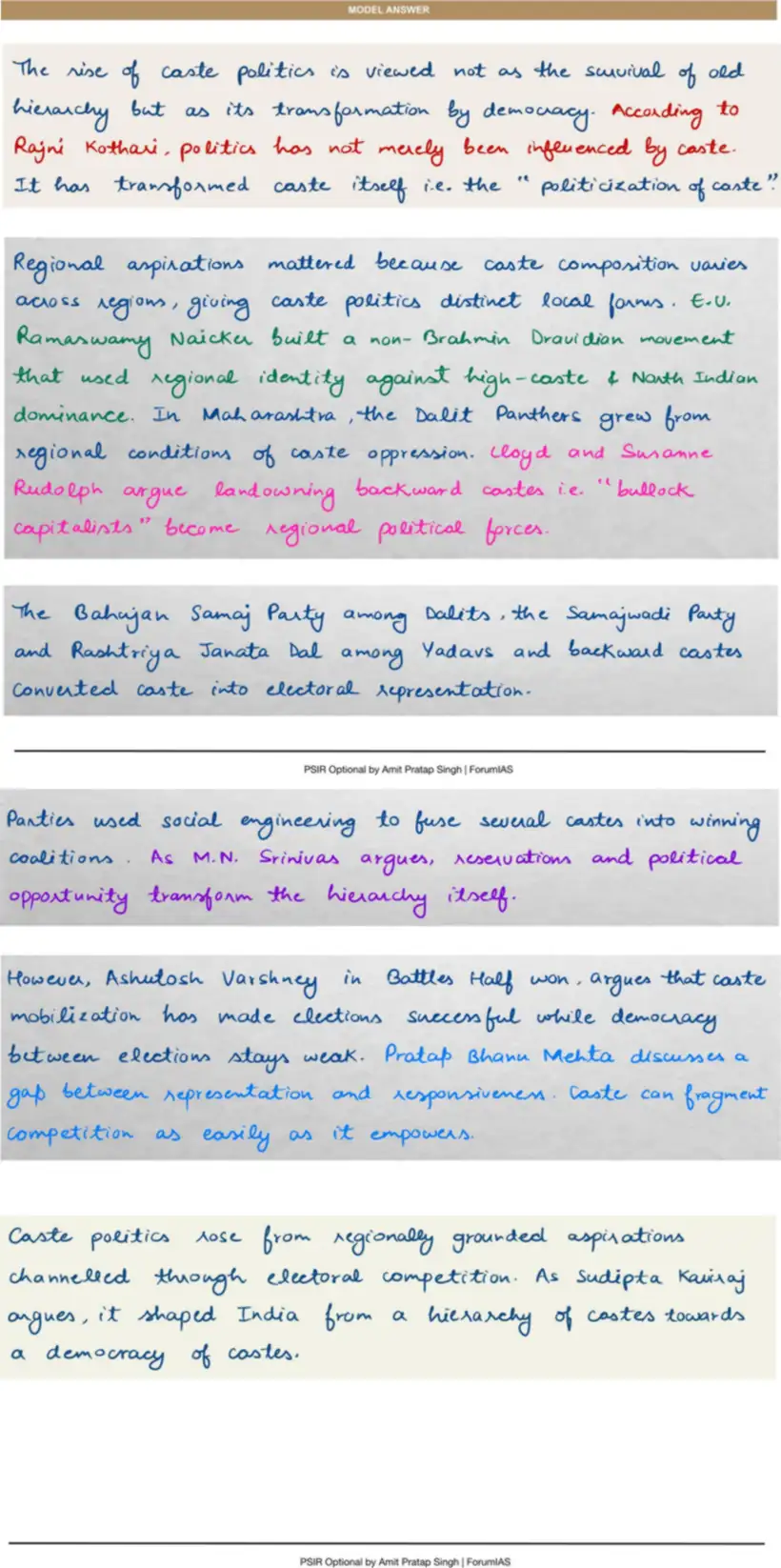
Model answer
Handwritten, in the form it would be written in the examination hall.
Also asked on this head
Caste, Religion and Ethnicity in Indian Politics — 12 questions in the Vault.
- Map the different types of ethnic conflicts that have emerged in 21st century India.
- Identity has become an important phenomenon in the modern politics in India. Discuss. (150 words)
- Caste remains a vital axis for political mobilisation in India. How would the caste census address the aspirations of people? Discuss.
How this is taught
The same flow snapshot, built for every head of the syllabus, with the answer written in class.
The first session of Foundation 2027 is published in full.
Six programmes across three levels.