
“Relative deprivation is a major source of ethnic conflict.” Elaborate the statement with relevant examples.
How the answer moves
The flow snapshot — the routes in, the body, the counter-view and the routes out.
Route 1 conflict not from difference but from perceived disadvantage → Gurr’s ‘ought–is’ gap
Route 2 relative deprivation defined → a group compares status / resources / recognition → identity becomes grievance
deprivation mechanism (economic, social, cultural, language exclusion) → North-East (Assam, Nagaland): neglect + weak development → Bodo: land, language, institutional exclusion → Telangana: deprivation within a larger state → Guru: Dalit exclusion (bottom-up) → Yadav: Jat / Patidar status-anxiety (dominant castes fear decline)
deprivation supplies the grievance but is not sufficient → it erupts as conflict only when politically mobilised
Route 1 deprivation = grievance, mobilisation = trigger
Route 2 the answer lies in recognition, representation and equitable development
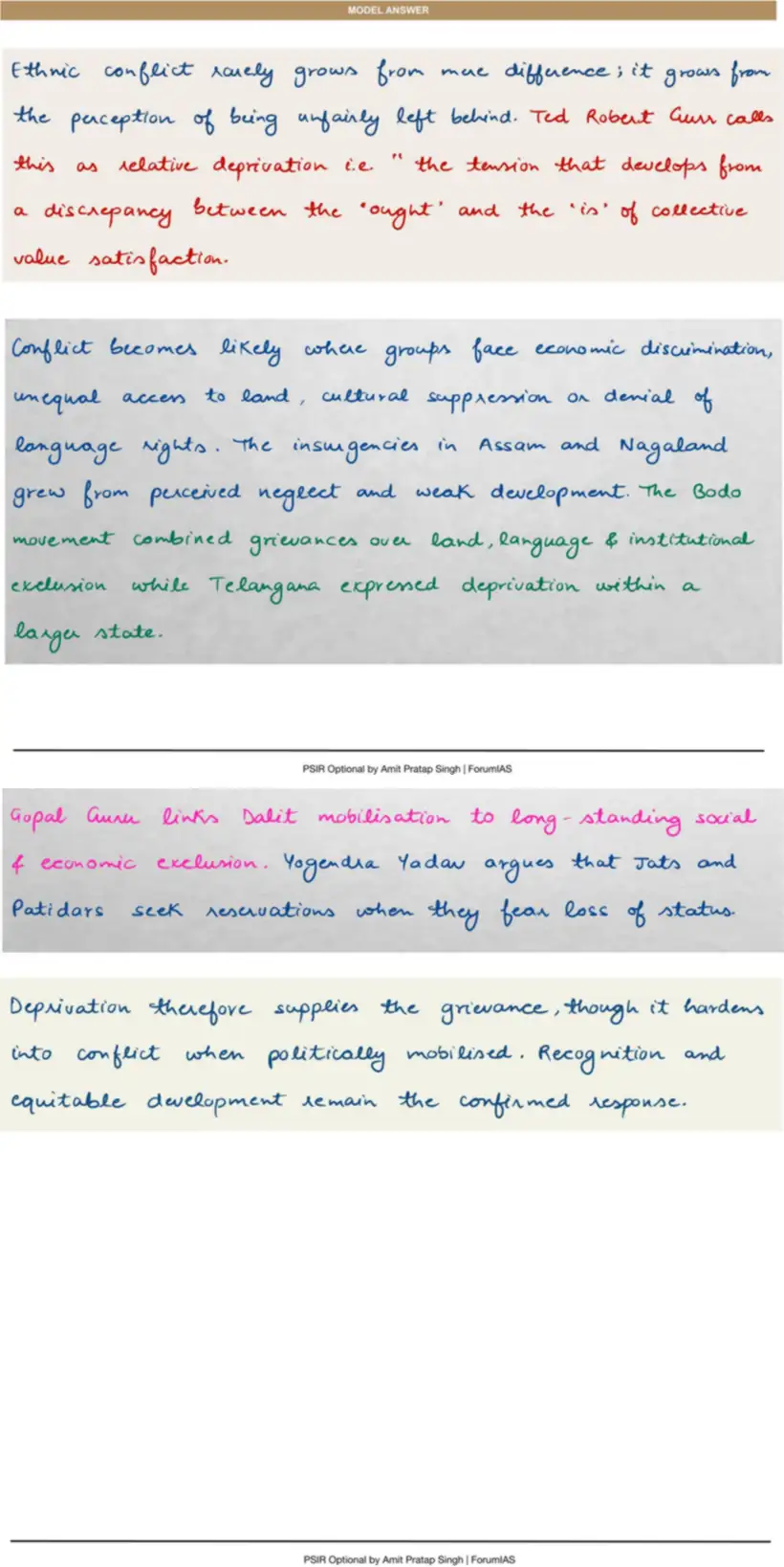
Model answer
Handwritten, in the form it would be written in the examination hall.
Also asked on this head
Caste, Religion and Ethnicity in Indian Politics — 12 questions in the Vault.
- Map the different types of ethnic conflicts that have emerged in 21st century India.
- Identity has become an important phenomenon in the modern politics in India. Discuss. (150 words)
- Caste remains a vital axis for political mobilisation in India. How would the caste census address the aspirations of people? Discuss.
How this is taught
The same flow snapshot, built for every head of the syllabus, with the answer written in class.
The first session of Foundation 2027 is published in full.
Six programmes across three levels.